Why Governments Are Borrowing More Than Ever: Is the World Entering a New Debt Era?
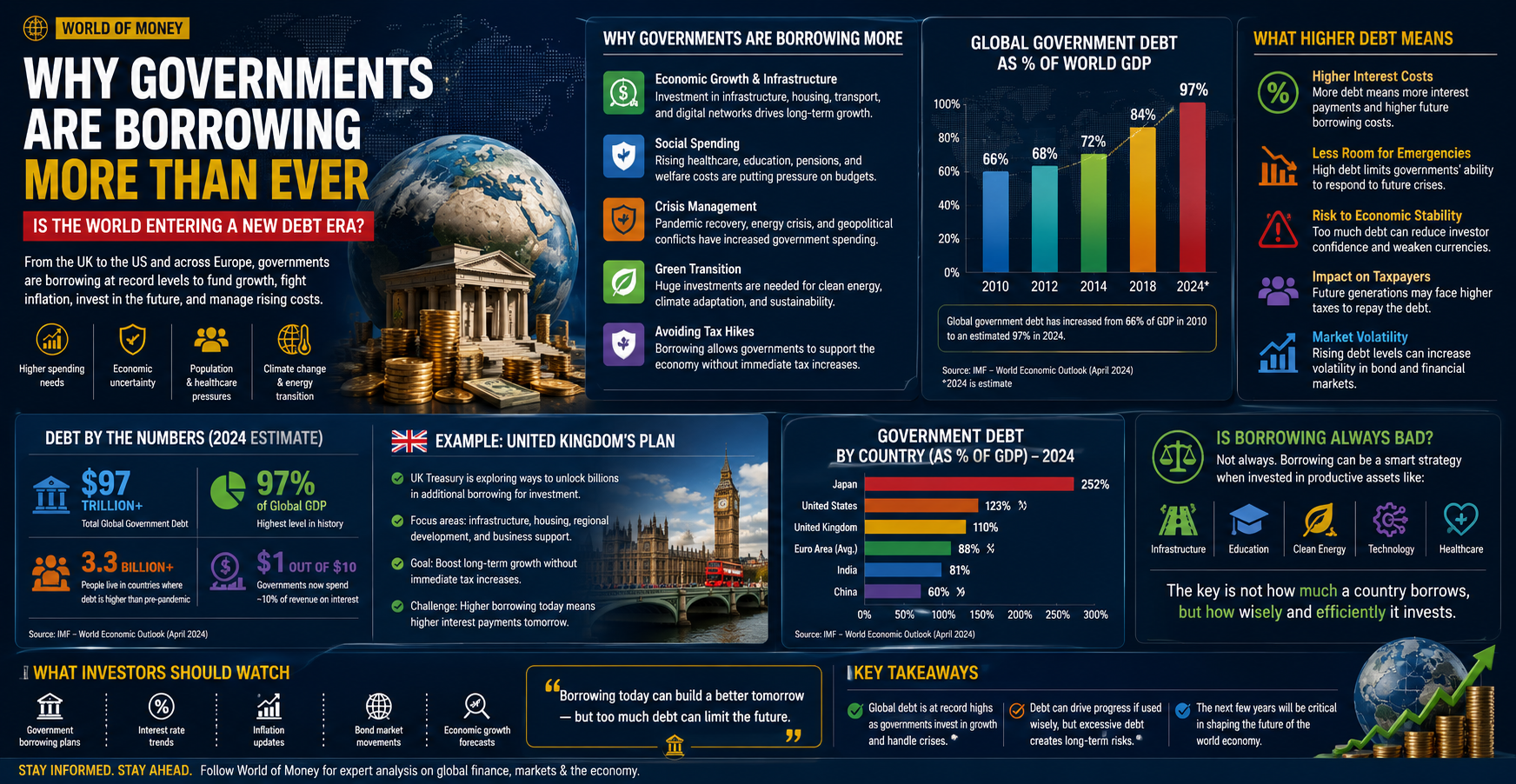
Governments around the world are borrowing at levels not seen in decades. From the United Kingdom to the United States and several European economies, rising public debt has become one of the biggest financial stories of 2026.
While borrowing helps governments invest in infrastructure, housing, healthcare, and economic growth, economists are increasingly asking an important question: How much debt is too much?
Recent developments suggest that many countries are entering a new era where higher government borrowing could become the norm rather than the exception.
Why Are Governments Borrowing More?
The global economy has faced multiple challenges over the past few years, including inflation, geopolitical tensions, supply chain disruptions, climate-related spending, and rising defense budgets.
To support economic growth without imposing significant tax increases, many governments have chosen to finance new investments through borrowing.
In the United Kingdom, officials are exploring ways to increase investment spending by making use of flexibility within existing fiscal rules. Additional funds could be directed toward infrastructure projects, housing, regional development, and business support.
The UK's New Borrowing Strategy
According to recent reports, the UK Treasury is evaluating options that could allow billions of pounds in additional investment over the coming years.
Rather than borrowing simply to cover day-to-day expenses, policymakers argue that investing in productive assets such as transport, housing, and technology could strengthen long-term economic growth.
However, higher borrowing also means larger interest payments in future budgets, making careful financial management increasingly important.
What Does Higher Government Debt Mean for Investors?
Government borrowing directly affects global financial markets.
Large borrowing programs often increase the supply of government bonds. If investor demand does not keep pace, bond yields may rise. Higher bond yields can influence mortgage rates, business loans, and borrowing costs across the economy.
Financial markets therefore closely monitor government borrowing plans because they can shape interest rates and investment decisions worldwide.
Global Debt Is Rising Everywhere
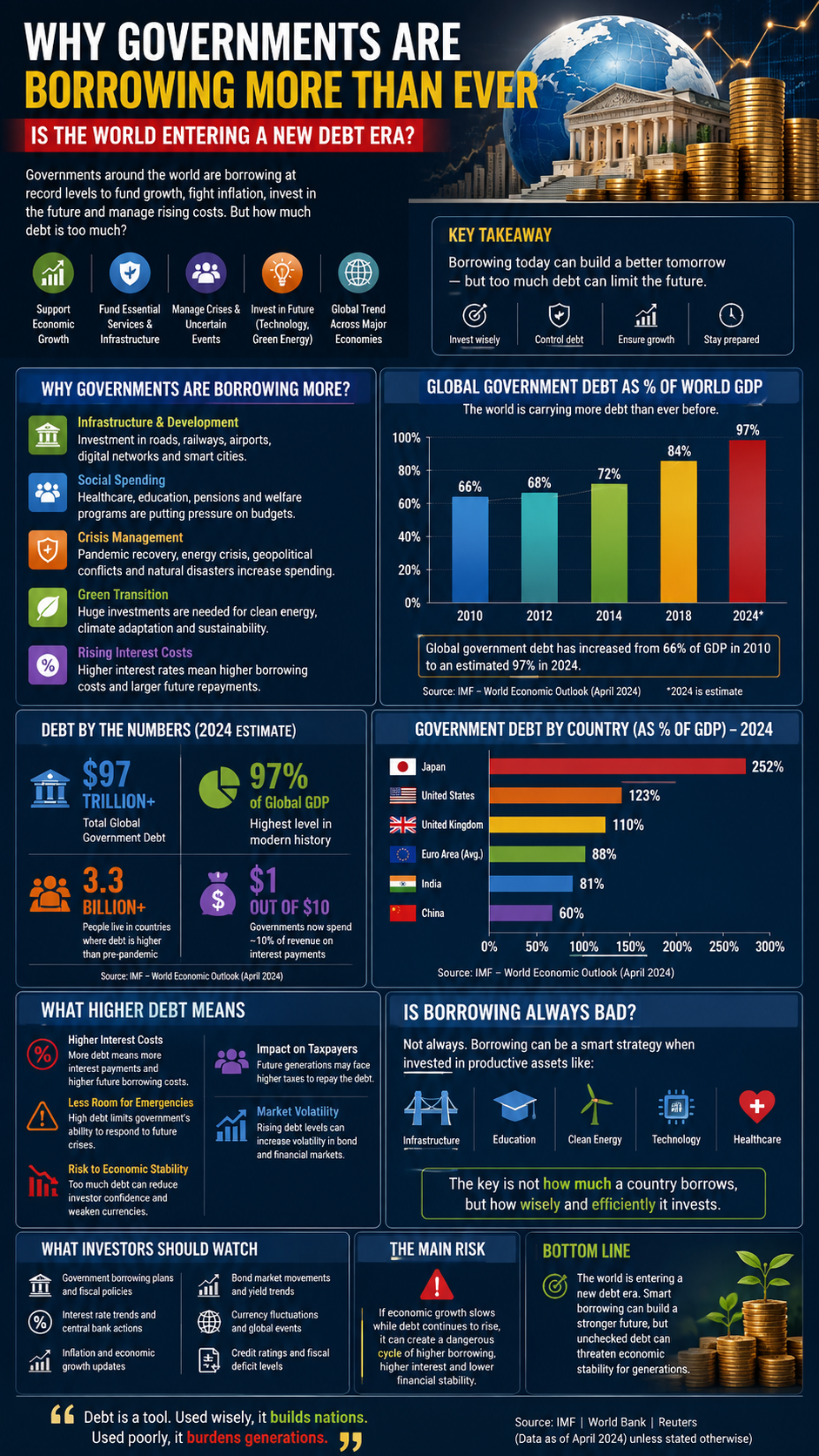
The increase in borrowing is not limited to the United Kingdom. Governments around the world have accumulated record levels of debt over the past several years. According to international financial institutions, global public debt continues to rise as countries invest heavily in defense, climate adaptation, healthcare, and economic modernization. At the same time, higher interest rates have made government borrowing more expensive than it was during the previous decade.
Many developed economies now spend billions of dollars each year simply to pay interest on existing debt. As older government bonds mature, they are replaced with new bonds carrying higher interest rates, increasing the overall cost of borrowing. This situation has forced policymakers to carefully balance economic growth with fiscal responsibility, making debt management one of the most important challenges facing governments in 2026
Government borrowing has a direct impact on global financial markets because government bonds serve as one of the world's most important investment assets. When governments issue large quantities of bonds, investors closely evaluate whether future economic growth will be strong enough to support repayment. If confidence remains high, governments can continue borrowing at reasonable interest rates. However, if investors become concerned about rising debt levels, borrowing costs may increase significantly.
Higher government bond yields can affect nearly every part of the economy, including mortgage rates, business loans, stock market valuations, exchange rates, and consumer borrowing costs. This is why announcements regarding government budgets and borrowing plans are carefully monitored by central banks, investment firms, pension funds, and international financial institutions.
Borrowing itself is not the problem. History shows that many of the world's strongest economies were built using borrowed capital invested in productive assets such as highways, ports, railways, universities, hospitals, and technology.
The real question is whether today's borrowing will generate enough future economic growth to justify its cost.
If governments invest wisely, today's debt could finance tomorrow's innovation, create millions of jobs, strengthen productivity, and improve living standards.
If investments fail to generate meaningful economic returns, however, countries may eventually face slower growth, rising taxes, higher interest payments, reduced public services, and greater financial instability.
That is why economists increasingly describe government borrowing as one of the defining economic experiments of the decade.
Sources & References
1. Reuters (Primary News Source)
UK Treasury explores additional borrowing options for investment.
https://www.reuters.com/business/finance/uk-treasury-working-scope-extra-borrowing-times-says-2026-08-05/
2. Reuters – Global Debt Report
Global debt reaches nearly $353 trillion, highlighting record public and private borrowing worldwide.
https://www.reuters.com/world/china/global-debt-hits-record-near-353-trillion-with-signs-move-away-us-2026-05-06/
3. International Monetary Fund (IMF)
Fiscal Monitor & Public Debt Analysis – Official reports on government debt, fiscal policy, and global economic outlook.
https://www.imf.org/en/Publications/FM
4. World Bank – Debt Statistics
Official global database for public debt, external borrowing, and government finance indicators.
https://www.worldbank.org/en/topic/debt
5. OECD – Government at a Glance
Official data on public finance, government spending, debt, and fiscal performance across OECD countries.
https://www.oecd.org/governance/government-at-a-glance/
6. Bank for International Settlements (BIS)
Research on sovereign debt, bond markets, and global financial stability.
https://www.bis.org/
7. Institute of International Finance (IIF)
Global Debt Monitor covering worldwide debt trends and capital markets.
https://www.iif.com/
8. UK Government – HM Treasury
Official policy announcements, fiscal strategy, budgets, and public borrowing updates.
https://www.gov.uk/government/organisations/hm-treasury