Back to News
News AlertWorld Defence Tech
World Defence Tech: The "Active Theater" Lab – Where Combat Zones Become R&D Accelerators
V
Author
Vishal Sable
Published
April 7, 2026
Reading Time
14 MIN READ
Spread the Word
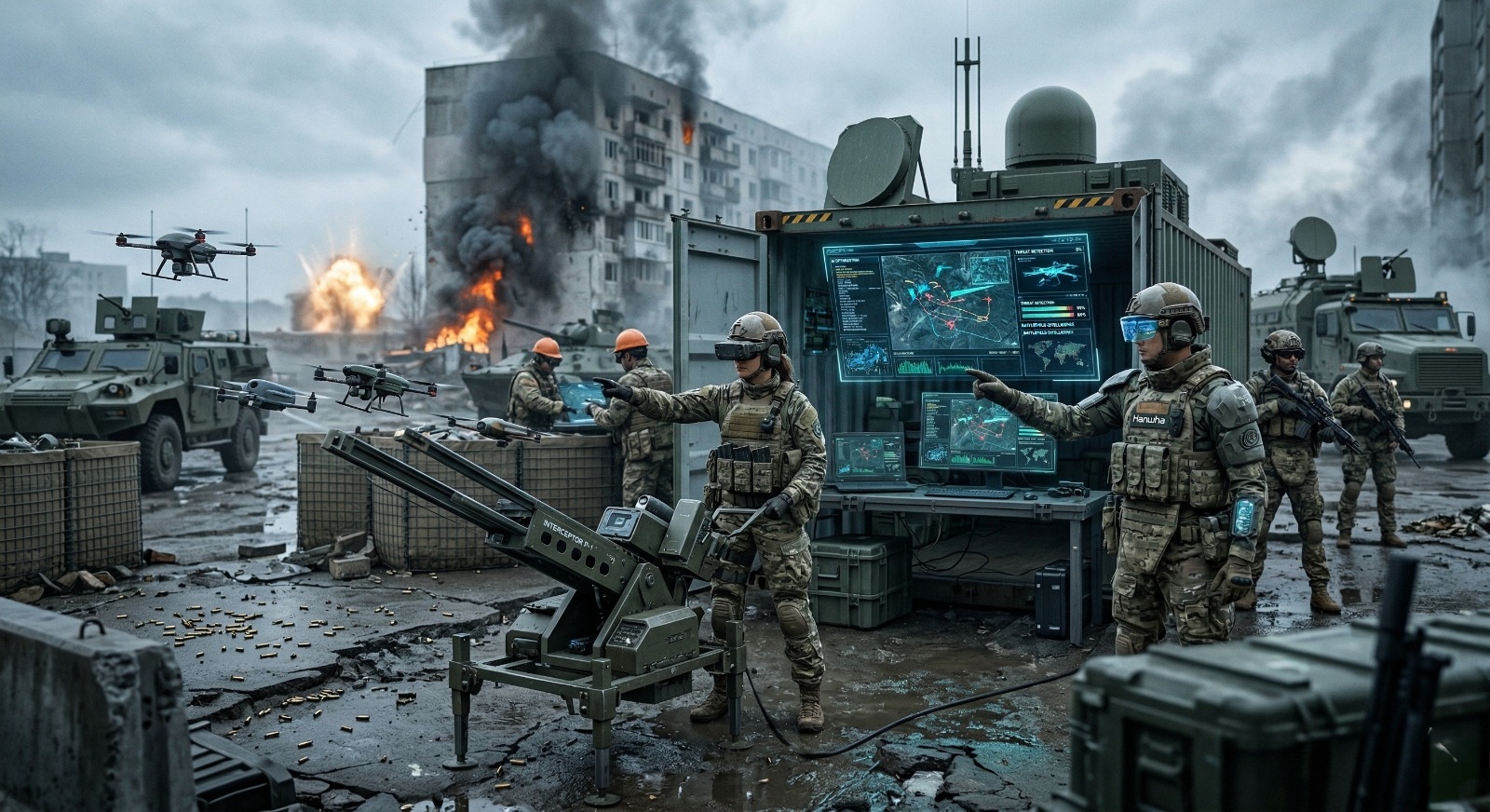
Active Theater 2026: ZenaTech Ukraine, Hanwha FIDAE ZenaTech builds Ukraine drone testing site; Hanwha unveils SAR satellite & AI swarm defense at FIDAE 2026. Inside combat zone R&D.
The Battlefield Is Now the Laboratory – Welcome to the Active Theater Era
Modern warfare has entered a new phase. In 2026, combat zones are no longer just places where weapons are deployed—they are where weapons are invented.
Today, two major announcements from opposite sides of the globe signal a fundamental shift in defence technology. In Eastern Europe, ZenaTech is moving its R&D directly into Ukraine's active combat theater. In Latin America, Hanwha is showcasing a fully integrated land‑to‑space defence portfolio at FIDAE 2026, proving that the future of warfare is seamless, AI‑driven, and multi‑domain.
This is the Active Theater era: where real‑time threat validation accelerates innovation, and where the line between testing and combat has effectively disappeared.
ZenaTech – Turning Ukraine Into the World's Most Demanding Drone Lab
Today, April 7, 2026, Vancouver‑based ZenaTech (Nasdaq: ZENA) announced plans to establish a dedicated drone testing facility inside Ukraine. This facility will operate alongside the company's previously announced Ukrainian manufacturing hub, creating a complete development‑to‑deployment pipeline inside the world's most intense drone warfare environment.
Why Ukraine?
"There is no testing environment on earth that replicates the operational intensity, threat complexity, and pace of innovation occurring in Ukraine today."
— Shaun Passley, Ph.D., ZenaTech CEO
Ukraine offers something no simulation can provide: live threat validation. Every engagement scenario, every data point collected under fire, directly strengthens ZenaTech's products for NATO allies, Gulf states, and the U.S. Department of War.
The Interceptor P-1: $5,000 Asymmetric Warfare
The star of ZenaTech's portfolio is the Interceptor P‑1, a single‑use, autonomous vertical takeoff and landing (VTOL) drone engineered to physically intercept and neutralize hostile drones in flight. The target selling price: under $5,000. Feature Specification
Type Single‑use autonomous interceptor
Design VTOL (Vertical Take‑Off and Landing)
Target Price Under $5,000 USD
Primary Function Physical interception & neutralization of hostile drones
This price point is critical. Today's cost asymmetry—inexpensive attacking drones versus million‑dollar missile interceptors—has made traditional air defence economically unsustainable. The Interceptor P‑1 flips that equation.
Zena AI: Swarm Intelligence at Machine Speed
Beyond the hardware, ZenaTech is developing an integrated counter‑UAS software platform through its Zena AI division. The system delivers two core capabilities:
Threat Tracking System: AI‑powered detection, identification, and real‑time tracking of hostile slow‑moving drones.
Swarm Intelligence Coordination Platform: Autonomous direction of interceptor fleets against swarm attacks at machine speed.
"Together, they are designed to give a single operator the ability to direct an AI‑commanded fleet of low‑cost interceptors against a swarm attack, autonomously and at machine speed, at a cost per engagement that is finally on the correct side of the cost equation."
— Shaun Passley, Ph.D.
The Market Opportunity
The global counter‑UAS market is growing at over 25% annually and is projected to exceed $10 billion by 2030. The U.S. Department of War requested $13.4 billion for autonomous weapons and systems for fiscal year 2026, with counter‑UAS identified as a top priority. ZenaTech is positioning itself to capture this demand, targeting U.S. Defence customers, NATO partners, and Gulf Cooperation Council buyers.

Hanwha at FIDAE 2026 – From Armored Vehicles to SAR Satellites
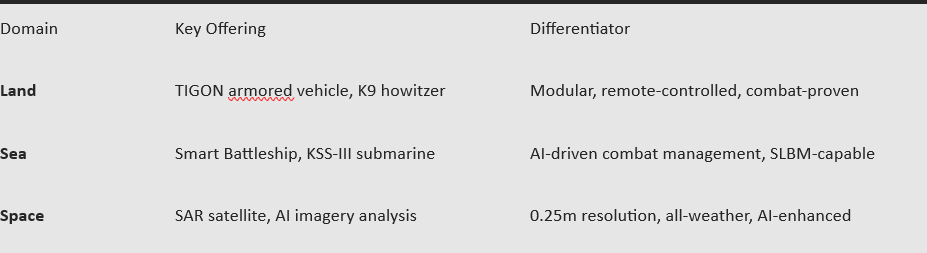
While ZenaTech focuses on the micro‑scale of drone warfare, South Korea's Hanwha Group is demonstrating the macro‑scale of integrated defence. At FIDAE 2026 (April 7–12, Santiago, Chile)—Latin America's largest defence exhibition—Hanwha has unveiled a sweeping portfolio that spans land, sea, and space.
Land: TIGON, K9, and the Chilean Market Push
Hanwha Aerospace is showcasing the TIGON 6×6 wheeled armored vehicle, making its Chilean debut. Equipped with a remote‑controlled weapon station and available in 4×4, 6×6, and 8×8 variants, TIGON offers independent wheel control and protection against bullets and landmines. The vehicle is strategically positioned to meet Chile's ongoing armored vehicle modernization program.
The company is also presenting its "global bestseller" K9A1 self‑propelled howitzer (in service in 10 countries) alongside the K10 ammunition resupply vehicle as a packaged artillery solution tailored for the Chilean and broader Latin American markets.
Sea: Smart Battleships and Submarines
Hanwha Ocean is exhibiting multiple naval assets, including:
The 3,000‑ton KSS‑III (Changbogo‑III Batch‑II) submarine, capable of operating submarine‑launched ballistic missiles.
The 2,000‑ton OCEAN 2000 submarine, optimized for South American operational environments.
4,000‑ton and 5,600‑ton frigates.
But the true innovation is Hanwha Systems' "Smart Battleship" concept—a naval command platform designed to operate alongside unmanned systems in real time. It features a stealth design, an AI‑driven combat management system, and a cockpit‑style Integrated Bridge System.
Space: SAR Satellites with 0.25‑Meter Resolution
Perhaps the most significant offering is from Hanwha Systems: a compact synthetic aperture radar (SAR) satellite with 0.25‑meter resolution, capable of all‑weather, day‑and‑night observation. Unlike optical satellites, SAR penetrates clouds and darkness, providing persistent surveillance regardless of conditions.
Crucially, the satellite data is paired with Hanwha's proprietary AI‑based imagery analysis solution, designed to enable faster and more accurate tactical decision‑making. This AI layer transforms raw satellite data into actionable intelligence.
The Strategic Message
Hanwha's presence at FIDAE 2026 is not merely a product showcase—it is a strategic declaration. As a company representative stated:
"We aim to position ourselves as a trusted and strategic defense partner for Chile and the Latin American region by offering solutions that span land, sea, and space."
With 440 companies from 35 countries participating, Hanwha is signaling its ambition to become a full‑spectrum defence provider in a region historically dominated by Western suppliers.
The Active Theater Thesis – Why Combat Zones Are the Ultimate R&D Accelerators

The convergence of these two announcements—ZenaTech's Ukraine facility and Hanwha's integrated portfolio—reveals a broader trend: defence innovation is now happening inside active theaters, not behind them.
Traditional defence procurement cycles take years. Lab‑based testing cannot replicate the fog of war. But in 2026, companies are realizing that the fastest path to a combat‑ready product is to build, test, and iterate where the threat is real.
Ukraine has become the world's most advanced drone warfare laboratory, compressing years of development into months. Hanwha, meanwhile, is demonstrating that the future of defence is not about individual platforms but about seamless integration—from SAR satellites in orbit to AI‑directed swarm interceptors on the ground.
The message for defence investors and procurement officials is clear: the companies that succeed in the Active Theater era will be those that embrace real‑world validation, AI‑driven autonomy, and multi‑domain integration.
Conclusion: From Test Range to Combat Range
April 7, 2026, will be remembered as the day the Active Theater era fully arrived. ZenaTech is putting its R&D dollars into Ukraine's combat zones. Hanwha is showing Latin America what integrated land‑to‑space defence looks like.
The battlefield is no longer just where weapons are used. It is where they are born.

Vishal Sable
B.Tech AD @ shri balaji institute of technology and management
Engineering and tech journalist. I love exploring the impact of emerging technologies on global defense, sovereignty, and everyday life. Always looking for the real story behind the headlines.