Back to News
News AlertWorld Defence Tech
World Defence Tech: The Rise of Additive "Hour-Built" Drones
V
Author
Vishal Sable
Published
July 1, 2026
Reading Time
9 MIN READ
Spread the Word
Modern conflict has forced global militaries to abandon slow manufacturing lines in favor of immediate, on-site automated production. The past month has witnessed a cascade of developments confirming that defense procurement is officially moving at "startup speed"—from containerized drone factories deploying to the Indo-Pacific to AI-enhanced mesh networks that keep forces connected when GPS fails.
The Latest News
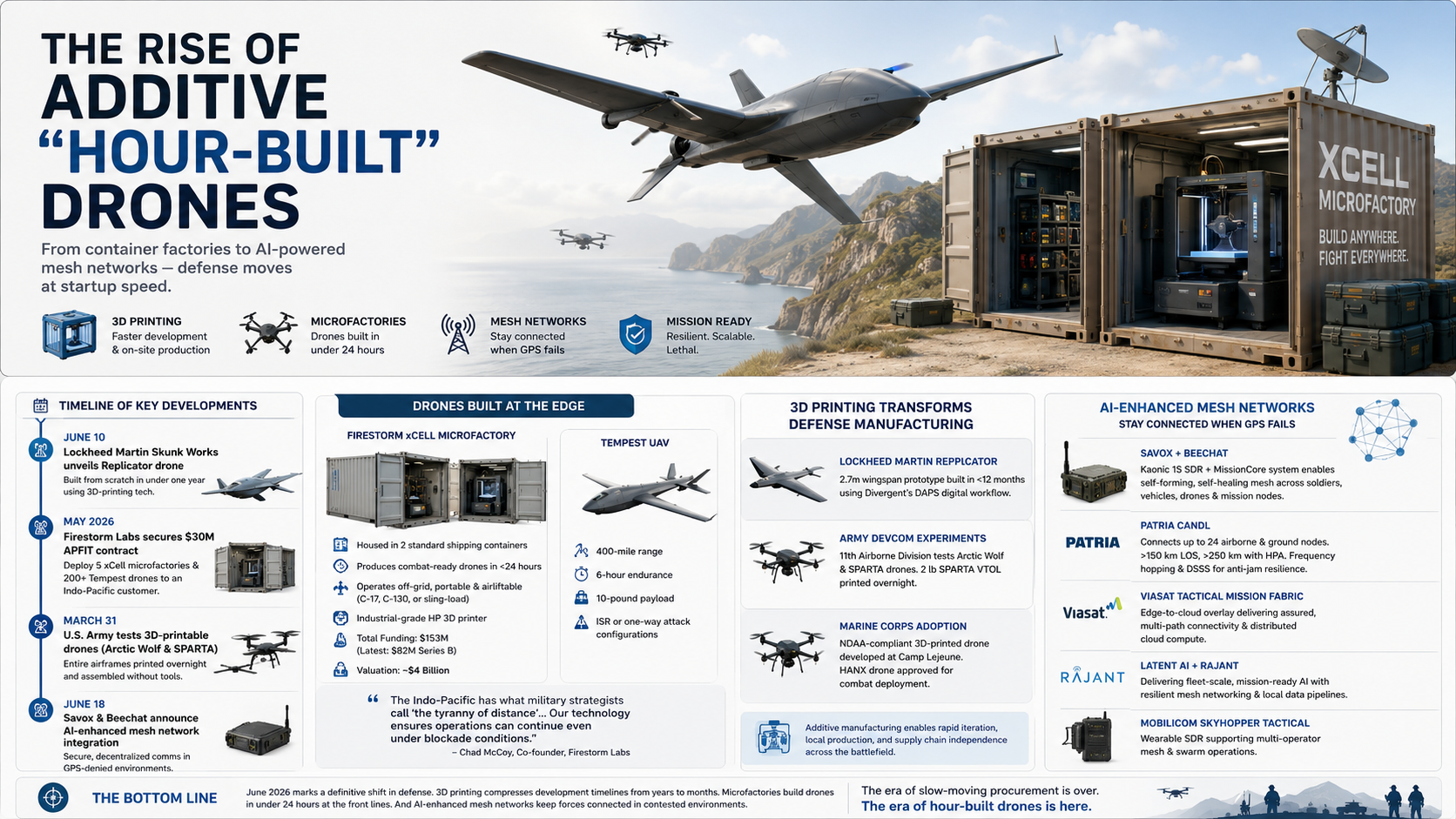
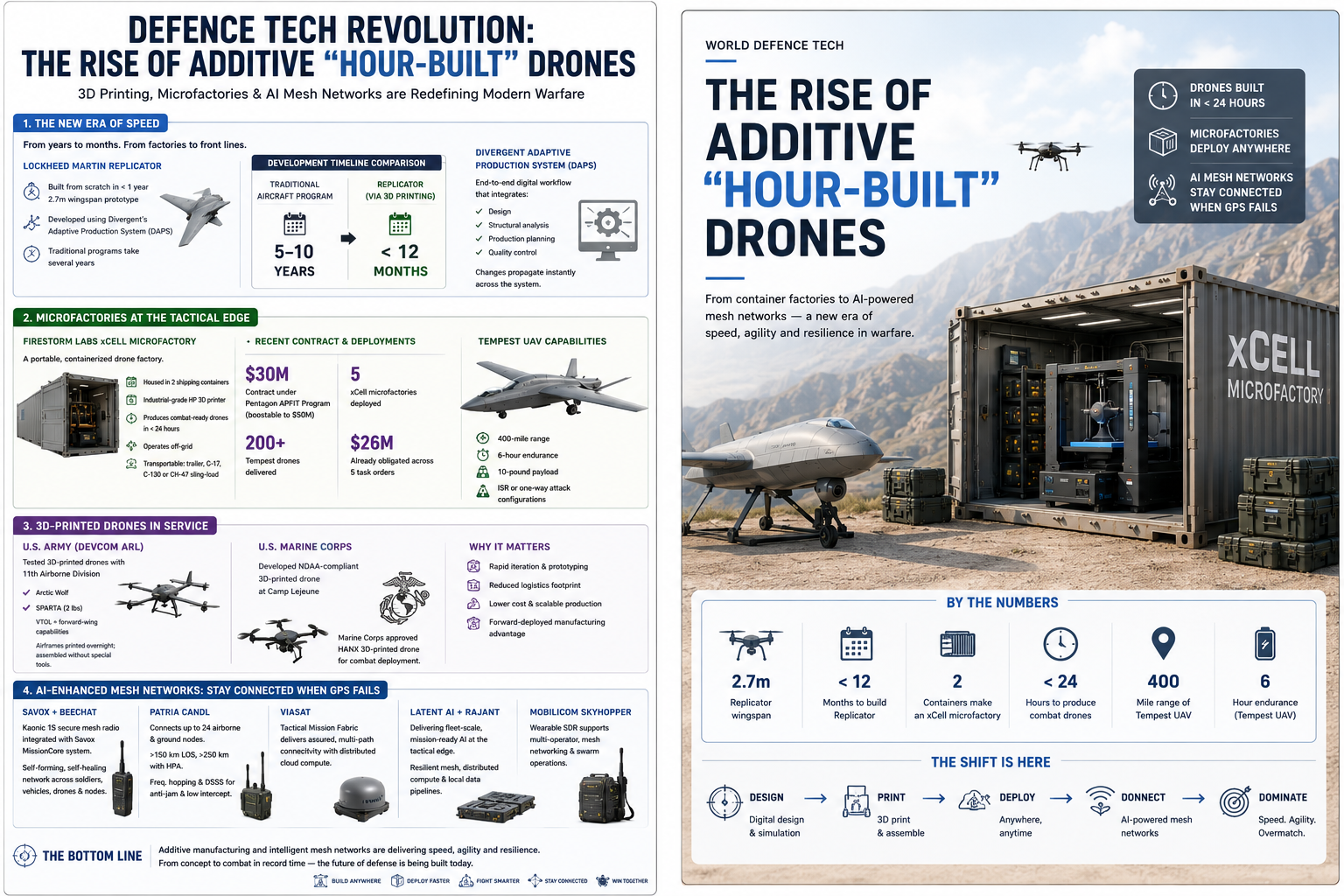
On June 10, Lockheed Martin's secretive Skunk Works division unveiled Replicator, a drone built from scratch in under one year using 3D-printing technology. The 2.7-meter wingspan prototype went from initial concept to first physical article in less than twelve months—a timeline that stands in sharp contrast to the years-long development cycles that characterize most military aircraft programs. The enabling technology is Divergent's Adaptive Production System (DAPS), which integrates design, structural analysis, production assembly, and quality control into a unified digital workflow. When a designer changes a dimension or material specification, the change propagates immediately through analysis and manufacturing planning without manual reentry. Secretary of War Pete Hegseth viewed the Replicator during his nationwide "Arsenal of Freedom" tour.
But the most radical shift is happening at the tactical edge. Firestorm Labs—a San Diego-based defense startup valued at approximately $4 billion—has secured an $82 million Series B round led by Washington Harbour Partners, with participation from Lockheed Martin, Booz Allen Ventures, and In-Q-Tel, bringing total funding to $153 million. The company's core product is the xCell, a drone manufacturing microfactory housed in two standard shipping containers. Each unit contains an industrial-grade HP 3D printer and can produce combat-ready drones in under 24 hours. The system can operate entirely off-grid, travel by trailer, be airlifted inside a C-17 or C-130, or sling-loaded beneath a CH-47 Chinook.
In May, Firestorm secured a $30 million contract under the Pentagon's APFIT program, boostable to $50 million, to deploy five xCell microfactories and more than 200 Tempest drones to an Indo-Pacific customer. Approximately $26 million has already been obligated across five task orders, with deliveries already underway—the company's first deployments outside the continental United States. The Tempest UAV carries a 400-mile range, six-hour endurance, and a ten-pound payload capacity, configurable for intelligence, surveillance, reconnaissance, or one-way attack operations. Firestorm co-founder Chad McCoy framed the strategic logic in stark terms: "The Indo-Pacific has what military strategists call 'the tyranny of distance.' If, god forbid, things go kinetic against an adversary like China, we know that they have a large quantity of long-range weapons, which are going to make it very difficult to freely move from [the continental US] and Hawaii and Guam into the first island chain". The company sees its technology as providing assurances that operations can continue even under blockade conditions.
The Army is also embracing additive manufacturing. On March 31, researchers from the DEVCOM Army Research Laboratory experimented with the 11th Airborne Division using two advanced 3D-printable small drones: the Arctic Wolf and SPARTA. SPARTA, weighing just two pounds, combines vertical takeoff and landing capabilities with forward-winged flight. Entire airframes can be 3D printed overnight and assembled without specialized tools or technical expertise. Marines at Camp Lejeune have similarly developed their own NDAA-compliant 3D-printed drone, while the Marine Corps has officially approved the HANX 3D-printed drone for combat deployment.
Daily Battlefront Use
Military forces are increasingly relying on AI-enhanced mesh networks to maintain connectivity in contested electromagnetic environments. On June 18, Savox Communications and Beechat Network Systems announced a collaboration to integrate Beechat's Kaonic 1S secure mesh radio with the Savox MissionCore system. The Kaonic 1S, a rugged software-defined radio, enables secure, decentralized communications in denied and infrastructure-free environments, supporting a self-forming, self-healing network across soldiers, vehicles, drones, and other mission nodes at the tactical edge.
Finland's Patria is fielding its Compact Airborne Networking Data Link (CANDL), built on a compact Software Defined Radio architecture that connects up to 24 airborne and ground nodes in a dynamic TDMA mesh network, sharing capacity across the force and reconfiguring as the operational picture evolves. The system operates beyond 150 km line of sight, extending beyond 250 km with an external High Power Amplifier. Frequency hopping and Direct Sequence Spread Spectrum make interception and jamming significantly more difficult—critical when operating against peer adversaries with advanced SIGINT capabilities.
Viasat has unveiled its Tactical Mission Fabric, a comprehensive edge-to-cloud networking overlay that delivers assured, multi-path connectivity and mesh networking combined with distributed cloud compute. Latent AI and Rajant Health Incorporated are partnering to deliver fleet-scale, mission-ready AI at the tactical edge, unifying resilient mesh networking, distributed compute, and local data pipelines. Mobilicom has launched SkyHopper Tactical, a new wearable software-defined radio designed to support emerging multi-operator, mesh networking, and swarm operational requirements.
The Bottom Line
June 2026 marks a definitive shift in how militaries procure and communicate. Lockheed Martin's Replicator demonstrates that 3D printing can compress aircraft development from years to months. Firestorm's xCell microfactories prove that drones can be manufactured at the front lines in under 24 hours, bypassing supply chains that stretch thousands of miles. The Army, Marine Corps, and allied forces are rapidly adopting 3D-printable drones for experimentation and combat deployment. Meanwhile, AI-enhanced mesh networks using software-defined radios are creating self-healing communication architectures that keep field units connected even when primary GPS signals are jammed or destroyed. The era of slow-moving defense procurement is over. The era of hour-built drones and resilient, self-forming networks is already here.

Vishal Sable
B.Tech AD @ shri balaji institute of technology and management
Engineering and tech journalist. I love exploring the impact of emerging technologies on global defense, sovereignty, and everyday life. Always looking for the real story behind the headlines.