World Money 2026: The Shift in Global Wealth and the Rise of Digital Finance Global wealth is expanding, the U.S. doll
The State of Global Wealth in 2026
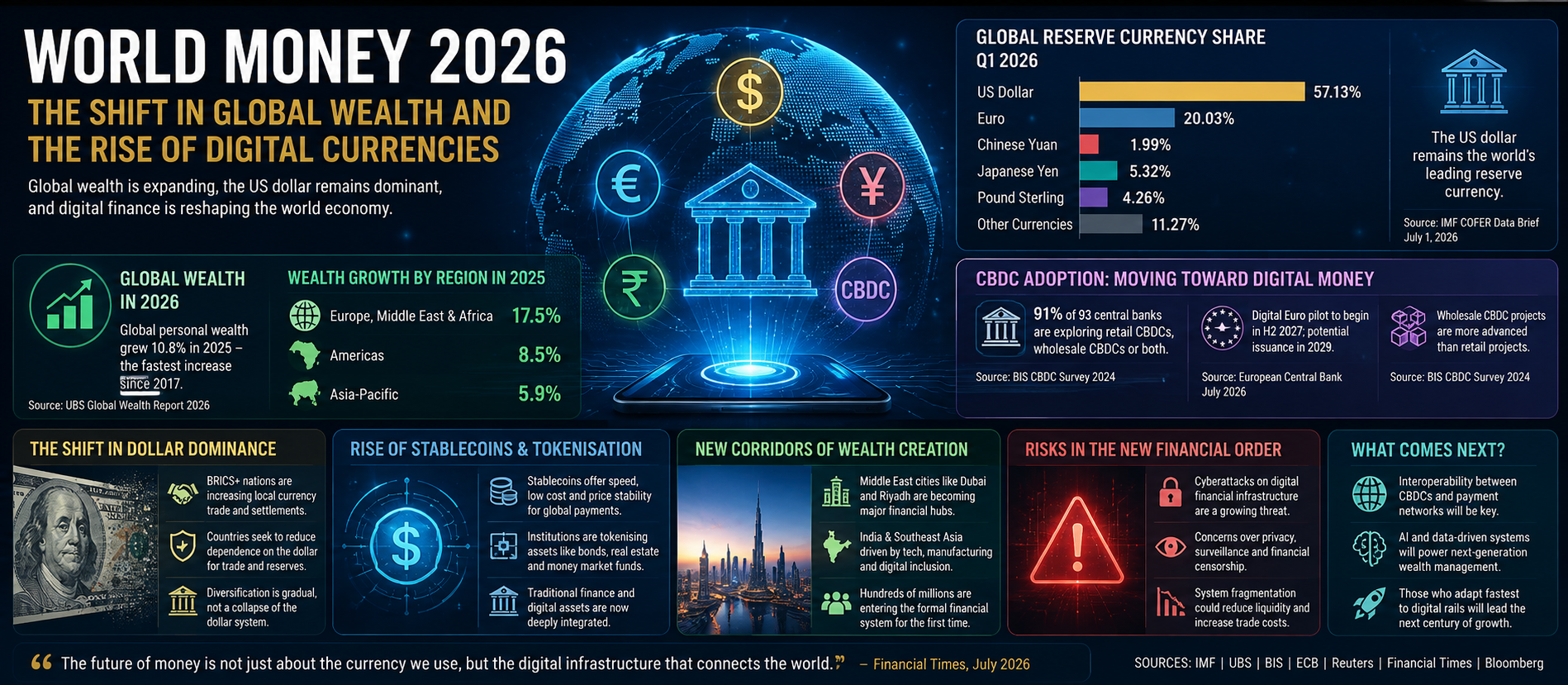
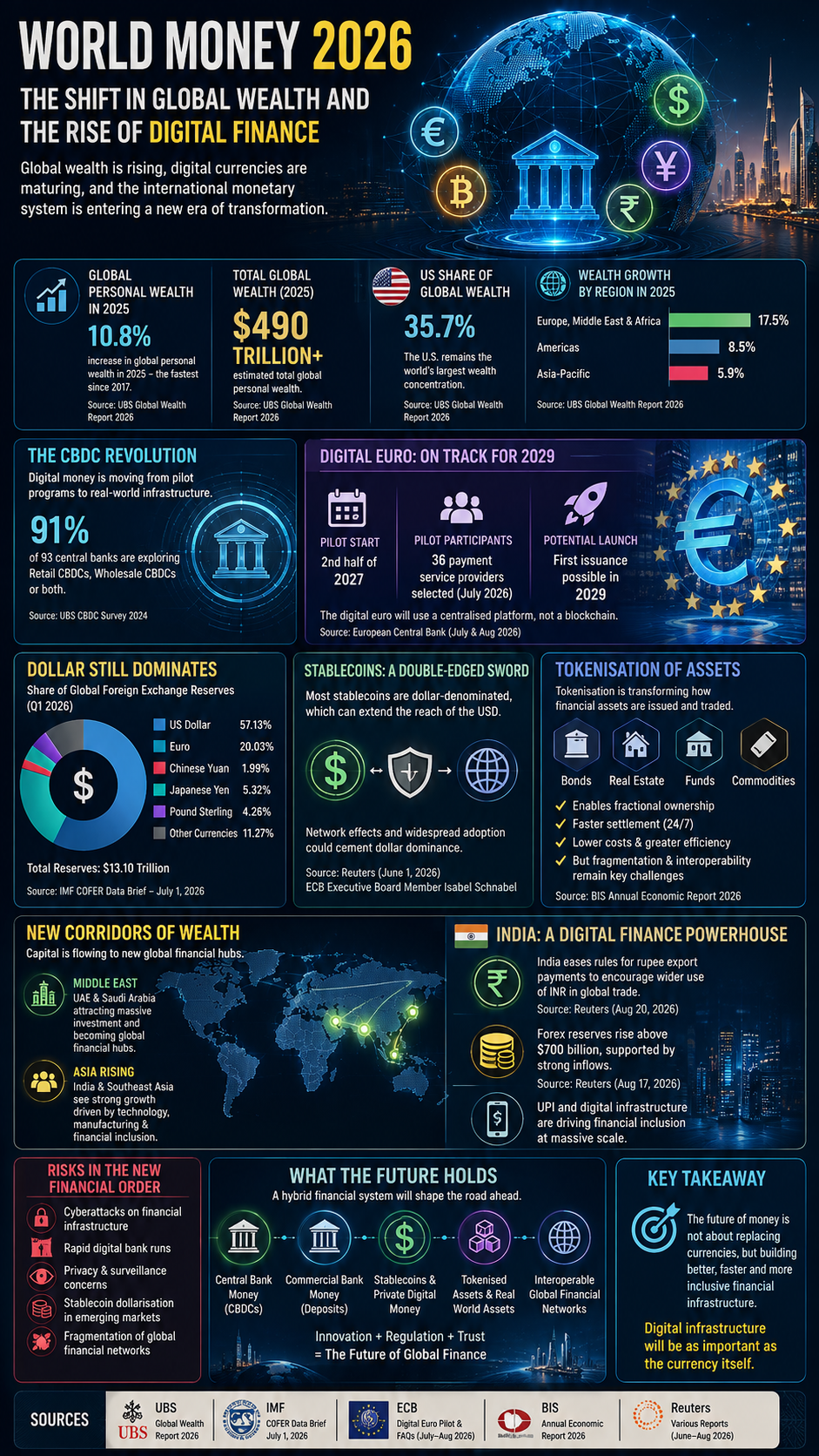
The global wealth landscape is entering 2026 on a stronger footing than in previous years, but the distribution of that wealth is changing. According to the UBS Global Wealth Report 2026, global personal wealth increased by 10.8% in 2025, marking the third consecutive year of growth and the fastest annual increase since 2017. The report also shows that the United States remains the world's largest concentration of personal wealth, accounting for 35.7% of global wealth, while the U.S. and China together account for more than half of the world's wealth.
The rise in wealth has not been evenly distributed across regions. UBS reported that wealth in Europe, the Middle East and Africa grew 17.5% in 2025, compared with 8.5% in the Americas and 5.9% in Asia-Pacific. Currency movements, financial-market performance and the growth of non-financial assets all contributed to these differences. The figures suggest that global wealth is becoming increasingly connected to market performance, currency movements and the economic rise of different regions rather than being concentrated in only a handful of traditional financial centres.
Digital Money Moves From Experiment to Infrastructure
One of the most important changes in global finance is the growing institutional interest in digital forms of money. Central bank digital currencies, stablecoins and tokenised financial assets are moving from experimental concepts toward practical financial infrastructure.
The Bank for International Settlements (BIS) found in its 2024 survey, published in 2025, that 91% of 93 central banks surveyed were exploring retail CBDCs, wholesale CBDCs or both. The BIS also noted that wholesale CBDC work was generally more advanced than retail projects, reflecting strong interest in using digital central bank money for financial-market infrastructure and settlement.
This does not mean that most countries are preparing to replace physical cash with digital currencies immediately. Instead, central banks are exploring how digital money could improve payments, settlement and financial-market infrastructure while maintaining the role of central bank money in the financial system.
The Digital Euro Is Advancing — But Has Not Launched
Europe provides one of the clearest examples of how cautiously major economies are approaching CBDCs. Contrary to claims that the Digital Euro has already entered widespread implementation in 2026, the European Central Bank is still preparing the project.
In July 2026, the ECB announced that it had selected 36 payment service providers to participate in the digital euro pilot. The pilot is expected to begin in the second half of 2027 and run for 12 months. The ECB says a potential first issuance could take place in 2029, assuming the necessary legislation is adopted.
The technology behind the proposed digital euro is also different from the common image of a cryptocurrency-based CBDC. The ECB says the digital euro would use a centralised settlement platform rather than a distributed ledger or blockchain. The Eurosystem would process and verify settlements and holdings, while the system would incorporate design principles intended to improve resilience and efficiency.
This distinction is important because CBDCs should not automatically be described as government-issued cryptocurrencies. Their architecture, governance and monetary characteristics are fundamentally different from decentralised cryptoassets.
Dollar Remains Dominant Despite the Shift Toward Multipolar Finance
The international monetary system is becoming more diversified, but the evidence does not support the idea that the U.S. dollar is rapidly losing its reserve-currency position.
The latest IMF COFER data, released in July 2026, show that the U.S. dollar accounted for 57.13% of global foreign-exchange reserves in the first quarter of 2026, up from 56.42% in the previous quarter. The euro represented 20.03%, while the Chinese renminbi accounted for 1.99%. Total official foreign-exchange reserves stood at about $13.10 trillion at the end of the quarter.
The figures demonstrate that the monetary system is diversifying, but the dollar continues to occupy a commanding position. Earlier in 2026, the IMF also described the dollar's reserve share as broadly stable around 58–59% since 2020. This makes the current transition better understood as gradual diversification rather than a collapse of dollar dominance.
Stablecoins Could Strengthen Dollar Influence
An unexpected development in the digital-money race is that stablecoins may actually reinforce the international role of the U.S. dollar.
Most major stablecoins are denominated in dollars, allowing users to access dollar-linked digital liquidity through blockchain-based payment networks. In June 2026, ECB Executive Board member Isabel Schnabel warned that increasing stablecoin adoption could strengthen U.S. dollar dominance because of network effects and the widespread use of dollar-denominated stablecoins.
This creates an important contradiction in the global monetary transition. Countries may be exploring CBDCs partly to strengthen monetary sovereignty, while private digital currencies linked to the U.S. dollar could simultaneously expand the dollar's reach across digital payment networks.
Tokenisation Is Reshaping Financial Markets
The transformation of money is occurring alongside a broader transformation of financial assets. Tokenisation allows financial claims such as bonds, deposits and other assets to be represented digitally on programmable platforms, potentially reducing settlement frictions and enabling more automated financial transactions.
The BIS Annual Economic Report 2026 argues that tokenisation can support fractional ownership, peer-to-peer transfers, simultaneous exchange and round-the-clock operations. At the same time, the BIS warns that multiple networks can create interoperability problems and fragmented financial "walled gardens."
This means the future of digital finance may not be determined simply by whether blockchain technology succeeds or fails. A more important question is whether different digital financial networks can communicate securely with each other while preserving regulation, monetary stability and consumer protection.
Sources & References
- UBS — Global Wealth Report 2026, June 30, 2026. UBS Global Wealth Report 2026
- IMF — Currency Composition of Official Foreign Exchange Reserves, Q1 2026, July 1, 2026. IMF COFER Data Brief
- European Central Bank — Digital Euro Pilot, updated July 2026. ECB Digital Euro Pilot
- European Central Bank — Digital Euro FAQs, August 2026. ECB Digital Euro FAQs
- BIS — Annual Economic Report 2026, June 2026. BIS Annual Economic Report 2026
- BIS — 2024 Survey on CBDCs and Crypto, August 2025. BIS CBDC Survey
- Reuters — Rising stablecoin use could cement dollar dominance, June 1, 2026. Reuters report on stablecoins and dollar dominance
- Reuters — India eases rules for rupee export payments, August 20, 2026. Reuters report on rupee trade settlement
SEO Metadata
SEO Title: World Money 2026: Global Wealth and Digital Finance
Meta Description: Global wealth is rising as CBDCs, stablecoins and tokenised assets reshape finance while the U.S. dollar remains the world's dominant reserve currency.
Focus Keywords: World Money 2026, global wealth 2026, digital currencies, CBDC, digital euro, US dollar dominance, stablecoins, tokenisation, global finance
SEO-Friendly Social Headlines
- World Money 2026: How Digital Finance Is Reshaping Global Wealth
- Is the Dollar Losing Its Power? What the Latest IMF Data Really Shows
- Digital Euro, Stablecoins and Tokenisation: The New Era of Global Money
- Global Wealth Is Shifting — But the Dollar Still Dominates
- The Future of Money: CBDCs, Stablecoins and the Race to Digitise Finance