LATEST NEWS
Swiggy Didn't Sell Its B2B Arm for Cash — It Bought Into the Company Buying It
September 9, 2026 5M
Back to News
News AlertWorld of Startup’s
World of Startups: Deep Tech and New Energy Dominate the VC Flow
V
Author
Vishal Sable
Published
July 1, 2026
Reading Time
8 MIN READ
Spread the Word
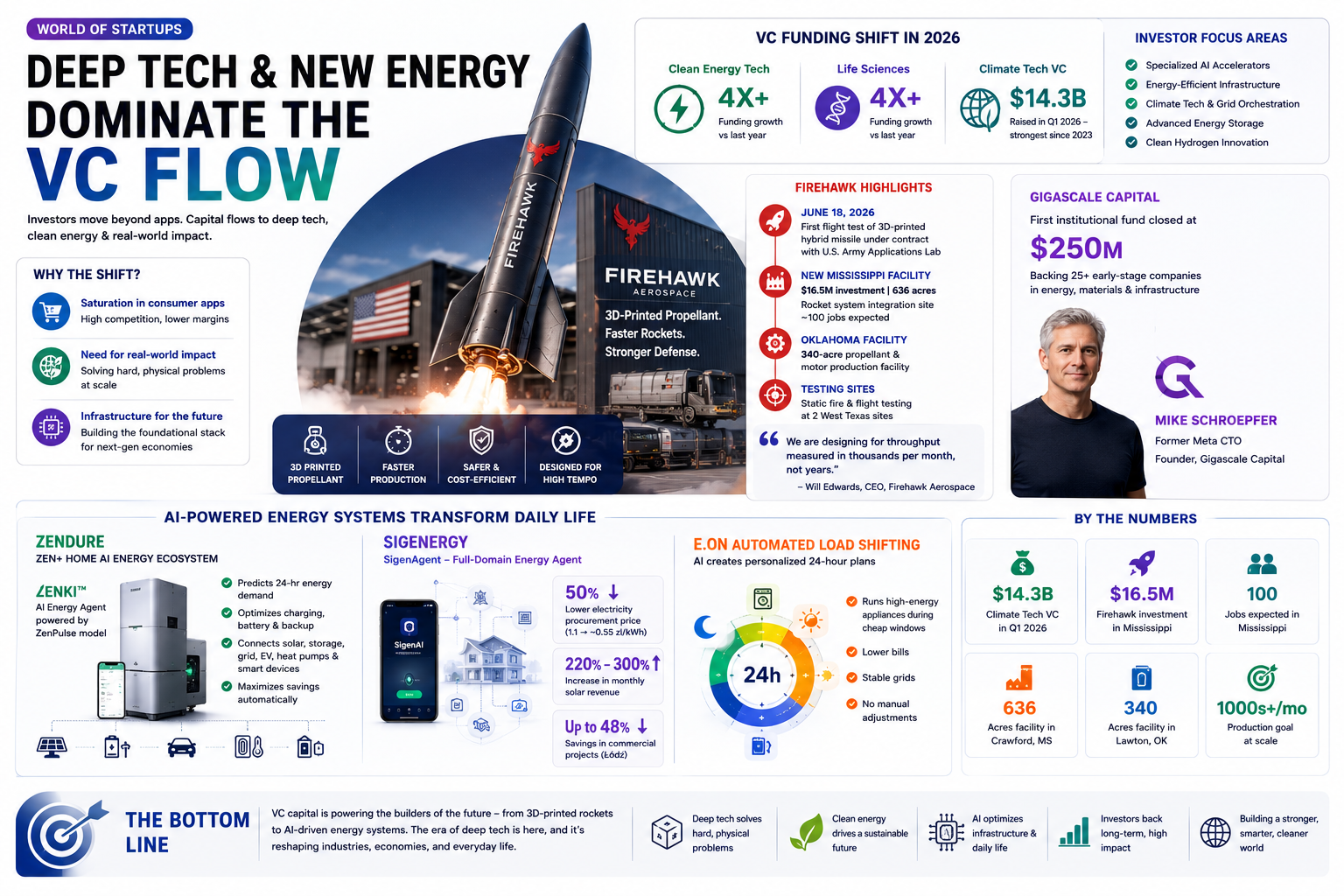
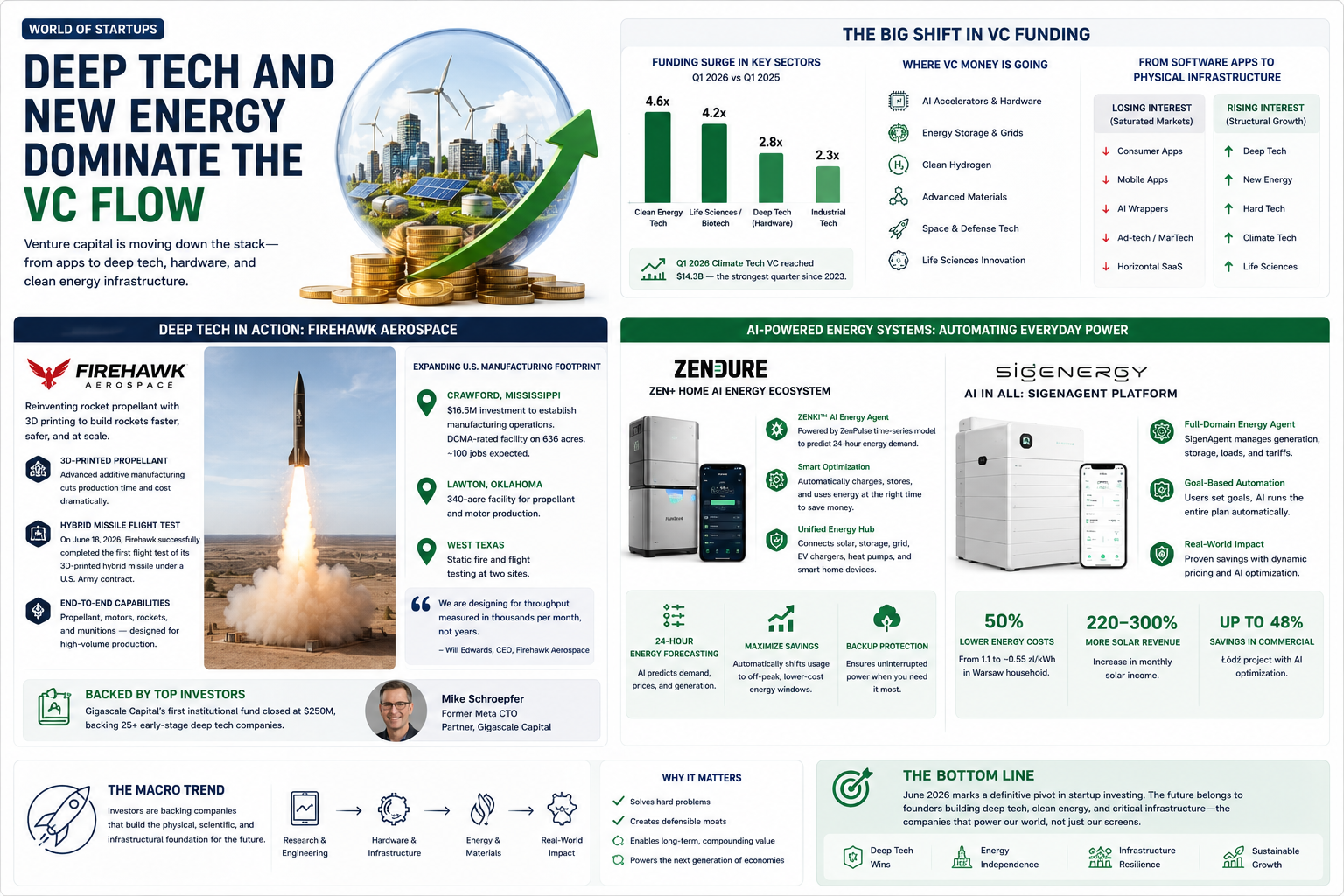
Generic software apps are losing investor interest as venture capitalists aggressively route funding into heavy engineering and clean energy tech. The global venture capital landscape of 2026 is undergoing a profound structural correction. For nearly a decade, investment portfolios were heavily weighted toward application-layer software, mobile apps, and consumer-facing AI wrappers. However, market saturation and high operational costs have pushed those sectors into margin compression. In response, capital is moving down the stack into the physical and infrastructure layers: Deep Tech.
The Latest News
According to mid-year venture capital data, sectors like clean energy tech and life sciences have seen their funding more than quadruple compared to last year. Investors are prioritizing the foundational stack required to support next-generation workflows—specialized AI accelerators, energy-efficient GPU orchestration platforms, and hardware optimized for Agentic AI. Climate-tech and energy grid orchestration have become major investment themes, with funding increasingly directed toward next-generation energy storage, clean hydrogen innovation, and advanced grid orchestration systems. Q1 2026 climate tech VC reached $14.3 billion—the strongest quarter since 2023.
Startups are no longer pitching pure digital solutions; they are scaling physical mechanics. Firehawk Aerospace is using advanced 3D printing to fundamentally reinvent how rocket propellant is manufactured, dramatically cutting production times for commercial aerospace ventures. Firehawk is an end-to-end energetics company that produces munitions, rockets, and motors powered by its proprietary 3D-printed propellant, which enables faster, safer, and more cost-efficient production. In December 2025, the company announced plans to establish manufacturing operations in Crawford, Mississippi, with a $16.5 million investment and an expectation to create some 100 jobs. The DCMA-rated facility sits on 636 acres and will serve as Firehawk's rocket system integration site.
On June 18, 2026, Firehawk successfully conducted the first flight test of its 3D-printed hybrid missile under a contract with the U.S. Army Applications Laboratory. In the future, Firehawk will test analogs of Javelin and Stinger-class missiles, designed to replace solid fuel engines in existing weapons systems. The company is also building a 340-acre propellant and motor production facility in Lawton, Oklahoma, and conducts static fire and flight testing at two West Texas sites. As CEO Will Edwards stated: "While the current industrial base is built to produce thousands of rockets per year, we are building this site—and our broader manufacturing footprint—to operate at a much higher production tempo. With R&D in Texas, energetics production in Oklahoma, and now full system integration in Mississippi, we are designing for throughput measured in thousands per month, not years". Former Meta CTO Mike Schroepfer has closed Gigascale Capital's first institutional fund at $250 million, backing more than 25 early-stage companies building energy, materials, and infrastructure systems.
Daily Routine Impact
Daily power grids are becoming automated by startups. Clean-energy infrastructure companies are integrating AI directly into smart-home meters to automatically shift home energy consumption away from peak grid hours, saving consumers money without manual intervention. Zendure showcased its ZEN+ HOME AI Energy Ecosystem at Intersolar 2026 in Munich on June 22. At its heart is ZENKI™, Zendure's AI Energy Agent powered by the proprietary ZenPulse time-series model. By analyzing solar generation, household consumption, and dynamic electricity pricing, ZENKI™ predicts 24-hour energy demand and automatically formulates the optimal strategy—from intelligent charging and battery scheduling to automatic backup protection. The ecosystem's PowerHub platform connects solar generation, battery storage, grid electricity, EV chargers, heat pumps, and smart home devices into a unified energy coordination system.
Sigenergy unveiled its "AI in All" strategy in June 2026, introducing SigenAgent, a full-domain energy agent designed to support home energy management. The platform aims to simplify the operation of increasingly complex solar and energy storage systems through autonomous, goal-based optimization. The model shifts from "users operate devices" to "users set goals, and the system completes the task". In a Warsaw household case study, Sigen AI paired with Poland's dynamic-pricing rollout cut the average monthly electricity procurement price from 1.1 to about 0.55 zł/kWh—a 50% reduction—while monthly solar revenue rose 220% to 300%. A separate commercial project in Łódź reported savings of up to 48%. As E.ON's automated load shifting creates personalized 24-hour plans that run high-energy appliances during cheap windows, consumers no longer have to guess when prices are lowest.
The Bottom Line
June 2026 marks a definitive pivot in startup investing. Venture capital is abandoning consumer software in favor of deep-tech ventures grounded in scientific research, complex engineering, and proprietary intellectual property. Firehawk Aerospace's 3D-printed rocket propellant is redefining what's possible in commercial aerospace manufacturing. AI-powered home energy systems from Zendure and Sigenergy are transforming households from passive consumers into active, energy-independent participants—automatically shifting consumption, cutting bills, and stabilizing grids without a single manual adjustment. The era of software-only startups is fading. The era of physical, infrastructural, and energy-focused deep tech is here.

Vishal Sable
B.Tech AD @ shri balaji institute of technology and management
Engineering and tech journalist. I love exploring the impact of emerging technologies on global defense, sovereignty, and everyday life. Always looking for the real story behind the headlines.