LATEST NEWS
Swiggy Didn't Sell Its B2B Arm for Cash — It Bought Into the Company Buying It
September 9, 2026 5M
Back to News
News AlertWorld of Startup’s
World of Startups: Meta Enters the Fintech Game
V
Author
Vishal Sable
Published
June 30, 2026
Reading Time
7 MIN READ
Spread the Word
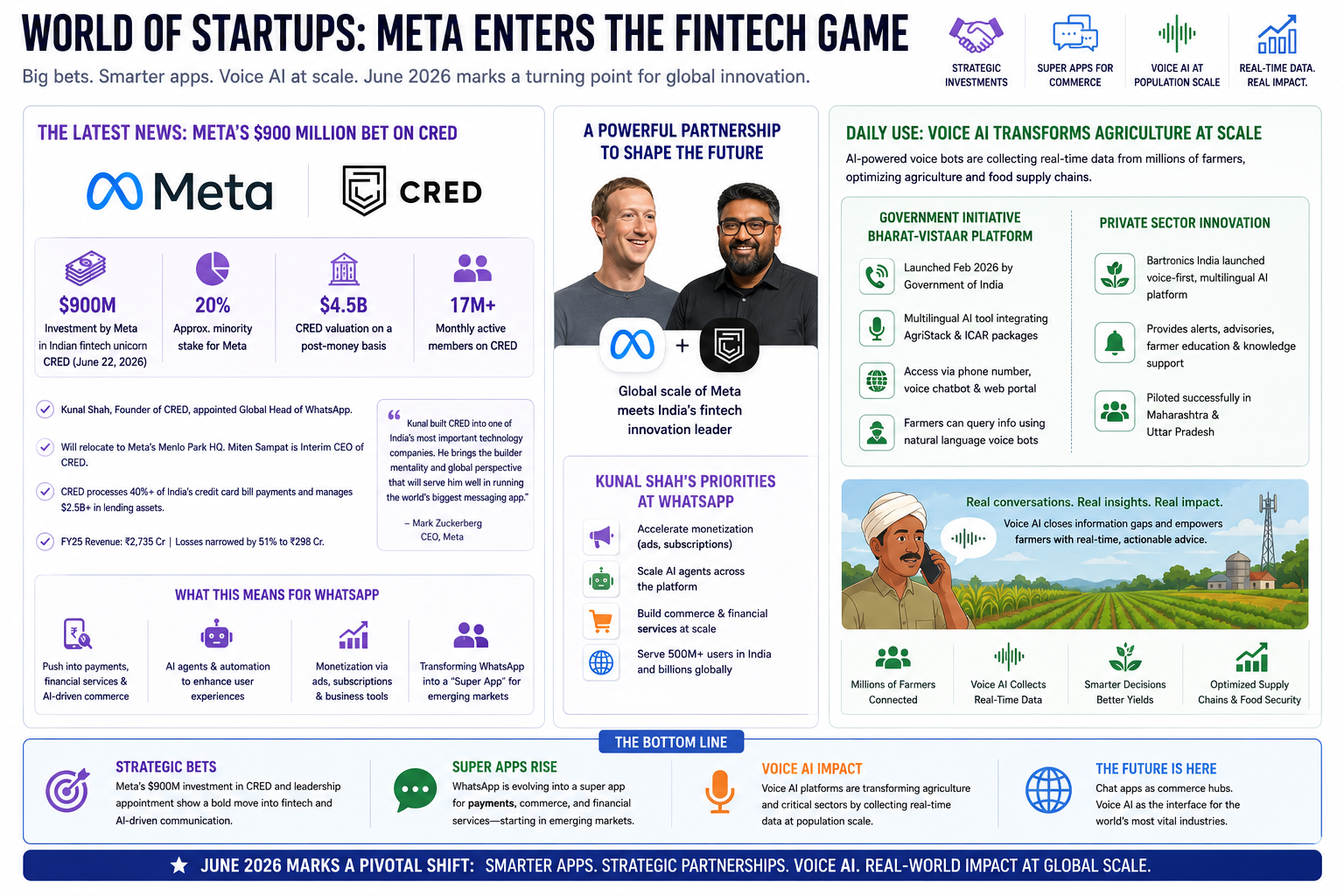
Tech giants are partnering with local ecosystems to completely transform communication and consumer services. June 2026 has witnessed one of the most surprising structural moves in recent memory, alongside continued momentum in AI-driven population-scale operations that are reshaping how critical sectors collect and act on data.
The Latest News: Meta's $900 Million Bet on CRED
In a landmark deal announced on June 22, Meta Platforms invested $900 million in Indian fintech unicorn CRED, valuing the Bengaluru-based company at $4.5 billion on a post-money basis. The investment, structured through a combination of primary and secondary share purchases, gives Meta a minority stake of approximately 20% in CRED without granting access to the company's customer data.
Simultaneously, Meta appointed CRED's founder Kunal Shah as the new global head of WhatsApp, succeeding Will Cathcart, who stepped down after seven years leading the messaging service. Shah, who founded CRED in 2018, will relocate from Bengaluru to Meta's Menlo Park headquarters. Miten Sampat, who has led strategy and finance at CRED since 2020, has been appointed interim CEO.
The deal represents one of the largest investments into India's financial technology sector in recent years. CRED, which serves 17 million monthly active members and processes more than 40% of India's credit card bill payments while managing over $2.5 billion in lending assets, plans to use the fresh capital to accelerate growth and expand across product categories. The fintech platform reported consolidated operating revenue of Rs 2,735 crore in FY25, with operating losses narrowing by 51% to Rs 298 crore.
Meta's Chief Product Officer Chris Cox approached Shah directly, seeking a leader with "an intuitive grasp of the immense, global product potential for WhatsApp" who could navigate the shifts AI will bring. Among Shah's priorities at WhatsApp will be monetization efforts including advertising and subscription offerings, alongside the broader rollout of AI agents across the platform. Industry observers see the move as Meta's bid to transform WhatsApp from a messaging service into a "super app" for commerce and financial services, particularly in emerging markets where WhatsApp already dominates—India alone has more than 500 million WhatsApp users.
Mark Zuckerberg, Meta's founder and CEO, said in a statement: "Kunal built CRED into one of India's most important technology companies, and he brings the kind of builder mentality and global perspective that will serve him well in running the world's biggest messaging app". Shah himself noted: "While it's come very far, the delta between WhatsApp today and its full potential is massive".
Daily Use: Voice AI Transforms Agriculture at Scale
Beyond the Meta-CRED deal, startups are successfully targeting population-scale operations through AI deployment in specialized sectors. Multilingual voice bots are being deployed directly into agriculture, automating real-time data collection from millions of farmers to optimize food supply chains.
India's government launched the BHARAT-VISTAAR platform in February 2026, a multilingual AI tool that integrates AgriStack portals and ICAR packages, available through a dedicated telephone number, a voice-based AI chatbot, and a web portal. The platform enables farmers to query information using natural language voice bots without typing.
Private sector players are equally active. Bartronics India Limited launched a voice-first, multilingual AI-powered rural technology platform following a successful pilot in Maharashtra and Uttar Pradesh. The application supports multilingual voice navigation, proactive alerts, contextual advisories, farmer education, and interactive knowledge support.
Research from the International Food Policy Research Institute highlights how generative AI-powered voice technology can close agricultural information gaps, offering tailored, real-time advice to smallholder farmers even in remote areas. These systems collect real conversational farm audio to train their models, recognizing that accurate listening is the foundation of effective voice AI. The result is a direct pipeline from the farm to the data center—millions of agricultural workers and farmers now contribute real-time intelligence that helps optimize planting decisions, crop selection, and supply chain logistics at unprecedented scale.
The Bottom Line
June 2026 marks a pivotal moment where tech giants are placing strategic bets on fintech ecosystems to transform global communication and commerce. Meta's $900 million investment in CRED and the appointment of Kunal Shah to lead WhatsApp signal an aggressive push into payments, financial services, and AI-driven commerce. At the same time, AI-powered voice bots are proving their worth at population scale, bringing real-time data collection and optimization to sectors that have traditionally lagged in digital transformation. The era of chat apps as primary hubs for daily commerce, and voice AI as the interface for the world's most critical industries, is already here.

Vishal Sable
B.Tech AD @ shri balaji institute of technology and management
Engineering and tech journalist. I love exploring the impact of emerging technologies on global defense, sovereignty, and everyday life. Always looking for the real story behind the headlines.