Back to News
News AlertWorld Money
Yellow Card Raises $40M for Stablecoins; 10x Banking Lands £40M for Core Modernisation
V
Author
Vishal Sable
Published
August 4, 2026
Reading Time
4 MIN READ
Spread the Word
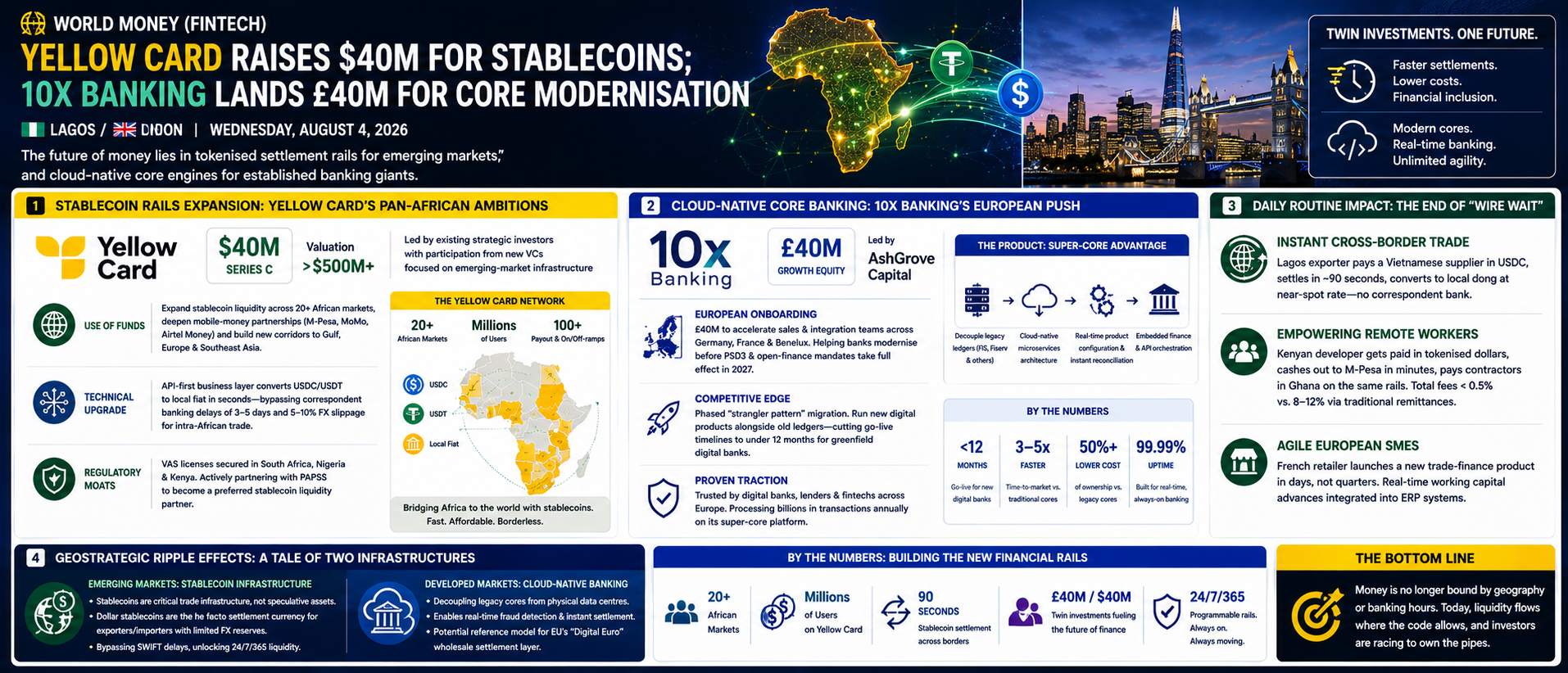
LAGOS / LONDON – Wednesday, August 4, 2026
The global financial infrastructure is being rebuilt in real time—and today's twin funding announcements prove that the future of money lies in two distinct but convergent lanes: tokenised settlement rails for emerging markets, and cloud-native core engines for established banking giants. As cross-border commerce sheds its Cold War-era settlement delays, investors are placing billion-dollar bets on speed, interoperability, and financial inclusion.
STABLECOIN RAILS EXPANSION: Yellow Card's Pan-African Ambitions
Pan-African fintech major Yellow Card has closed a $40 million Series C funding round, led by existing strategic investors with participation from new venture arms focused on emerging-market infrastructure. The capital injection pushes the company's valuation past the half-billion mark, cementing its position as the continent's dominant stablecoin on/off-ramp operator.
Use of Funds: The fresh capital will expand stablecoin liquidity pools across 20+ African markets, deepen partnerships with local mobile-money providers (M-Pesa, MoMo, Airtel Money), and deploy new settlement corridors bridging Africa with the Gulf, Europe, and Southeast Asia.
Technical Upgrade: Yellow Card is rolling out an API-first business layer that allows enterprises to convert USDC and USDT into local fiat currencies within seconds, bypassing correspondent banking bottlenecks that have traditionally added 3–5 business days and 5–10% FX slippage for intra-African trade.
Regulatory Moats: The firm has secured virtual-asset service provider licences in South Africa, Nigeria, and Kenya, and is actively negotiating with the Pan-African Payment and Settlement System (PAPSS) to become a preferred stablecoin liquidity partner.
CLOUD-NATIVE CORE BANKING: 10x Banking's European Push
Meanwhile, across the English Channel, London-based core-banking pioneer 10x Banking has secured £40 million in growth equity from AshGrove Capital—a significant endorsement of its "super-core" strategy after a period of strategic retrenchment.
The Product: 10x's platform decouples legacy ledger systems (e.g., legacy mainframes from FIS, Fiserv) into a cloud-native, microservices-based architecture that enables real-time product configuration, instant reconciliation, and embedded finance orchestration.
European Onboarding: The £40M will be deployed to accelerate sales and integration teams across Germany, France, and the Benelux, where mid-tier lenders are under intense pressure to modernise before PSD3 and open-finance mandates take full effect in 2027.
Competitive Edge: Unlike monolithic core replacements that take 3–5 years, 10x offers a phased "strangler pattern" migration, allowing banks to run new digital products alongside old ledgers—cutting go-live timelines to under 12 months for greenfield digital banks.
DAILY ROUTINE IMPACT: The End of the "Wire Wait"
For businesses and individuals, these two developments converge into a tangible, everyday upgrade:
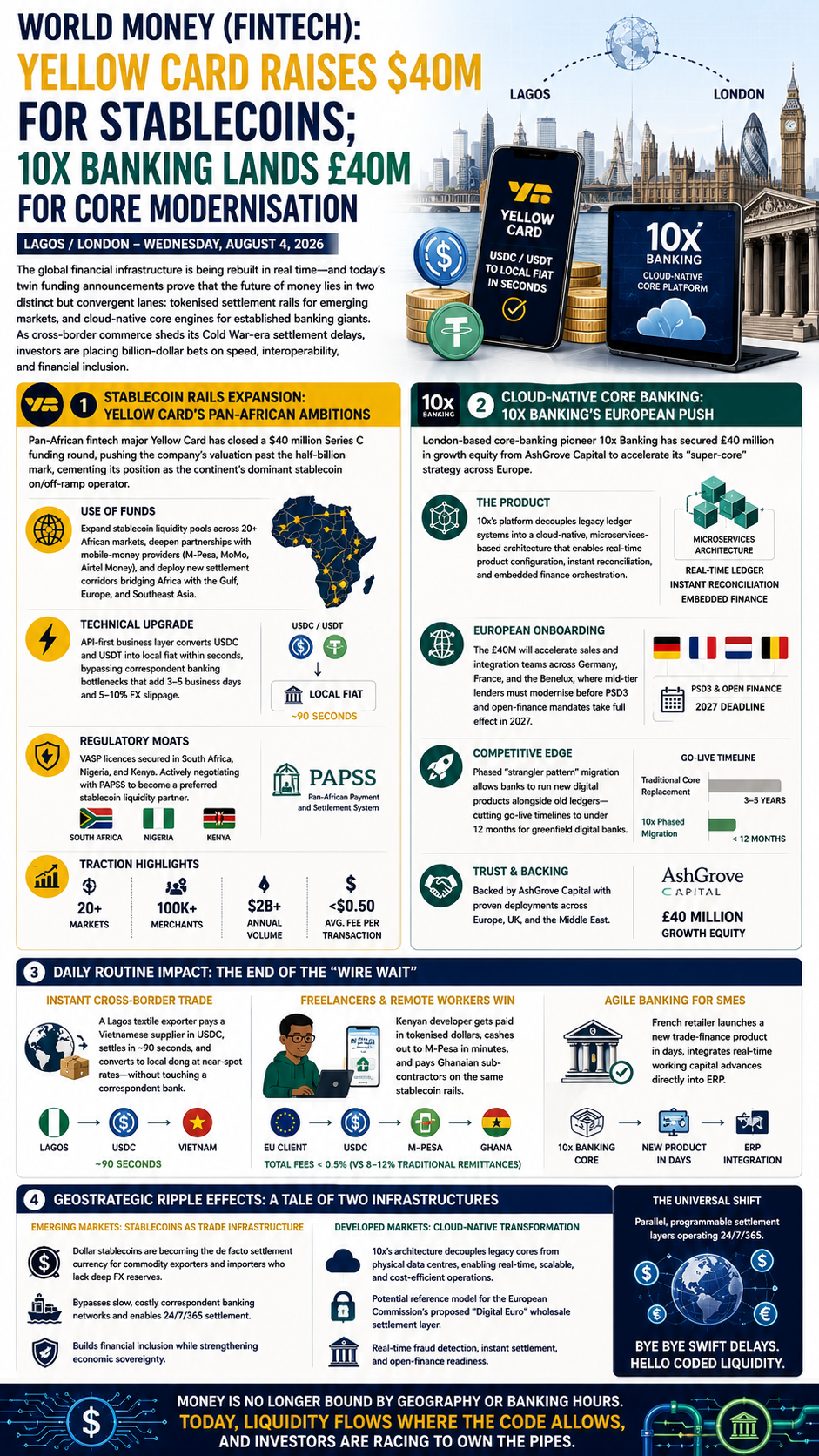
Cross-border trade is bypassing traditional multi-day wire delays. A Lagos-based textile exporter can now pay a Vietnamese fabric supplier in USDC, settle within 90 seconds, and convert the stablecoin to local dong at a near-spot rate—all without touching a correspondent bank.
Remote workers and freelancers are the biggest beneficiaries. A Kenyan developer contracting for a European SaaS firm can receive tokenised dollar payouts directly to a Yellow Card wallet, withdraw to M-Pesa in minutes, and pay sub-contractors in Ghana using the same stablecoin rails—all with total fees under 0.5%, versus 8–12% for traditional remittance corridors.
European SMEs are gaining agility. With 10x-powered banking engines, a French retailer can spin up a new trade-finance product for seasonal inventory within days, not quarters, and integrate real-time working capital advances directly into their ERP systems.
GEOSTRATEGIC RIPPLE EFFECTS: A Tale of Two Infrastructures
The convergence of these funding events signals a broader bifurcation in global finance:
For emerging markets, Yellow Card's model proves that stablecoins are not speculative vehicles but critical trade infrastructure. As the US Federal Reserve's interest-rate cycle remains uncertain, dollar-denominated stablecoins are becoming the de facto settlement currency for commodity exporters and importers who lack deep FX reserves.
For developed markets, 10x's cloud-native core represents the final push to decouple legacy banking from physical data centres. European regulators are watching closely: if 10x's architecture can demonstrate real-time fraud detection and instant settlement, it could become the reference model for the European Commission's proposed "Digital Euro" wholesale settlement layer.
Industry observers note that both firms are effectively bypassing SWIFT's gpi and traditional clearing houses—not by replacing them, but by offering parallel, programmable settlement layers that operate 24/7/365. The message is clear: money is no longer bound by geography or banking hours. Today, liquidity flows where the code allows, and investors are racing to own the pipes.

Vishal Sable
B.Tech AD @ shri balaji institute of technology and management
Engineering and tech journalist. I love exploring the impact of emerging technologies on global defense, sovereignty, and everyday life. Always looking for the real story behind the headlines.