Back to News
News AlertWorld Money
140 Giants Unite to Launch "Open USD" for Instant Web Commerce
V
Author
Vishal Sable
Published
July 7, 2026
Reading Time
4 MIN READ
Spread the Word
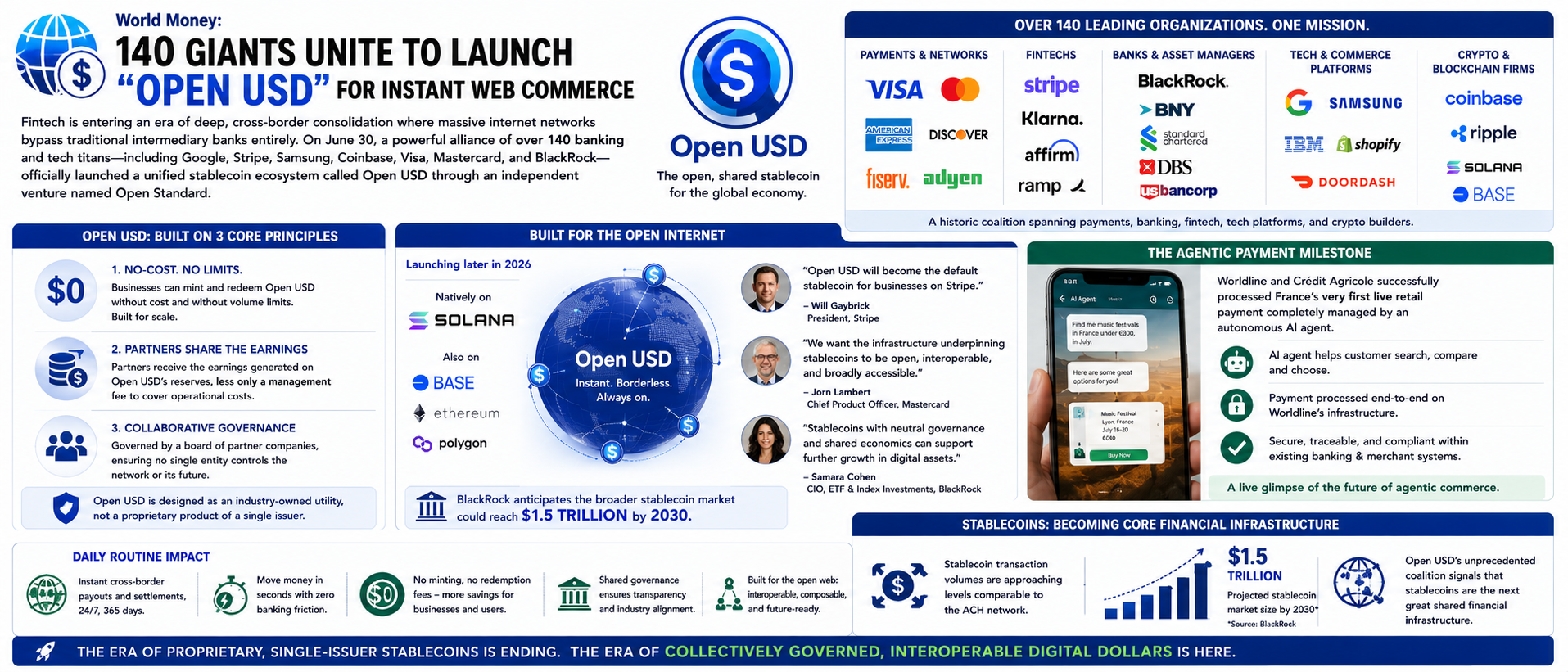
Fintech is entering an era of deep, cross-border consolidation where massive internet networks are bypassing traditional intermediary banks entirely. On June 30, a powerful alliance of over 140 banking and tech titans—including Google, Stripe, Samsung, Coinbase, Visa, Mastercard, and BlackRock—officially launched a unified stablecoin ecosystem called Open USD through an independent venture named Open Standard .
The Latest News
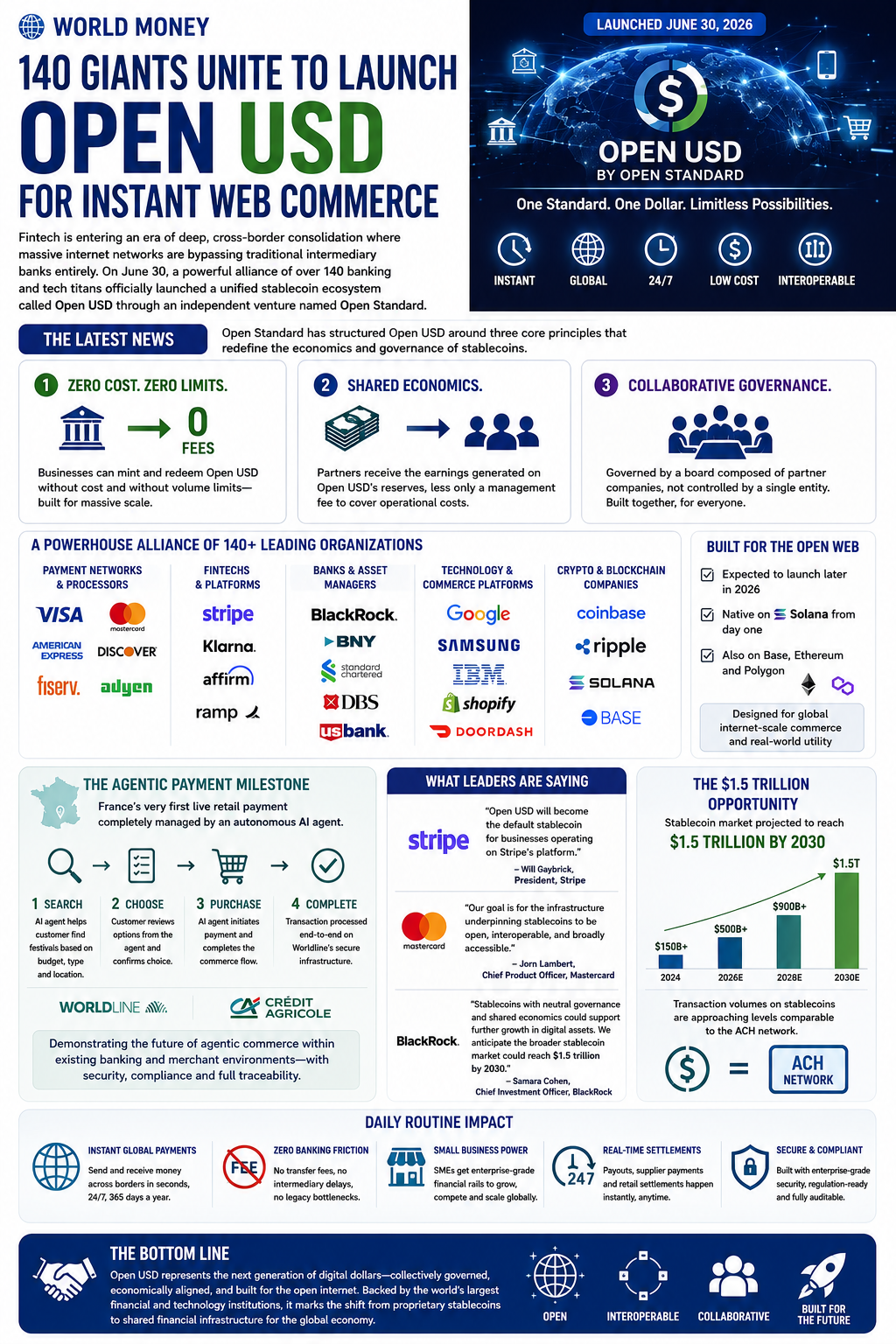
Open Standard has structured Open USD around three core principles that directly target the pain points of existing stablecoin models. First, businesses will be able to mint and redeem Open USD without cost and without volume limits—a feature the company describes as built for scale . Second, partners will receive the earnings generated on Open USD's reserves, less only a management fee to cover operational costs . This model strikes at the core economics of today's stablecoin issuers like Circle and Tether, who typically retain most of the interest generated by reserve assets. Third, the stablecoin will be governed collaboratively through a board composed of partner companies, rather than being controlled by a single entity .
The roster of participating companies reads like a who's who of the global financial and technology ecosystem. Payment networks and processors include Visa, Mastercard, American Express, Discover, Fiserv, and Adyen. Fintechs include Stripe, Klarna, Affirm, and Ramp. Banking participants include BlackRock, BNY, Standard Chartered, DBS Bank, and U.S. Bank. Technology and commerce platforms Google, Samsung Electronics, IBM, Shopify, and DoorDash are also listed, alongside crypto firms Coinbase, Ripple, Solana, and Base .
The stablecoin is expected to launch natively on Solana from day one later in 2026, and will also run on Coinbase's Base blockchain, Ethereum, and Polygon . Stripe's Will Gaybrick signaled the company's commitment, saying Open USD would become the default stablecoin for businesses operating on Stripe's platform . Mastercard's Jorn Lambert said the goal was for infrastructure underpinning stablecoins to be "open, interoperable, and broadly accessible" . BlackRock's Samara Cohen noted that stablecoins with neutral governance and shared economics could support further growth in digital assets, adding that the firm anticipates the broader stablecoin market could reach $1.5 trillion by 2030 .
The Agentic Payment Milestone
Simultaneously, paytech Worldline and Crédit Agricole successfully processed France's very first live retail payment completely managed by an autonomous AI agent. The production use case involved an AI agent supporting a customer in searching for festivals. By setting specific parameters such as budget, event type, and location, the customer received a range of options from the agent, enabling them to confirm their choice before initiating the purchase. The commerce flow was processed end-to-end on Worldline's infrastructure, demonstrating the ability to enable agentic commerce journeys within existing banking and merchant environments while respecting market security and traceability requirements.
Daily Routine Impact
The rollout of Open USD means international business payouts and retail supply line settlements can happen instantly around the clock. Small businesses can now move money across borders in seconds with zero standard banking friction or transfer fees. The stablecoin's no-cost minting and redemption model, combined with its shared governance structure, positions it as a potential industry-owned utility rather than a proprietary product controlled by a single issuer . As stablecoin transaction volumes approach levels comparable to the ACH network, Open USD's unprecedented coalition—spanning payments, banking, fintech, and crypto—signals that stablecoins are becoming shared financial infrastructure . The message is clear: the era of proprietary, single-issuer stablecoins is giving way to an era of collectively governed, interoperable digital dollars backed by the world's largest financial institutions.

Vishal Sable
B.Tech AD @ shri balaji institute of technology and management
Engineering and tech journalist. I love exploring the impact of emerging technologies on global defense, sovereignty, and everyday life. Always looking for the real story behind the headlines.