Back to News
News AlertWorld Money
Global FinTech Revenue Crosses $500B Amid AI-Native Overhauls
V
Author
Vishal Sable
Published
July 8, 2026
Reading Time
3 MIN READ
Spread the Word
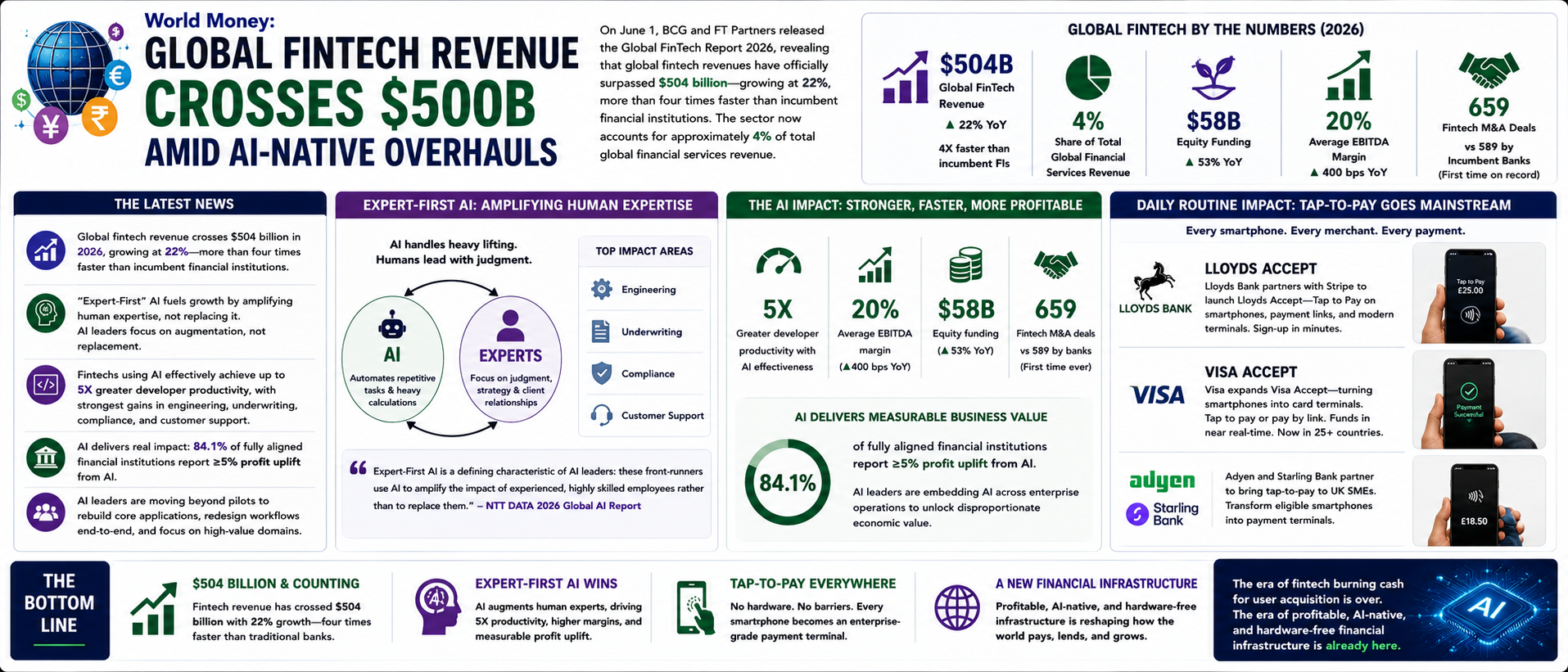
The financial sector is undergoing an infrastructure rewiring, using native AI to automate corporate accounting, risk compliance, and consumer lending. On June 1, Boston Consulting Group and FT Partners released the Global FinTech Report 2026, revealing that global fintech revenues have officially surpassed $504 billion—growing at 22%, more than four times faster than incumbent financial institutions. The sector now accounts for approximately 4% of total global financial services revenue.
The Latest News
The growth is heavily fueled by the integration of "Expert-First" AI—systems designed to build advanced algorithmic loops around human financial choices rather than replacing workers entirely. According to NTT DATA's 2026 Global AI Report, "Expert-First AI" is a defining characteristic of AI leaders: "these front-runners use AI to amplify the impact of experienced, highly skilled employees rather than to replace them". The report emphasizes that AI leaders' primary workforce goal is "augmentation, not replacement," with skilled, AI-savvy employees focusing on higher-value work while AI handles repetitive tasks.
The results are tangible. BCG data shows that fintechs using AI effectively achieve up to five times greater developer productivity, with the strongest near-term gains in engineering, underwriting, compliance, and customer support. The sector attracted $58 billion in equity funding, up 53% year-over-year, while average EBITDA margins rose by 400 basis points to 20%. For the first time on record, scaled fintech companies out-acquired banks in M&A, completing 659 deals compared to 589 by incumbents.
Leading financial institutions are embedding AI across enterprise operations. NTT DATA's banking report reveals that 84.1% of fully aligned financial institutions report ≥5% profit uplift from AI. The report outlines that AI leaders are moving beyond pilot projects to rebuild core applications with embedded AI, redesign workflows end-to-end, and focus on high-value domains that unlock disproportionate economic value.
Daily Routine Impact
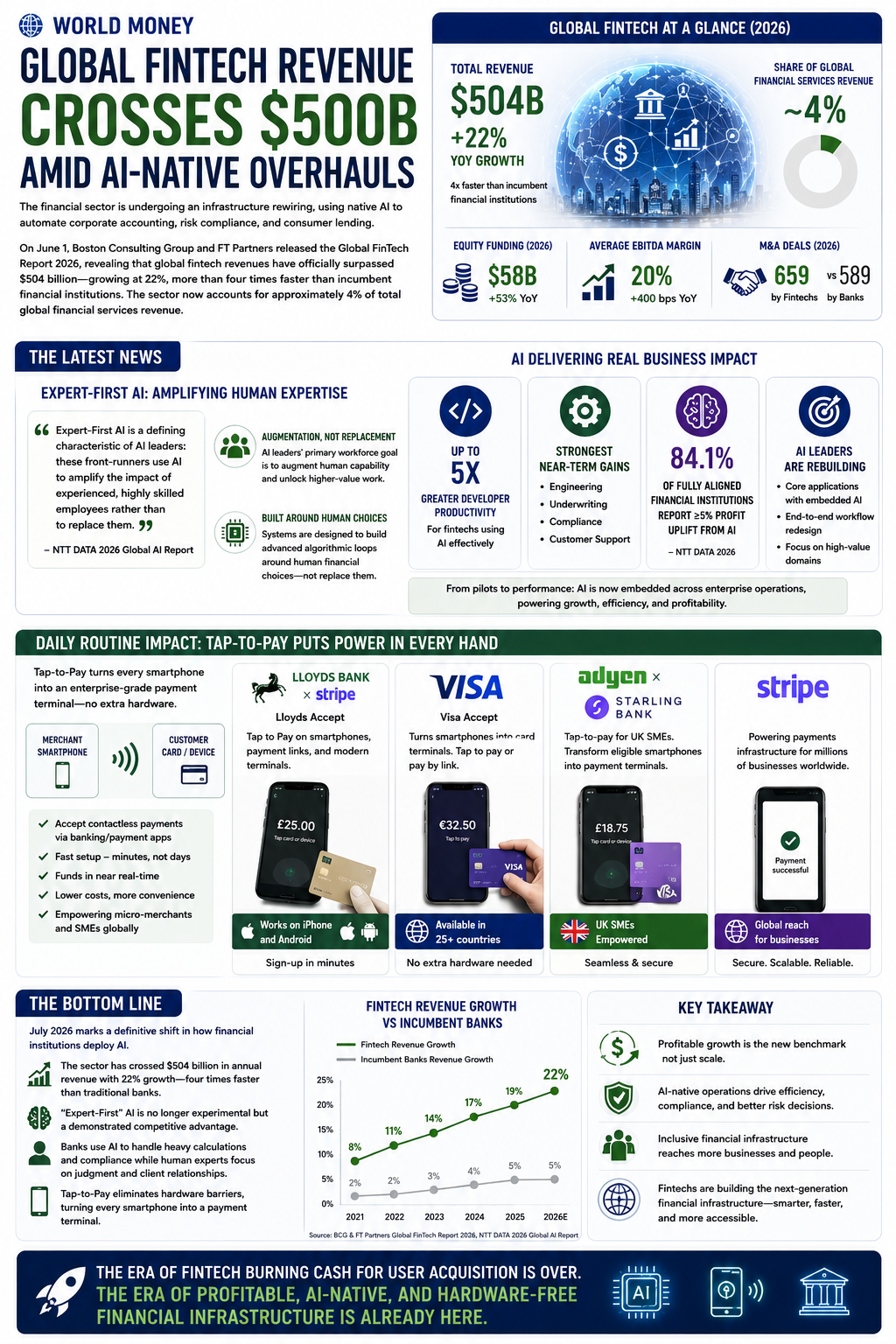
In daily operations, consumer platforms are merging with traditional banking. Mainstream tech providers are rolling out "Tap-to-Pay" capabilities built directly into banking apps, turning every single micro-merchant's smartphone into an enterprise-grade credit card terminal without extra hardware. In June, Lloyds Bank partnered with Stripe to launch Lloyds Accept, giving small business customers access to Tap to Pay on smartphones, payment links, and modern terminal devices—with sign-up times taking just minutes. Tap to Pay is supported on both iPhone and Android devices, allowing merchants to accept contactless payments via the Lloyds Accept app without additional hardware.
Visa has expanded its Visa Accept solution, turning smartphones into card terminals that allow micro-sellers to accept card payments through their Visa account with no extra hardware needed. Buyers can tap to pay or pay by link, with funds reaching the seller's account in near real-time. The solution is now available in more than 25 countries. Adyen and Starling Bank have also partnered to bring tap-to-pay to UK SMEs, enabling customers to transform their eligible smartphones into payment terminals.
The Bottom Line
July 2026 marks a definitive shift in how financial institutions deploy AI. The sector has crossed $504 billion in annual revenue with 22% growth—four times faster than traditional banks. "Expert-First" AI is no longer experimental but a demonstrated competitive advantage, with banks using AI to handle heavy calculations and compliance while human experts focus on judgment and client relationships. Meanwhile, Tap-to-Pay is eliminating hardware barriers, turning every smartphone into a payment terminal. The era of fintech burning cash for user acquisition is over. The era of profitable, AI-native, and hardware-free financial infrastructure is already here.

Vishal Sable
B.Tech AD @ shri balaji institute of technology and management
Engineering and tech journalist. I love exploring the impact of emerging technologies on global defense, sovereignty, and everyday life. Always looking for the real story behind the headlines.