Back to News
News AlertWorld Money
Digital Payment Dominance and Near-Term IPO Ambitions
V
Author
Vishal Sable
Published
July 9, 2026
Reading Time
3 MIN READ
Spread the Word
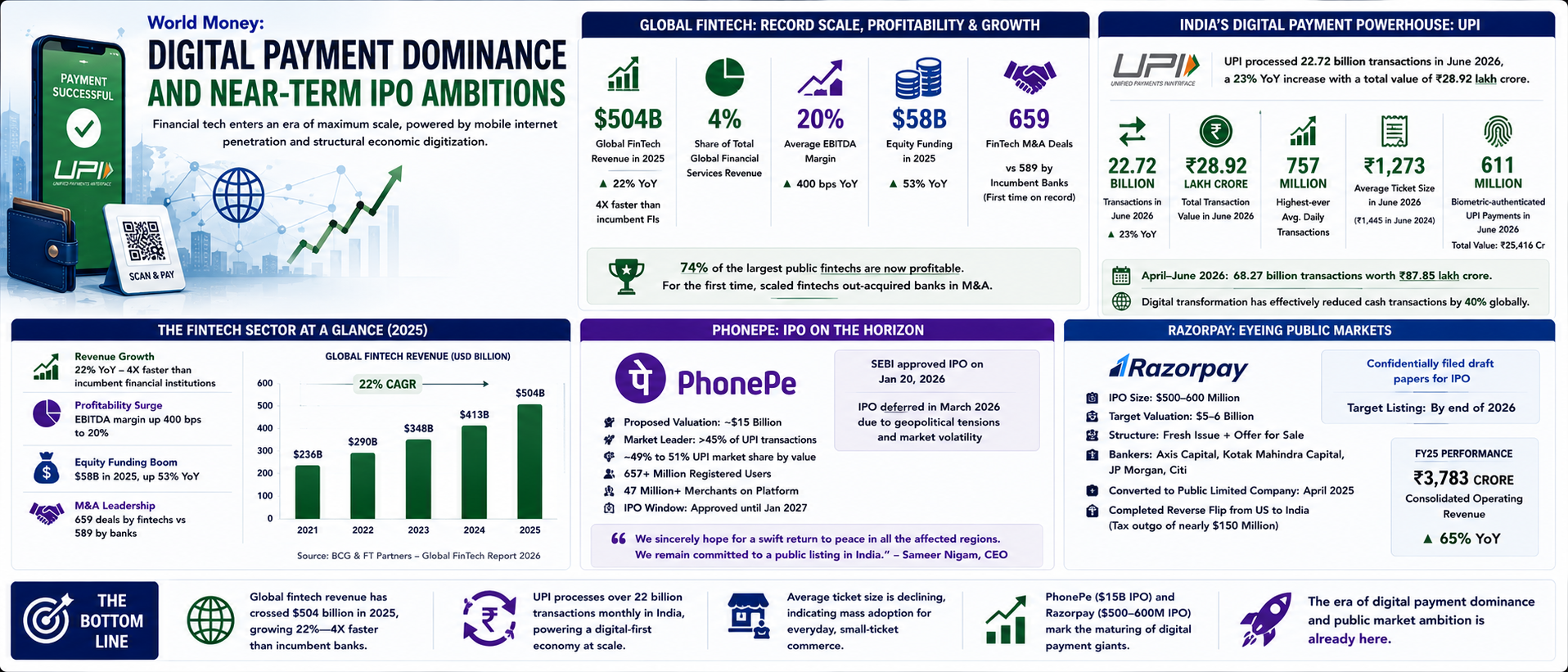
Financial tech is entering an era of maximum scale, heavily anchored by high mobile internet penetration and structural economic digitization. According to Boston Consulting Group and FT Partners' Global FinTech Report 2026, global fintech revenues have firmly cleared historical benchmarks, crossing $504 billion in 2025—growing at 22%, more than four times faster than incumbent financial institutions. The sector now accounts for approximately 4% of total global financial services revenue. Fintechs have also reached record profitability: 74% of the largest public fintechs are now profitable, with average EBITDA margins rising 400 basis points to 20%. Equity funding jumped 53% year-over-year to $58 billion, and for the first time on record, scaled fintech companies out-acquired banks in M&A, completing 659 deals compared to 589 by incumbents.
In primary markets like India, where mobile internet users have crossed 900 million, the Unified Payments Interface (UPI) is processing over 22 billion transactions monthly. According to data released by the National Payments Corporation of India, UPI processed 22.72 billion transactions in June 2026, a 23% year-on-year increase, with a total transaction value of ₹28.92 lakh crore. The platform recorded its highest-ever average daily transaction count of 757 million. The average ticket size has declined from ₹1,445 in June 2024 to ₹1,273 in June 2026, reflecting wider adoption for small-ticket everyday commerce. Between April and June 2026, UPI processed 68.27 billion transactions worth ₹87.85 lakh crore. Biometric-authenticated UPI payments also crossed 611 million in June 2026, totaling ₹25,416 crore. Digital transformation has effectively reduced cash transactions by 40% globally. For small merchants and consumers, this infrastructure translates into completely frictionless daily trade.
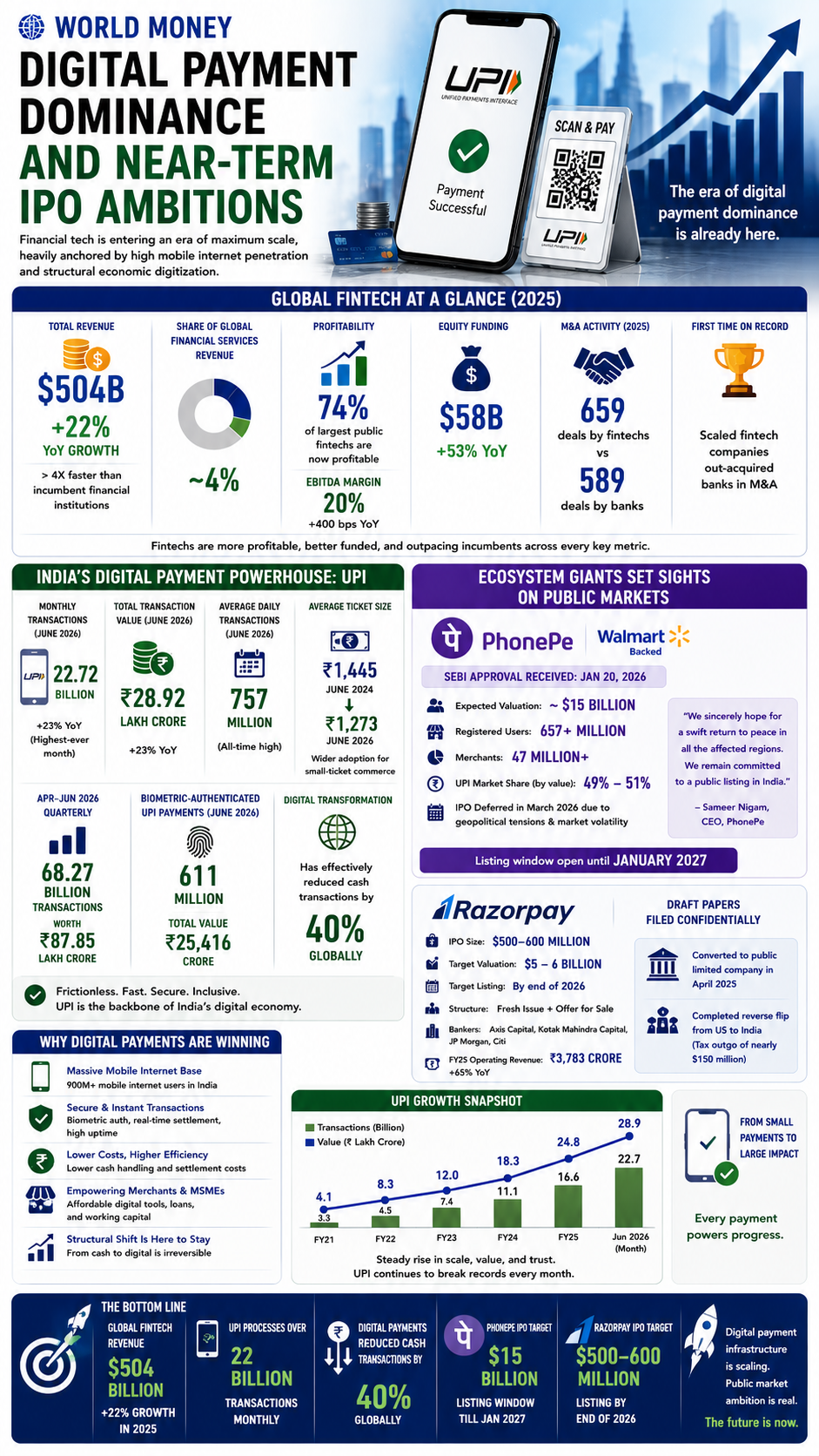
Ecosystem giants are now preparing for major public listings. PhonePe, the Walmart-backed fintech major commanding more than 45% of UPI transactions, received SEBI approval for its IPO on January 20, 2026, with the proposed offering expected to value the company at around $15 billion. However, in March 2026, the company temporarily deferred its listing plans amid ongoing geopolitical tensions and heightened volatility in global markets. "We sincerely hope for a swift return to peace in all the affected regions. We remain committed to a public listing in India," said Sameer Nigam, CEO of PhonePe. Under the current SEBI approval, the company has a window to list anytime until January 2027. PhonePe has over 657 million registered users and 47 million merchants, with a UPI market share by value of around 49% to 51%. Meanwhile, Razorpay has confidentially filed draft papers for an IPO expected to raise $500–600 million, targeting a stock market debut by the end of 2026. The Bengaluru-based fintech firm is seeking a valuation of $5–6 billion. The issue will comprise both a fresh issue and an offer for sale, with Axis Capital, Kotak Mahindra Capital, JP Morgan, and Citi appointed as bankers. Razorpay converted to a public limited company in April 2025 and completed its reverse flip from the US to India, a restructuring that involved a tax outgo of nearly $150 million. The company reported consolidated operating revenue of ₹3,783 crore in FY25, up 65% year-on-year.
The bottom line: Global fintech revenue has crossed $504 billion with 22% growth, while UPI processes over 22 billion monthly transactions in India. PhonePe's $15 billion IPO and Razorpay's $500–600 million listing signal the maturing of digital payment infrastructure into public market scale. The era of digital payment dominance and public market ambition is already here.

Vishal Sable
B.Tech AD @ shri balaji institute of technology and management
Engineering and tech journalist. I love exploring the impact of emerging technologies on global defense, sovereignty, and everyday life. Always looking for the real story behind the headlines.