Back to News
News AlertWorld Money
Agentic FinTech Revenue Hits $650B Amid "Deepfake" Security Siege
V
Author
Vishal Sable
Published
July 11, 2026
Reading Time
2 MIN READ
Spread the Word
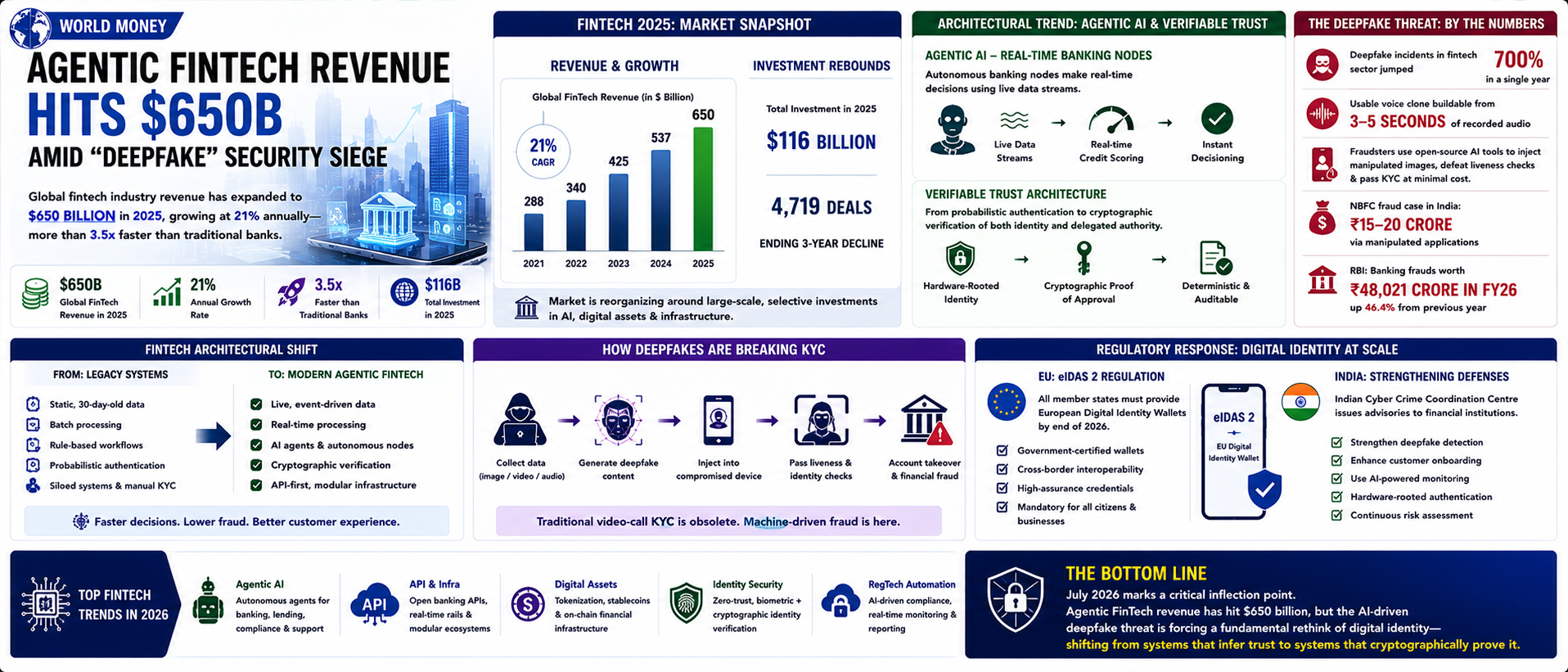
Financial technology is abandoning retail growth plays to focus heavily on modular API infrastructure, real-time liquidity, and advanced biometric compliance. A fresh 2026 global fintech software development trend report reveals that global fintech industry revenue has officially expanded to $650 billion in 2025, with the sector growing at 21% annually—more than 3.5 times faster than traditional banks . Total sector investment rebounded to $116 billion across 4,719 deals, ending a three-year decline as the market reorganized around large-scale, selective investments in AI and digital assets . The dominant architectural trend is Agentic AI—autonomous banking nodes that handle real-time credit scoring using live data streams rather than static 30-day-old history. The dominant architectural trend is the shift from probabilistic authentication to cryptographic verification of both identity and delegated authority, as financial institutions move toward hardware-rooted, deterministically auditable systems that can prove a specific person or authorized AI agent explicitly approved a specific action .
Daily consumer identity is under severe attack from high-quality AI video deepfakes, rendering basic video-call KYC checks completely obsolete. Fraudsters are exploiting open-source AI tools to inject manipulated images into compromised devices, defeat liveness verification, and pass identity checks at minimal cost . In one reported case in India, an NBFC suffered fraud worth ₹15-20 crore after manipulated applications passed verification and underwriting processes . Deepfake incidents in the fintech sector jumped 700% in a single year, with a usable voice clone now buildable from three to five seconds of recorded audio . The Reserve Bank of India reported banking frauds worth ₹48,021 crore in FY26, up 46.4% from the previous year . As a result, European and global banks are scrambling to integrate automated RegTech infrastructure and digital identity wallets to stop machine-driven fraud before late 2026 enforcement deadlines. The European Union's eIDAS 2 regulation requires all member states to provide European Digital Identity Wallets by the end of 2026, mandating government-certified, cross-border wallets with high-assurance credentials . The Indian Cyber Crime Coordination Centre has issued advisories warning financial institutions to strengthen deepfake detection mechanisms and enhance customer onboarding systems . July 2026 marks a critical inflection point: Agentic FinTech revenue has hit $650 billion, but the AI-driven deepfake threat is forcing a fundamental rethink of digital identity—shifting from systems that infer trust to systems that cryptographically prove it.

Vishal Sable
B.Tech AD @ shri balaji institute of technology and management
Engineering and tech journalist. I love exploring the impact of emerging technologies on global defense, sovereignty, and everyday life. Always looking for the real story behind the headlines.