Back to News
News AlertWorld Money
The AI Dealmaking Boom and India's Final Data Privacy Countdown
V
Author
Vishal Sable
Published
July 10, 2026
Reading Time
4 MIN READ
Spread the Word
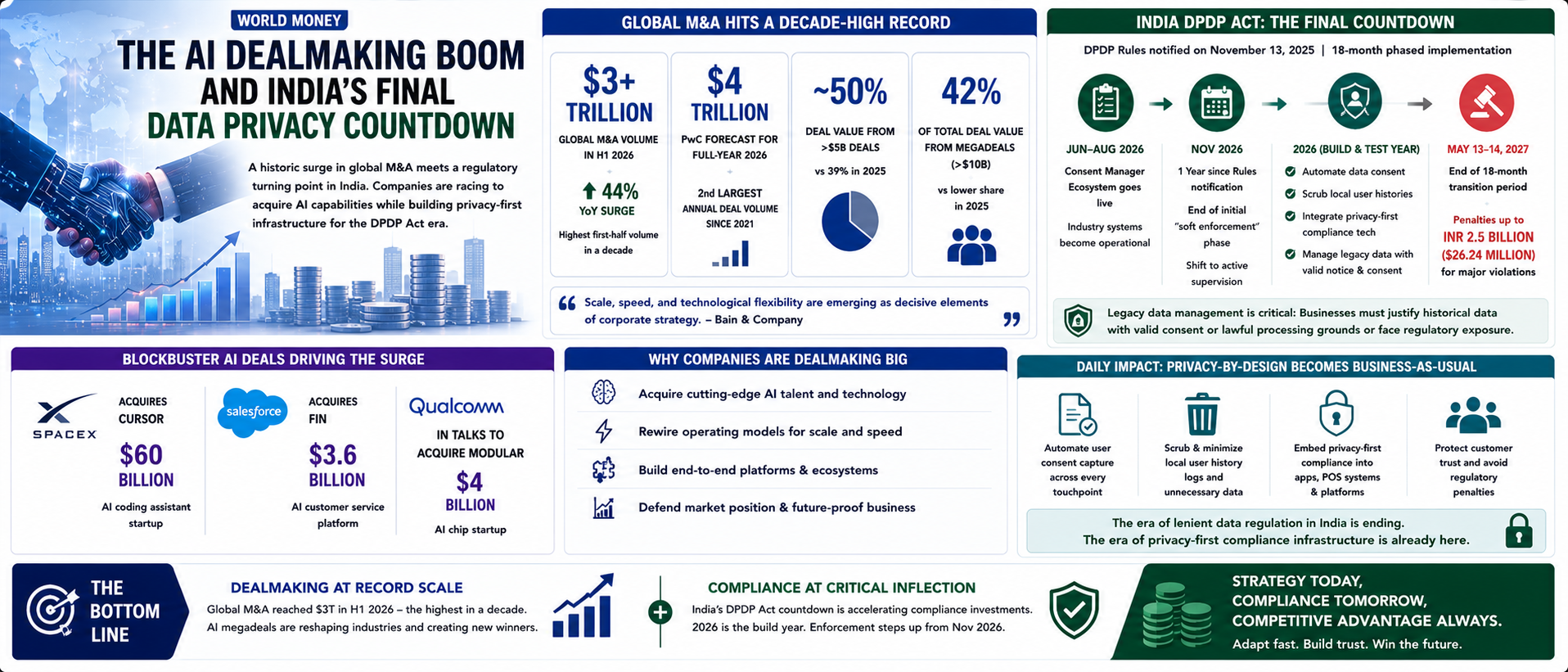
Fintech and corporate finance are responding aggressively to massive new structural and regulatory frameworks. Fresh mid-year financial market data reveals that an intense AI economy dealmaking frenzy has triggered a historic global surge. Corporate funding and structural acquisitions hitting the market represent the highest volume spent on global deal-making in a six-month period in an entire decade.
The Latest News
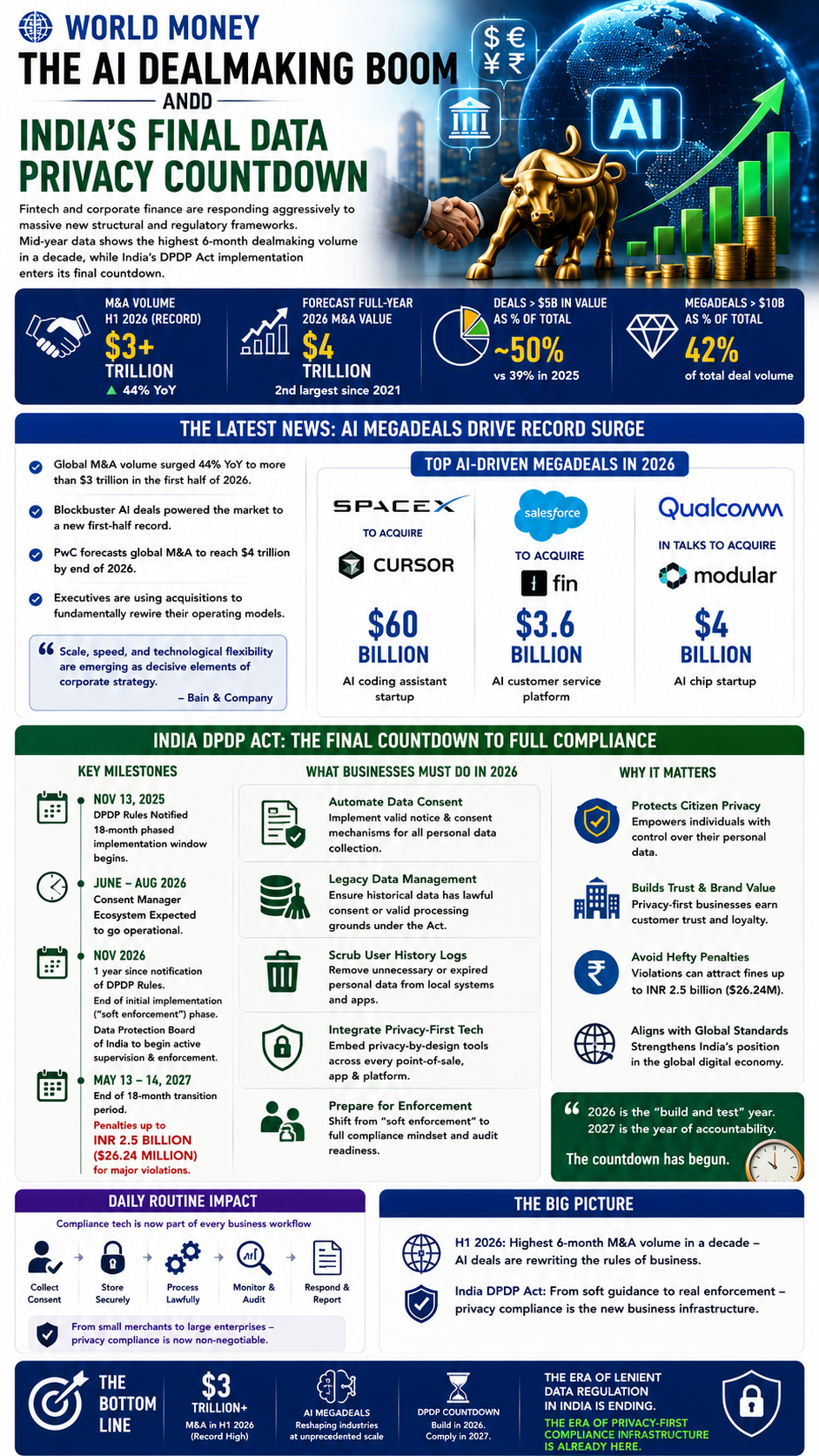
Global M&A volume surged 44% year-over-year to more than $3 trillion in the first half of 2026, setting a new first-half record as blockbuster AI deals powered the market. PwC forecasts that global M&A transaction value is on track to reach $4 trillion by the end of 2026, marking the second-largest annual deal volume since 2021. So far this year, deals worth more than $5 billion have accounted for nearly half of global transaction value, compared with 39% in 2025, with megadeals over $10 billion accounting for 42% of total dealmaking volume. Among the largest transactions, SpaceX entered a formal agreement to acquire AI startup Cursor for $60 billion, Salesforce is acquiring AI customer service firm Fin for $3.6 billion, and Qualcomm is in negotiations to acquire Modular, an AI chip startup valued at $4 billion. The rise of AI megadeals reflects a structural transformation where executives are using acquisitions not just for incremental growth but to fundamentally rewire their operating models. Bain & Company noted that "scale, speed, and technological flexibility are emerging as decisive elements of corporate strategy".
Daily Routine Impact
Compliance technology is seeing an immediate spike in daily business integration. In regions like India, companies are racing against the clock as the final countdown to the Digital Personal Data Protection (DPDP) Act deadline begins. The DPDP Rules were notified on November 13, 2025, establishing an 18-month phased implementation window. For businesses, 2026 is the "build and test" year leading into full regulatory accountability in 2027. The consent manager ecosystem is expected to become operational between June and August 2026. November 2026 marks one year since the notification of the DPDP Rules and is widely expected to signify the end of the initial implementation or "soft enforcement" phase, with the Data Protection Board of India expected to transition toward more active regulatory supervision and enforcement. A key compliance focus during this period will be legacy data management, with businesses expected to ensure that personal data collected prior to the DPDP framework is supported by valid notice and consent mechanisms consistent with the Act and Rules. Organizations unable to demonstrate lawful consent or valid processing grounds for historical datasets may face increased regulatory exposure. For small merchants and major corporations alike, this means automating data consent, scrubbing local user history logs, and integrating native privacy-first compliance tech into every point-of-sale app. While "soft enforcement" through guidance and warnings is expected through 2026, May 13-14, 2027 marks the end of the 18-month transition period, after which the Data Protection Board can impose penalties up to INR 2.5 billion ($26.24 million) for major violations.
The Bottom Line
July 2026 marks a historic convergence of dealmaking scale and regulatory urgency. Global M&A has surged to $3 trillion in six months—the highest first-half volume in a decade—driven by AI-driven acquisitions that are fundamentally rewiring corporate operating models. Meanwhile, India's DPDP Act countdown has triggered an immediate compliance technology spike, with businesses across the spectrum racing to automate data consent, scrub user histories, and integrate privacy-first infrastructure before the November 2026 enforcement transition. The era of lenient data regulation in India is ending. The era of privacy-first compliance infrastructure is already here.

Vishal Sable
B.Tech AD @ shri balaji institute of technology and management
Engineering and tech journalist. I love exploring the impact of emerging technologies on global defense, sovereignty, and everyday life. Always looking for the real story behind the headlines.