LATEST NEWS
ByteDance Just Borrowed $30 Billion It Didn't Need To. That's the Real Signal.
September 8, 2026 4M
Back to News
News AlertWorld AI Tech
Autonomous Aviation Milestones & Model Governance
V
Author
Vishal Sable
Published
August 8, 2026
Reading Time
7 MIN READ
Spread the Word
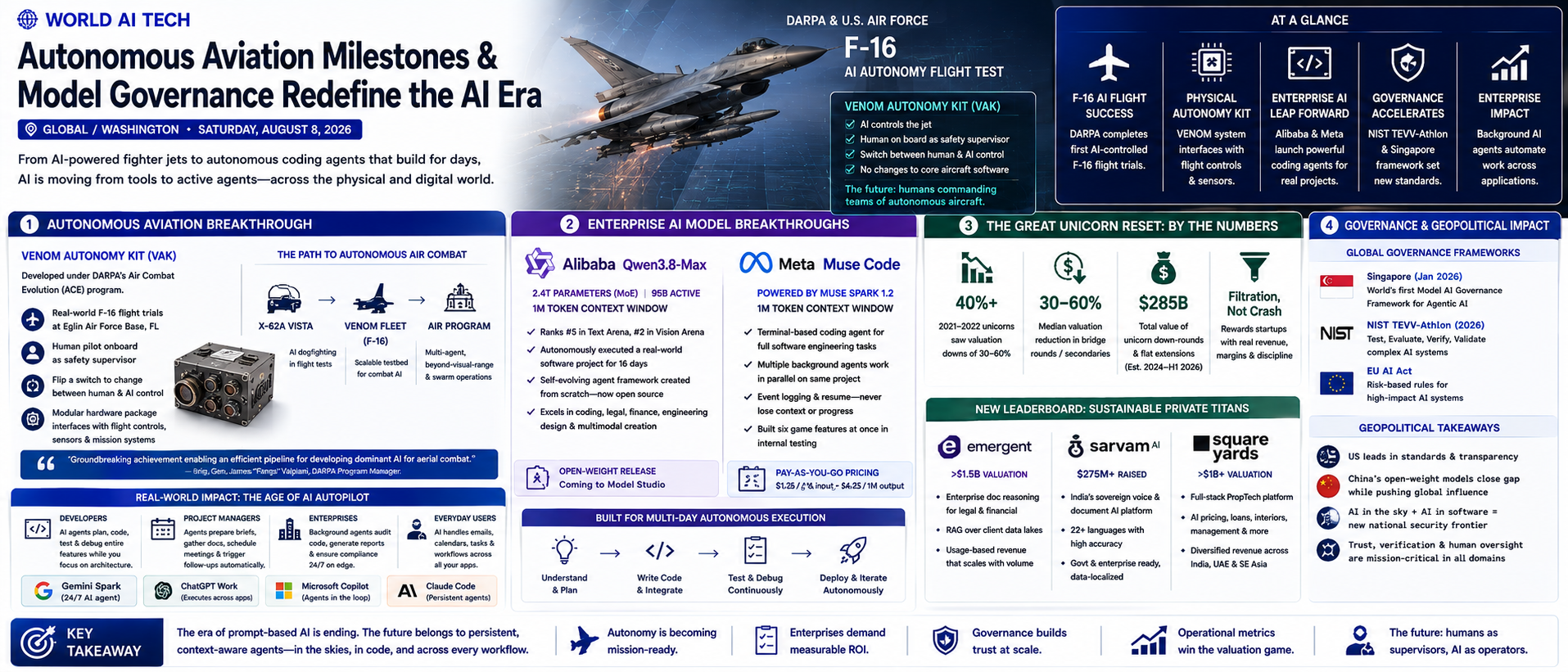
The artificial intelligence frontier has moved decisively from the server rack to the sky and the developer terminal, as two parallel tracks of innovation—autonomous combat aviation and frontier enterprise models—collide to redefine what AI can achieve without direct human oversight. DARPA and the U.S. Air Force have successfully completed real-world flight trials of an F-16 fighter jet fully controlled by an AI-powered autonomy kit, marking a monumental leap from experimental drones to standard fighter platforms. Simultaneously, Alibaba and Meta have unleashed their most ambitious enterprise AI models to date, targeting the lucrative software development market with claims of autonomous, multi-day project completion and persistent background agents that never lose context. Together, these milestones signal a broader shift: AI is no longer a tool that responds to prompts but an active, persistent agent operating across physical and digital domains, with human operators transitioning from drivers to supervisors.
The centerpiece of the aviation breakthrough is the VENOM Autonomy Kit (VAK), a complex physical hardware package—not merely software—that interfaces directly with the F-16's flight controls, sensors, and mission systems without altering the jet's core software. Developed under DARPA's Air Combat Evolution (ACE) program and tested at Eglin Air Force Base in Florida, the system allows a pilot to switch between traditional human control and AI control with the flip of a switch, keeping a human onboard at all times as a safety supervisor. The tests build on earlier ACE flights using the X-62A VISTA experimental aircraft, which demonstrated that an AI agent could autonomously fly a fighter during air-to-air dogfighting. VENOM takes that work further by adapting standard F-16s—workhorse fighters of the US fleet—into autonomous-capable test platforms, creating infrastructure for faster and more scalable development of combat AI across the joint force. Brig. Gen. James "Fangs" Valpiani, DARPA program manager, described the achievement as "groundbreaking," noting that the modifications "enable an efficient pipeline for developing dominant AI for aerial combat". The VENOM fleet will now become a core test platform for DARPA's Artificial Intelligence Reinforcements (AIR) program, which aims to evaluate multiple AI agents in live-flight scenarios, including beyond-visual-range and multi-aircraft operations. The ultimate vision: human pilots commanding and coordinating teams of autonomous, uncrewed aircraft in the fog and friction of modern warfare.
On the enterprise software front, the model wars have intensified with two major launches targeting the coding and development market. Alibaba unveiled Qwen3.8-Max, its largest and most powerful AI model to date, boasting a 2.4-trillion-parameter mixture-of-experts architecture that activates only about 95 billion parameters during inference for improved efficiency. The model supports a context window of up to 1 million tokens and ranks fifth in Text Arena and second in Vision Arena, while demonstrating exceptional proficiency in autonomous coding and long-horizon execution. In internal testing, Alibaba claims Qwen3.8-Max autonomously executed a real-world software engineering project over a 16-day period, tasked with creating a self-evolving agent framework from scratch without human intervention. The model established an engineering loop that synthesized user feedback, community best practices, and self-test data, producing an open-source framework now available on GitHub. Beyond coding, Alibaba positions the model for legal compliance, financial analysis, engineering design, and multimodal content creation, with open-weight versions scheduled for release through Alibaba Cloud's Model Studio. Forrester analyst Charlie Dai noted that the launch signals Alibaba is "narrowing the gap" with proprietary leaders, but added that "the larger story is the rapid maturation of open-weight models" as enterprises seek credible alternatives for software engineering, domain customization, and cost-sensitive deployments.
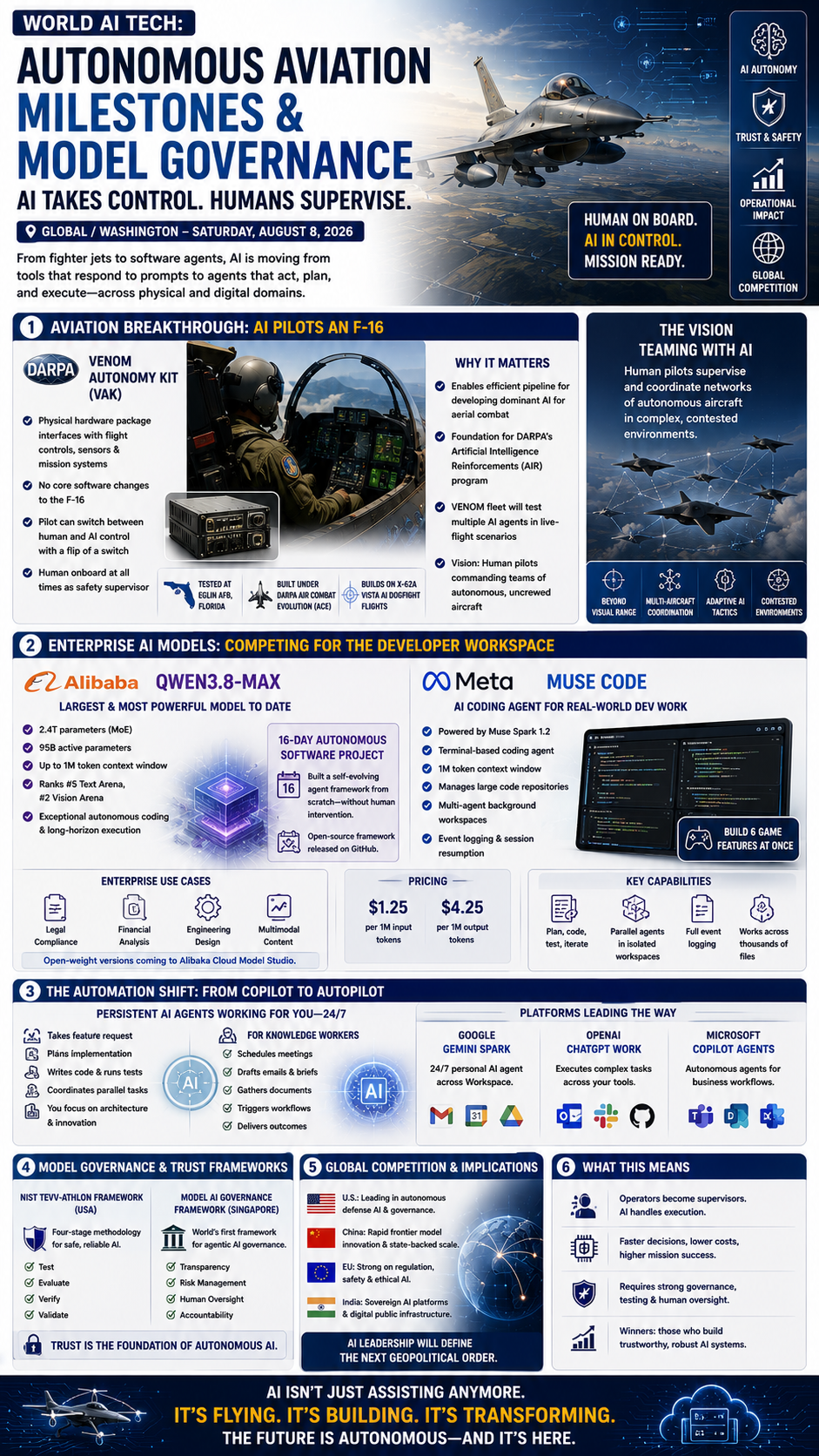
Meta, not to be outdone, launched Muse Code, its first AI coding agent, powered by the Muse Spark 1.2 model and positioned as a lower-cost alternative to Anthropic's Claude Code and OpenAI's Codex. Available in public beta for macOS and Linux, Muse Code is a terminal-based agent designed to handle complete software engineering tasks across large code repositories—planning changes, writing code, testing results, and managing long-running development projects. One of its standout features is the ability to launch multiple background AI agents that work on different parts of the same project simultaneously, each operating in its own isolated workspace. Meta said internal testing included building six separate game features at once. The agent also features an event logging system that records every model request, tool action, and code edit; if a session is interrupted, Muse Code can resume from the recorded progress without requiring users to start over. The Muse Spark 1.2 model can process up to 1 million tokens of context, allowing it to analyze thousands of files in a single session. Pricing follows a pay-as-you-go model at $1.25 per million input tokens and $4.25 per million output tokens. Meta CEO Mark Zuckerberg emphasized that Muse Code runs "specialized background agents that stay active your whole session, so they build up context over time instead of starting from scratch on every task".
For the average knowledge worker and developer, these advancements translate into a fundamental shift in daily workflow. AI is migrating from manual text prompts to persistent background workspace agents that handle calendar coordination, code auditing, and automated administrative tasks directly on edge hardware. Enterprise platforms now deploy vetted AI agents that operate silently in the background—scheduling meetings across time zones, auditing code repositories for security vulnerabilities, and generating compliance reports without requiring explicit user initiation. Google's Gemini Spark, introduced at I/O 2026, operates as a 24/7 personal AI agent that sends emails, adds calendar events, and completes tasks across Workspace apps. OpenAI's ChatGPT Work executes complex, multi-step tasks across email, calendars, code repositories, and messaging apps. For a software developer, this means an AI agent can now take a feature request, plan the implementation, write the code, run tests, and coordinate with sub-agents on parallel tasks—all while the developer focuses on higher-level architecture decisions. For a project manager, background agents can draft meeting briefs, gather documents from connected tools, and trigger follow-up workflows automatically based on calendar events. The era of the AI "co-pilot" is giving way to the AI "autopilot"—persistent, context-aware, and increasingly autonomous.
Geopolitically, the convergence of autonomous aviation and enterprise AI governance is prompting regulators and militaries to accelerate frameworks for trusted deployment. Singapore launched the world's first Model AI Governance Framework for Agentic AI in January 2026, providing comprehensive guidance for enterprises to deploy autonomous AI agents responsibly. The US NIST has simultaneously rolled out the TEVV-Athlon Framework under its AI Risk Management Framework, offering a four-stage methodology to test, evaluate, verify, and validate complex AI systems before enterprise deployment. Meanwhile, China's Alibaba is aggressively competing with US frontier models, with Qwen3.8-Max reportedly outperforming OpenAI's GPT-4.1 and Google's Gemini 2.5 Pro on several benchmarks while approaching Anthropic's Claude Opus 4.1 in coding-related evaluations. The VENOM tests add another layer: as AI gains control of fighter jets, the trust and verification mechanisms for autonomous systems become not just a business concern but a matter of national security. The AIR program's focus on "trustworthy autonomous air combat capabilities" underscores that the same governance questions—performance validation, error handling, human oversight—apply whether the AI is writing code or flying at supersonic speeds. As Lt. Col. Patrick "Dice" Highland, incoming AIR program manager, put it: "These flights give us an early glimpse of how AI agents may begin actively transforming air warfare". The same could be said for software development, calendar management, and every other domain where background agents are now taking the controls.

Vishal Sable
B.Tech AD @ shri balaji institute of technology and management
Engineering and tech journalist. I love exploring the impact of emerging technologies on global defense, sovereignty, and everyday life. Always looking for the real story behind the headlines.