LATEST NEWS
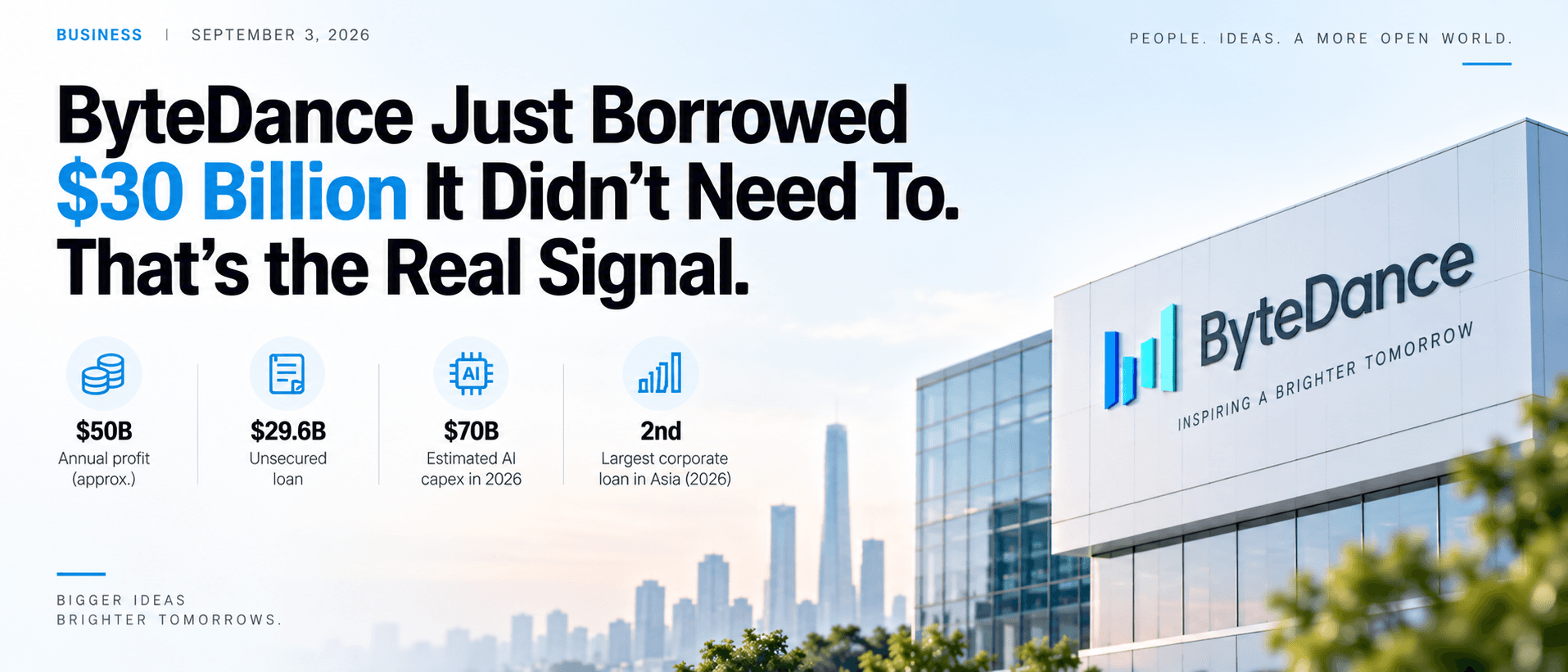
ByteDance Just Borrowed $30 Billion It Didn't Need To. That's the Real Signal.
September 8, 2026 4M
Back to News
News AlertWorld AI Tech
Bill Gates Wants to Protect Jobs From AI. Meta Just Built an AI That Codes for Hours Without You.
V
Author
Vishal Sable
Published
August 26, 2026
Reading Time
6 MIN READ
Spread the Word
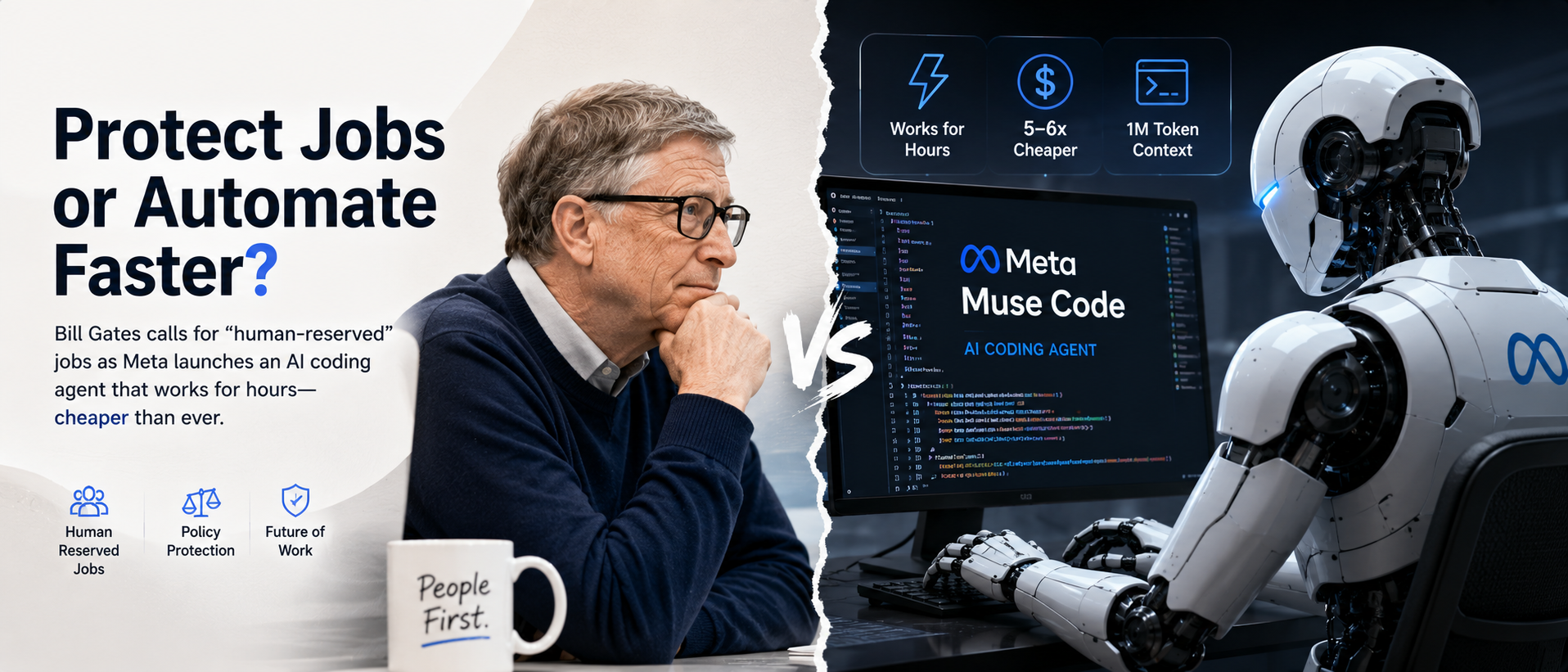
Bill Gates is calling for "human-reserved" jobs to shield workers from AI. Days later, Meta shipped a coding agent that codes better and cheaper than ever. Here's why those two headlines are actually the same story.
The contradiction nobody's talking about
The contradiction nobody's talking about
This week, two AI headlines landed almost on top of each other, and most coverage treated them as unrelated. They're not.
Bill Gates published a new essay arguing that society should carve out "human-reserved" jobs — work that stays with people on purpose, even when AI could technically do it. Around the same time, Meta released Muse Code, a coding agent paired with a new model, Muse Spark 1.2, built to run long, complex software engineering tasks with minimal supervision — and to do it cheaper than Claude or OpenAI's coding tools.
One story is about slowing AI down in the workplace. The other is about speeding it up in one of the jobs Gates himself has called relatively safe. That tension is worth sitting with.
What Gates is actually proposing
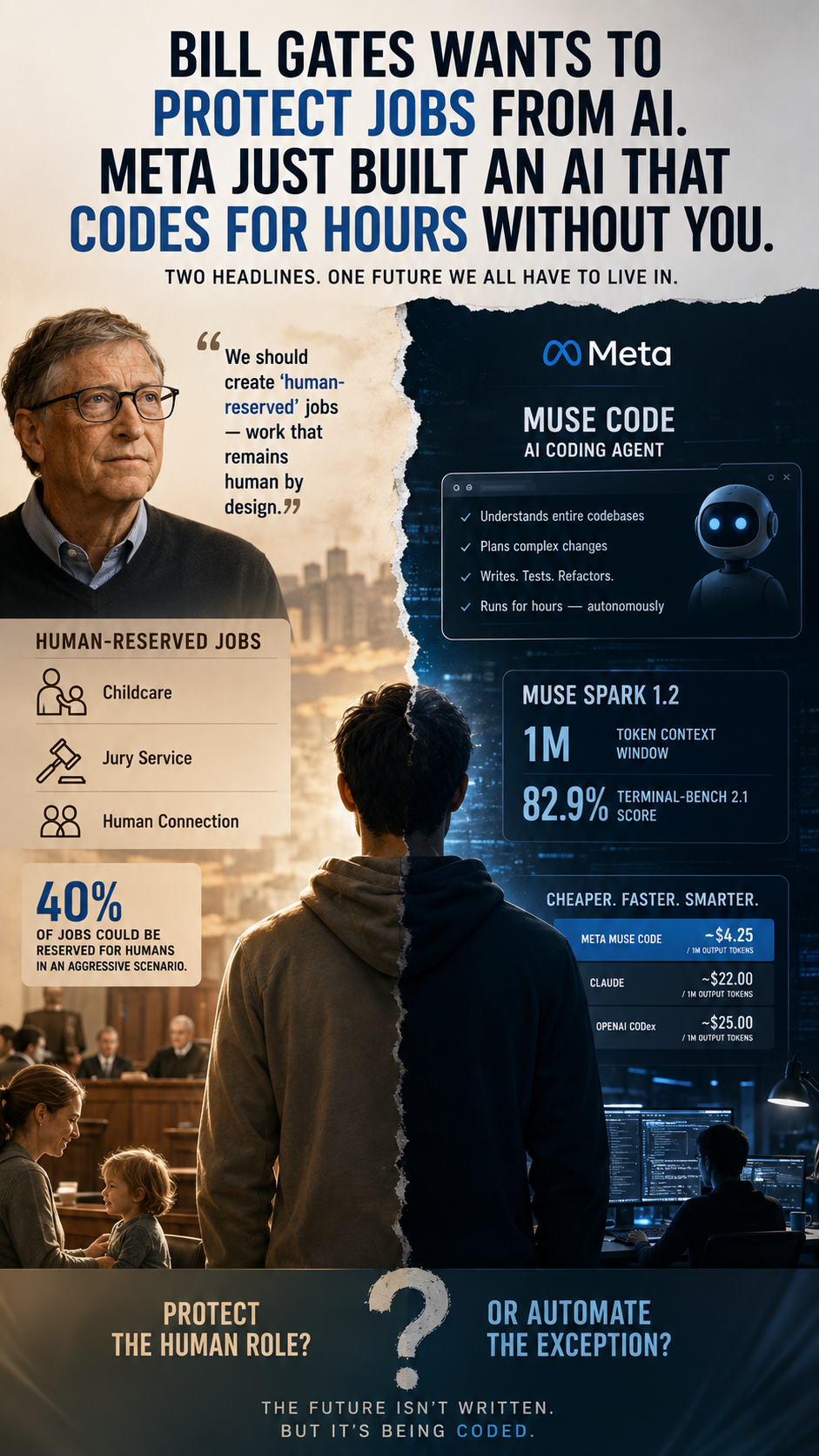
Gates's "Human Reserved" concept borrows its logic from nature reserves: land we could develop but deliberately don't, because what we'd lose isn't worth what we'd gain. Applied to labor, the idea is that certain occupations — he's pointed to childcare and jury service as clear examples — would stay staffed by humans by policy, not by market accident, even once AI is capable of doing the work.
He's floated two versions of this. In the first, a job is permanently reserved for humans, full stop. In the second, AI is allowed to assist, but the human role itself can't be automated away entirely — a doctor using AI diagnostics is still a doctor, not a supervisor of software.
The numbers he's attached to this are what make it more than a thought experiment. Gates has said that in an aggressive version of the policy, as much as 40% of jobs could initially be reserved for human workers. He's also linked the idea to a much bigger proposal: taxing AI compute and robot labor directly, rather than relying on corporate tax alone, to fund support for workers displaced by automation. By his own description, that would mean rewriting the tax system more dramatically than anything in his lifetime — a sign of how seriously he's treating the disruption ahead.
Notably, Gates has previously named coding as one of the fields likely to hold up longest against AI displacement, alongside energy and biology — precisely because those areas still need humans for debugging, judgment calls, and crisis response.
Bill Gates on AI, Jobs, and the Future of Work
Bill Gates on AI, Jobs, and the Future of Work
Meta's answer: an AI that codes for hours on its own
Which makes Meta's timing pointed. On August 5, Meta Superintelligence Labs shipped Muse Code, a terminal-based coding agent, alongside Muse Spark 1.2, the model built specifically to power it. The headline spec is a 1-million-token context window — enough for a coding agent to hold entire codebases, dependency graphs, and legacy files in memory across a single long-running session, instead of losing track of earlier work.
Under the hood, Muse Spark 1.2 was co-trained with Muse Code itself, and Meta says that pairing sharpened the model's tool use and multi-step planning. The performance gains are concrete: Meta reports the model scoring 82.9% on Terminal-Bench 2.1, up from 76.2% for the previous version, alongside similar jumps on other coding benchmarks. Muse Code runs multiple agents in parallel on a single task — some implementing, others reviewing in the background — closer to a small engineering team than a single autocomplete tool.
Pricing is the other headline. Meta's standard tier runs $1.25 per million input tokens and $4.25 per million output tokens — undercutting Claude and OpenAI's flagship coding tools by roughly 5-6x on output cost. Meta also offers a steeply discounted "contributor" tier at a fraction of that price, in exchange for letting Meta use submitted prompts and code to train future models — a trade-off regulated teams and client-facing shops will likely want to avoid.
Why this matters more together than apart
Put side by side, the picture gets uncomfortable. Gates is telling policymakers that some jobs deserve deliberate protection from automation — and naming coding as one of the fields that should hold up. Meta, in the same news cycle, is racing to make autonomous coding agents faster, more capable, and dramatically cheaper than the competition.
That's not necessarily a contradiction — Gates has consistently argued AI will augment rather than eliminate skilled technical work, not replace it outright. But it does raise the question his own essay poses: who decides which jobs actually get protected, and what happens to that assumption once the tools improve fast enough that "augmentation" starts looking a lot like automation with extra steps?
Everyday reality is already shifting
Away from the policy debate, the tools are already reshaping daily workflows. Software teams are increasingly running autonomous coding agents overnight — kicking off a task before leaving the office and reviewing finished, tested code the next morning. Creative platforms like Canva and Adobe have folded generative AI directly into their search bars and design surfaces, so asset creation happens in the same breath as the search for it, rather than as a separate step.
None of this is speculative anymore. It's the baseline most technical and creative workers are now operating from.
The question worth arguing about
If coding is one of the jobs Gates thinks is safest from AI, why is the industry sprinting to build coding agents that work unsupervised for hours at a time? And if 40% of jobs really could be "human-reserved" by policy, what stops the definition of "human-reserved" from shrinking every time a model like Muse Spark ships a better benchmark score?
Which comes first: a human-reserved jobs law, or a coding agent good enough to make the debate moot?
----
*Sources: Axios, MIT Technology Review, Forbes, Meta AI, Pulse2, Unite.AI, OpenRouter, Toolbit.*

Vishal Sable
B.Tech AD @ shri balaji institute of technology and management
Engineering and tech journalist. I love exploring the impact of emerging technologies on global defense, sovereignty, and everyday life. Always looking for the real story behind the headlines.