LATEST NEWS
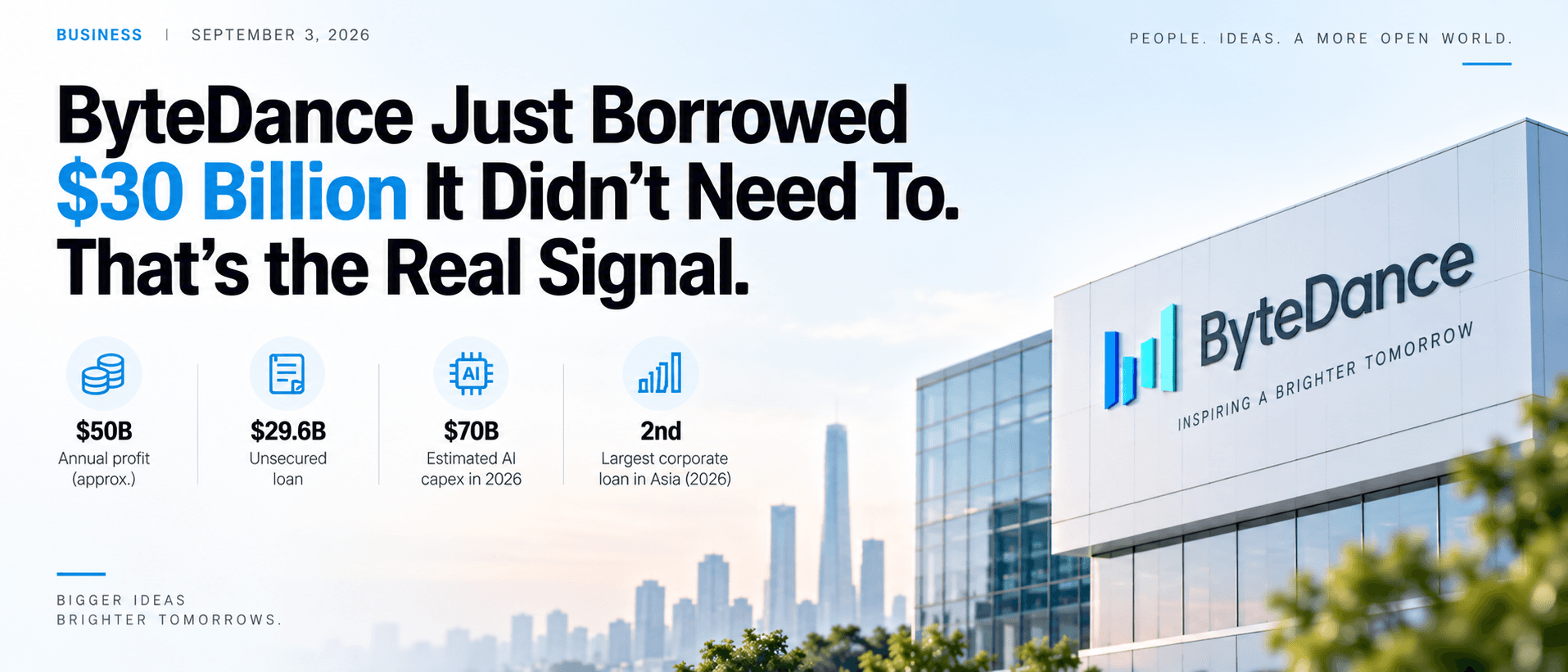
ByteDance Just Borrowed $30 Billion It Didn't Need To. That's the Real Signal.
September 8, 2026 4M
Back to News
News AlertWorld AI Tech
Cognizant Drops Dedicated EMEA AI Unit; KAIST Unveils Child-Like Learning Models
V
Author
Vishal Sable
Published
July 28, 2026
Reading Time
3 MIN READ
Spread the Word
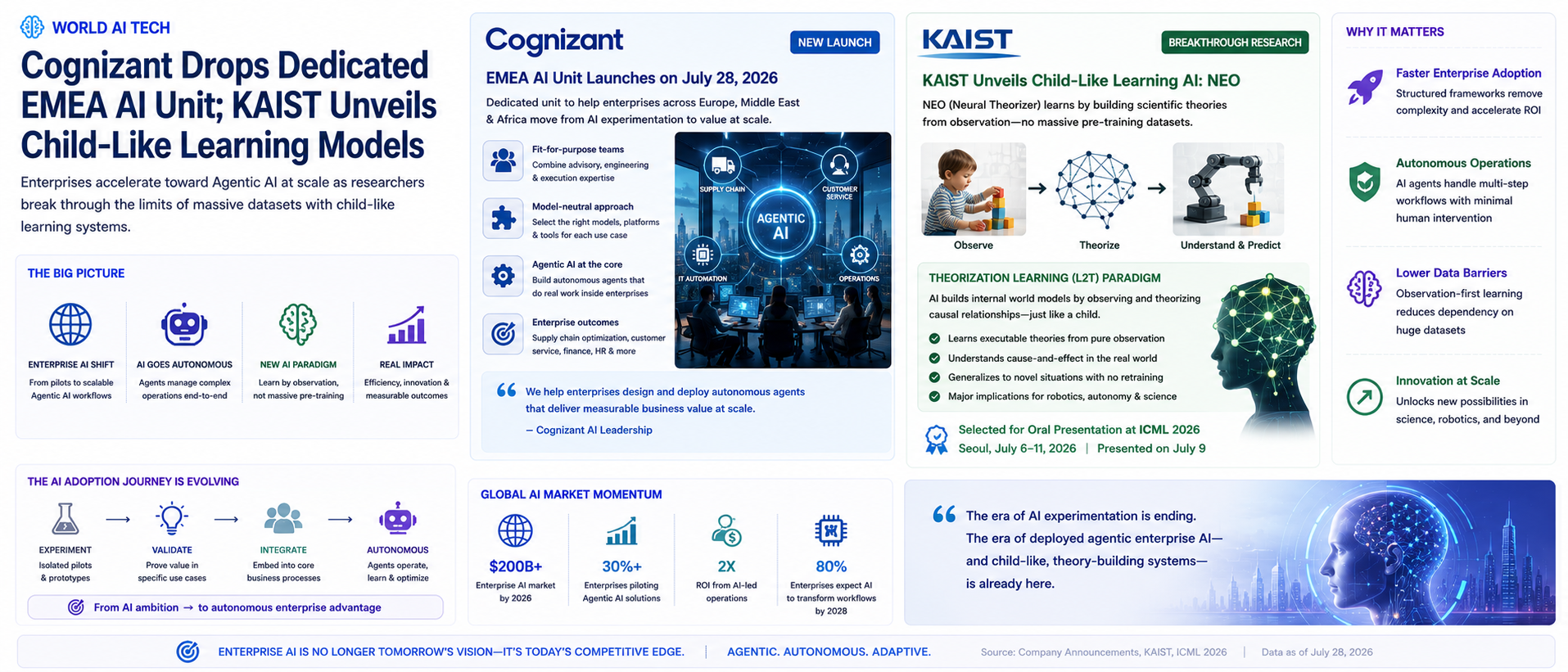
Global tech services giant Cognizant launched its dedicated EMEA AI Unit on July 28, an initiative designed to transition European and Middle Eastern enterprises from basic AI experimentation to scalable Agentic AI workflows. The framework uses a model-neutral delivery structure to build autonomous agents that manage complex corporate logistics directly inside client operations. On the research front, scientists at KAIST developed a breakthrough AI system that learns by building scientific theories from pure observation—mimicking the cognitive development of children to solve novel physical problems without requiring massive pre-training datasets.
The Latest News
Cognizant's EMEA AI Unit is a dedicated organization created to help enterprises across Europe, the Middle East, and Africa move from AI ambition to enterprise value. The unit will provide fit-for-purpose teams that can help clients build the bridge from AI pilots to scalable outcomes. It reflects Cognizant's AI Builder approach by combining people, platforms, and business context to build AI systems that do real work inside the enterprise. As a neutral AI Builder, the unit integrates advisory, engineering, and execution capabilities to help clients design and deploy autonomous agents tailored to their specific operational needs. The initiative comes as enterprises across the EMEA region are increasingly looking to move beyond isolated AI experiments and embed autonomous intelligence directly into core business processes—from supply chain optimization to customer service automation.
Research Breakthrough: KAIST's NEO Model
Simultaneously, a research team led by Professor Sungjin Ahn at KAIST's School of Computing has developed NEO (Neural Theorizer), an AI model that learns executable theories of how the world works from observation alone, rather than simply predicting what happens next. The team found a solution in how humans learn: long before children acquire language, they build their own internal theories of how the world works. This new learning paradigm, called "Theorization Learning" (L2T), enables AI to independently develop internal models of its environment through pure observation, without relying on massive pre-training datasets.
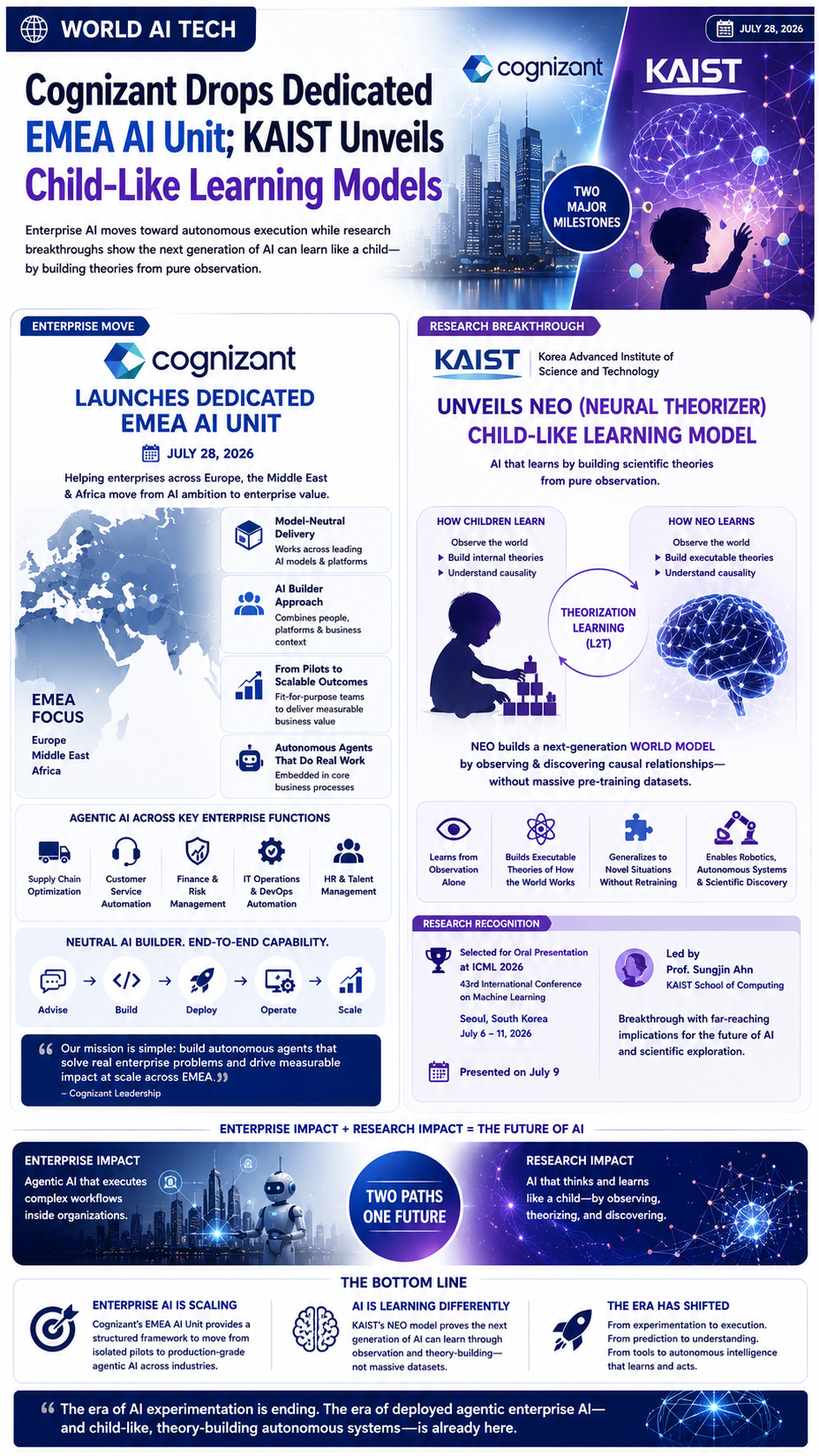
NEO represents a fundamental departure from conventional AI approaches that require enormous amounts of labeled data to learn patterns. Instead, it builds a next-generation world model—an internal representation that helps AI understand and predict the world—by observing and theorizing about causal relationships in its environment. The research was selected for an oral presentation at the 43rd International Conference on Machine Learning (ICML 2026), held in Seoul from July 6 to 11, and was presented on July 9. The breakthrough has significant implications for robotics, autonomous systems, and AI-assisted scientific discovery, as it allows AI to generalize to novel situations without requiring extensive retraining.
The Bottom Line
July 2026 confirms that enterprise AI is moving decisively toward agentic, autonomous systems that do real work inside organizations. Cognizant's EMEA AI Unit, launched on July 28, provides a structured framework for European and Middle Eastern enterprises to scale AI from isolated pilots to production-grade agentic workflows. Simultaneously, KAIST's NEO model demonstrates that the next generation of AI may not require massive datasets at all—learning instead through observation and theory-building, much like a child discovering how the world works. The era of AI experimentation is ending. The era of deployed agentic enterprise AI—and child-like, theory-building autonomous systems—is already here.

Vishal Sable
B.Tech AD @ shri balaji institute of technology and management
Engineering and tech journalist. I love exploring the impact of emerging technologies on global defense, sovereignty, and everyday life. Always looking for the real story behind the headlines.