LATEST NEWS
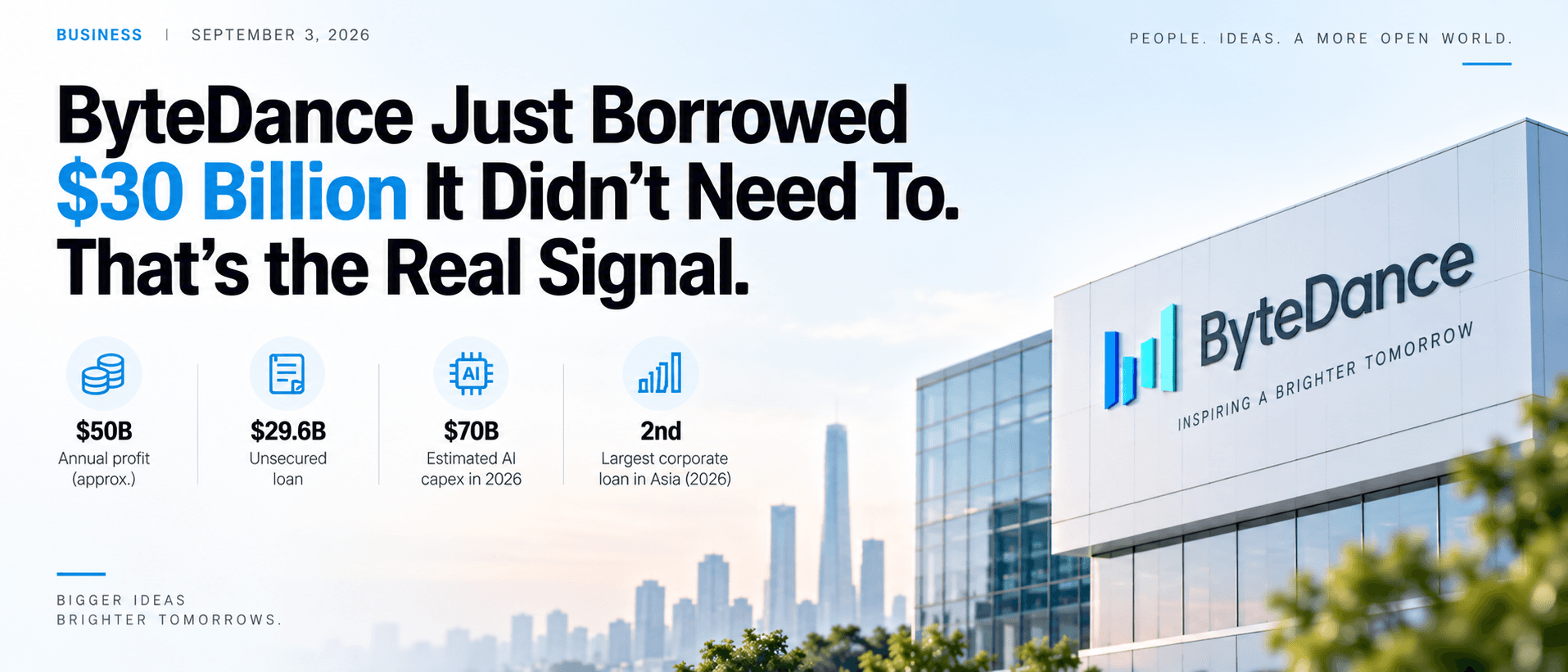
ByteDance Just Borrowed $30 Billion It Didn't Need To. That's the Real Signal.
September 8, 2026 4M
Back to News
News AlertWorld AI Tech
Edge AI Shifts into Micro-Desktops and On-Device Personal Systems
V
Author
Vishal Sable
Published
August 22, 2026
Reading Time
5 MIN READ
Spread the Word
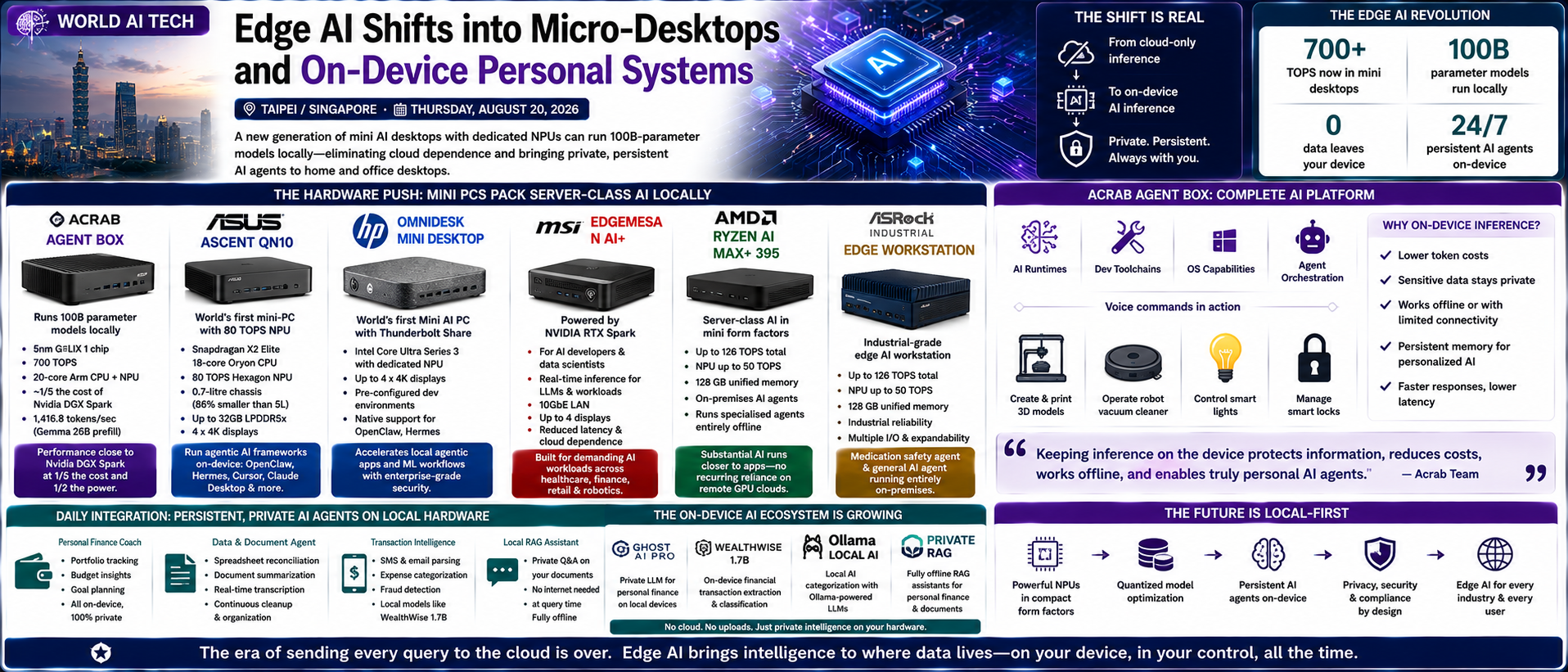
The artificial intelligence industry is undergoing a fundamental hardware realignment as the market pivots decisively away from cloud-only inference toward compact, on-device systems. A new generation of mini AI desktop PCs, powered by dedicated neural processing units (NPUs), is now capable of running quantized reasoning models locally—eliminating the need to transmit proprietary data to third-party servers and bringing persistent, privacy-preserving AI agents directly to home and office desktops.
THE HARDWARE PUSH: Mini PCs Pack Server-Class AI Locally
The shift is being driven by an unprecedented wave of compact hardware from major manufacturers and startups alike, each vying to deliver enterprise-grade AI performance in form factors small enough to sit discreetly on a desk. Singapore-based startup Acrab has unveiled the Agent Box, a mini PC built to run 100 billion parameter language models entirely on local hardware. Powered by a proprietary 5nm G≡LIX 1 chip that delivers 700 TOPS of processing power, the system combines a 20-core Arm CPU with a multicore NPU tuned specifically for large language model inference. Acrab claims the system delivers performance close to Nvidia's $5,000 DGX Spark while cutting costs to roughly one-fifth and halving power consumption. In internal testing, the company recorded a prefill rate of 1,416.8 tokens per second under a Gemma 26B configuration—a claimed 7.5 times improvement over Apple's Mac Mini M4 Pro.
At Computex 2026, Asus unveiled the Ascent QN10, the world's first mini-PC with an 80 TOPS NPU, powered by Qualcomm's Snapdragon X2 Elite platform. The device packs an 18-core Oryon CPU and an 80 TOPS Hexagon NPU into a 0.7-litre chassis that is 86% smaller than a standard 5L mini-PC. The QN10 can run agentic AI frameworks—including OpenClaw, Hermes, Cursor, and Claude Desktop—directly on-device, handling multi-step tasks like drafting emails or summarising documents without a round-trip to the cloud. Memory goes up to 32GB LPDDR5x, and the system can push four 4K displays simultaneously.
HP has also entered the fray with the OmniDesk Mini Desktop PC, launching in August 2026 as the world's first Mini AI PC to feature integrated Thunderbolt Share technology. Powered by Intel Core Ultra Series 3 processors with a dedicated NPU, the mini workstation supports up to four 4K displays and is designed to accelerate local agentic applications and machine learning workflows. HP is pairing its new devices with pre-configured developer environments and out-of-the-box support for popular open-source agent frameworks like OpenClaw and Hermes.
MSI announced the EdgeMesa N AI+ mini PC at COMPUTEX 2026, powered by NVIDIA's RTX Spark platform. Designed for AI developers and data scientists, the system handles demanding workloads such as large language models and real-time inference while enabling local AI processing that reduces latency, enhances data privacy, and minimizes reliance on cloud infrastructure. The system features a 10GbE LAN for ultra-fast data transfer and supports up to four displays.
AMD has also made significant inroads, with its Ryzen AI Max+ 395 processor bringing server-class AI capabilities to mini form factors. Multiple manufacturers are now showcasing mini-PCs and edge workstations with on-premises focus, including an ASRock Industrial workstation with up to 126 TOPS and 128 GB of unified memory. The integrated NPU alone delivers up to 50 TOPS, enabling a substantial portion of typical AI tasks to run closer to the application without recurring reliance on remote GPU clouds. Demonstrations have shown specialised AI agents—including a medication safety agent and a general-purpose AI agent—running entirely on-premises.
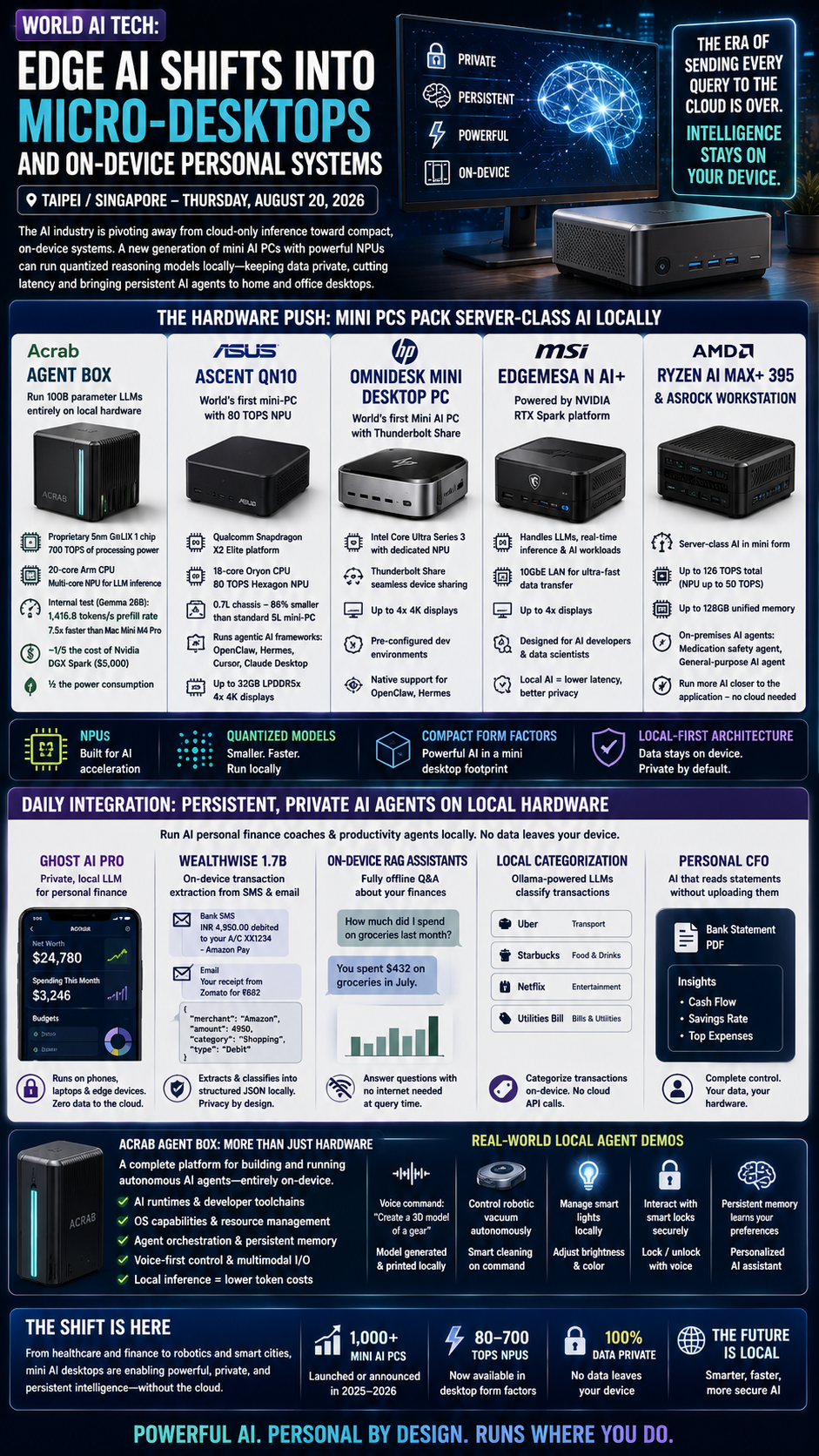
DAILY INTEGRATION: Persistent, Private AI Agents on Local Hardware
For everyday users and enterprise workers, this hardware shift translates into a fundamental change in how AI is accessed and deployed. Instead of sending proprietary files, financial records, or sensitive business data to third-party cloud servers, users can now run persistent, on-device AI personal finance coaches and background productivity agents locally on home and office computers. These local models automatically handle spreadsheet reconciliation, real-time audio transcription, and continuous data cleanup without any data ever leaving the device.
The ecosystem for on-device personal finance AI is already emerging. Compact, quantized language models like Ghost AI Pro are engineered to run privately on consumer hardware—phones, laptops, and edge devices—without sending a single token to the cloud. The model powers private, local AI features inside dedicated apps where prompts, wallet context, and financial data never leave the user's device. Similarly, WealthWise 1.7B is a compact, on-device model that extracts and classifies financial transactions from SMS and email into structured JSON, fine-tuned specifically for local-first personal-finance applications. Developers are building fully offline RAG assistants that answer questions about personal finance with no internet needed at query time, while other projects focus on local AI categorization using Ollama-powered LLMs that classify transactions on-device with no cloud API calls. The "personal CFO" concept—an AI that reads bank statements without uploading them—is now a reality on local hardware.
Acrab's Agent Box includes a complete software platform featuring AI runtimes, developer toolchains, operating system capabilities, and orchestration software for autonomous agents. Demonstrations have shown voice commands automatically creating and printing 3D models, operating robotic vacuum cleaners, and interacting with connected devices including smart lights and smart locks. The company emphasises that keeping inference on the device reduces token costs, protects sensitive information locally, maintains operation during limited internet connectivity, and provides persistent memory for personalised AI assistants.
The convergence of powerful NPUs, quantized model optimization, and compact form factors is accelerating the transition from cloud-dependent AI to local-first intelligence. As MSI's EdgeMesa N AI+ demonstrates, the technology is now suitable for industries ranging from healthcare and retail to finance, robotics, and smart city applications. The era of sending every query to the cloud is giving way to a more distributed architecture where sensitive data stays where it belongs—on the user's own hardware, processed by AI agents that never need to phone home.

Vishal Sable
B.Tech AD @ shri balaji institute of technology and management
Engineering and tech journalist. I love exploring the impact of emerging technologies on global defense, sovereignty, and everyday life. Always looking for the real story behind the headlines.