LATEST NEWS
ByteDance Just Borrowed $30 Billion It Didn't Need To. That's the Real Signal.
September 8, 2026 4M
Back to News
News AlertWorld AI Tech
EU AI Act Enforcement Officially Takes Effect
V
Author
Vishal Sable
Published
August 2, 2026
Reading Time
4 MIN READ
Spread the Word
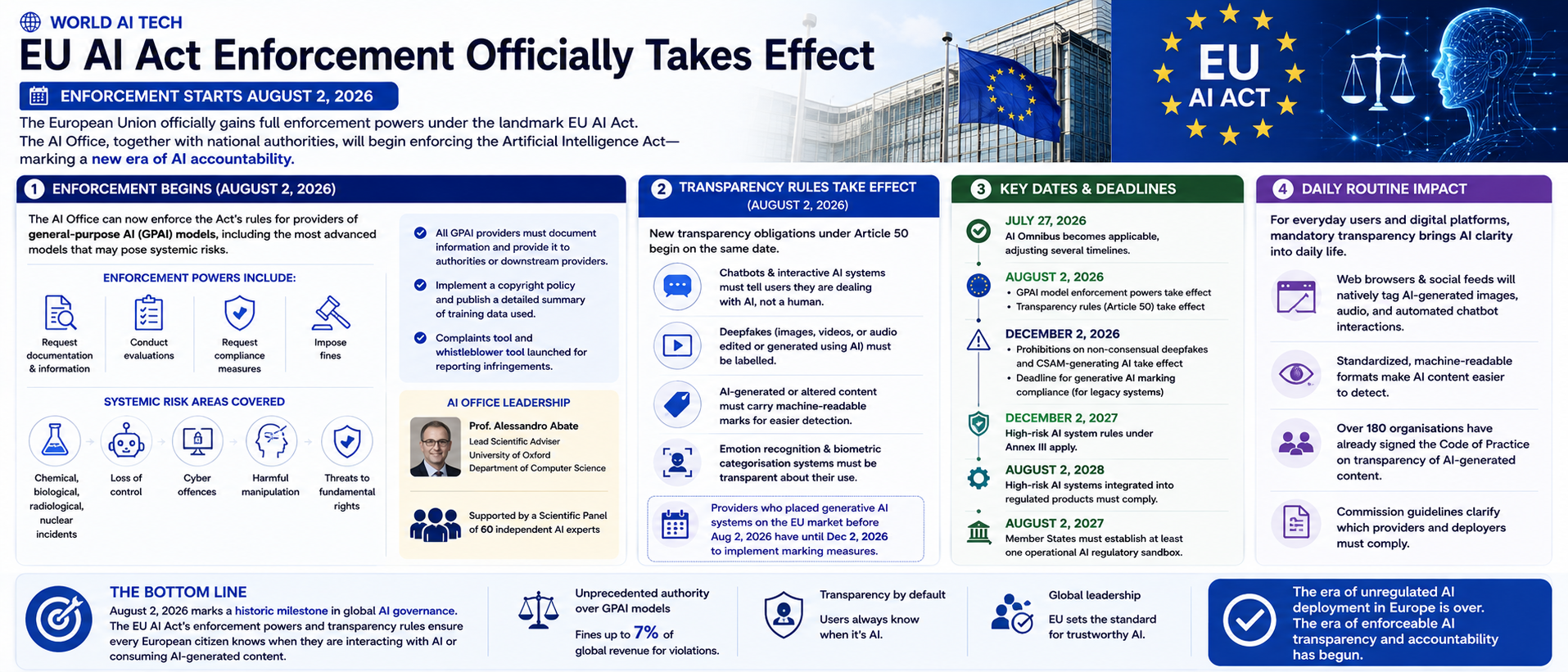
The global regulatory landscape for artificial intelligence has reached its most pivotal landmark to date. Starting August 2, 2026, the European Union officially gains full enforcement powers under the landmark EU AI Act. The European Commission's AI Office, together with national authorities, will now begin enforcing the Artificial Intelligence Act, marking the culmination of years of legislative work and the beginning of a new era of AI accountability.
Enforcement Begins
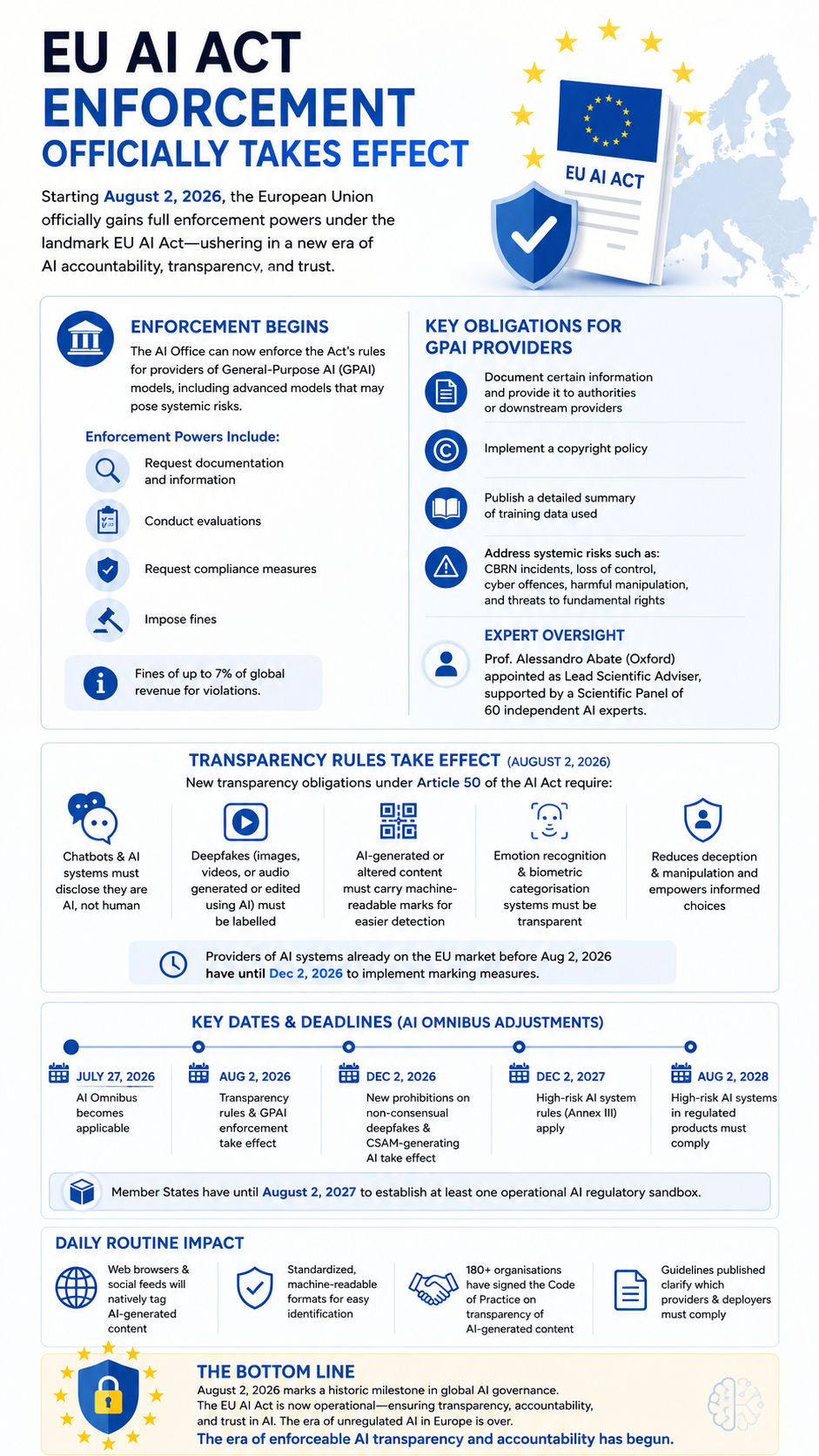
The AI Office can now enforce the Act's rules for providers of general-purpose AI (GPAI) models—systems that can perform many different tasks and can be used in a wide range of tools and services, including AI agents. These enforcement powers include the authority to request documentation and information, conduct evaluations, request compliance measures, and impose fines. The rules also cover the most advanced GPAI models that may pose systemic risks, with providers required to address risks of large-scale harm linked to chemical, biological, radiological, and nuclear incidents, loss of control, cyber offences, harmful manipulation, and threats to fundamental rights.
All providers of GPAI models must document certain information and provide it to competent authorities or downstream providers. They must also implement a copyright policy and publish a sufficiently detailed summary of the content used to train their models. The AI Office has appointed Professor Alessandro Abate of the University of Oxford's Department of Computer Science as Lead Scientific Adviser, supported by a Scientific Panel of 60 independent AI experts. The Commission has also launched a complaints tool and a whistleblower tool for reporting alleged infringements.
Transparency Rules Take Effect
On the same date, new transparency obligations under Article 50 of the AI Act start to apply. These require:
Chatbots and interactive AI systems to tell users they are dealing with AI, not a human
Deepfakes (images, videos, or audio edited or generated using AI) to be labelled
AI-generated or altered content to carry machine-readable marks for easier detection
Emotion recognition and biometric categorisation systems to be transparent about their use
The measures are intended to reduce deception and manipulation and help people make informed choices. Providers of generative AI systems already placed on the EU market before August 2, 2026 have until December 2, 2026 to implement the marking measures.
Key Dates and Deadlines
The AI Omnibus, which became applicable on July 27, 2026, has adjusted several timelines. While transparency rules and GPAI enforcement take effect August 2, new prohibitions on non-consensual deepfakes and CSAM-generating AI have been postponed to December 2, 2026. High-risk AI system rules under Annex III now apply from December 2, 2027, while high-risk systems integrated into regulated products must comply by August 2, 2028. Member States now have until August 2, 2027 to establish at least one operational AI regulatory sandbox.
Daily Routine Impact
For everyday users and digital platforms, mandatory transparency obligations mean web browsers and social feeds will natively tag AI-generated images, audio, and automated chatbot interactions in standardized, machine-readable formats. Over 180 organisations have already signed the Code of Practice on transparency of AI-generated content that operationalises these rules. The Commission has published guidelines clarifying which providers and deployers must comply with the transparency obligations.
The Bottom Line
August 2, 2026 marks a historic milestone in global AI governance. The EU AI Act's enforcement provisions give regulators unprecedented authority over GPAI models, while transparency rules ensure that every European citizen will know when they are interacting with AI or consuming AI-generated content. Though high-risk deadlines have been extended, the core framework is now operational—with fines of up to 7% of global revenue for violations. The era of unregulated AI deployment in Europe is officially over. The era of enforceable AI transparency and accountability has begun.

Vishal Sable
B.Tech AD @ shri balaji institute of technology and management
Engineering and tech journalist. I love exploring the impact of emerging technologies on global defense, sovereignty, and everyday life. Always looking for the real story behind the headlines.