LATEST NEWS
ByteDance Just Borrowed $30 Billion It Didn't Need To. That's the Real Signal.
September 8, 2026 4M
Back to News
News AlertWorld AI Tech
EU AI ACT TRANSPARENCY RULES TAKE FULL EFFECT
V
Author
Vishal Sable
Published
August 4, 2026
Reading Time
3 MIN READ
Spread the Word
BRUSSELS / GLOBAL – Wednesday, August 4, 2026
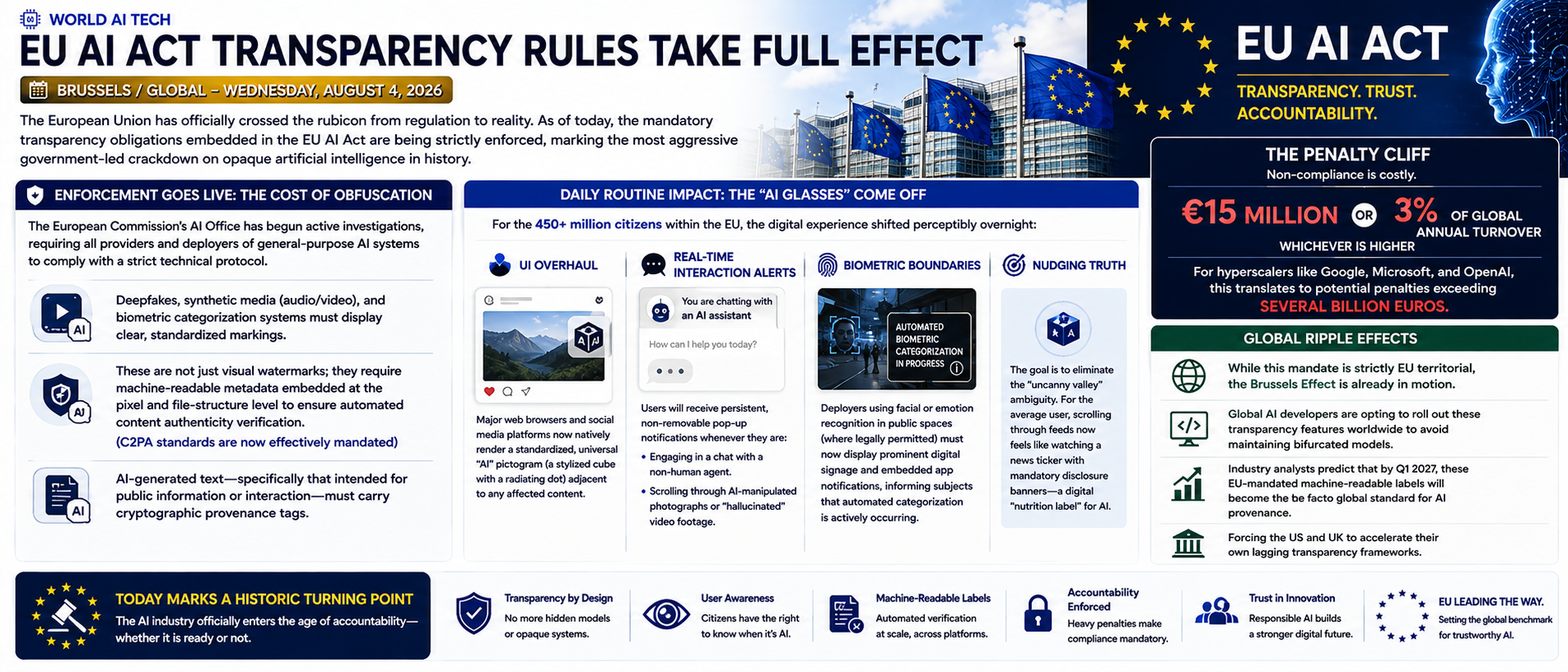
The European Union has officially crossed the rubicon from regulation to reality. As of today, the mandatory transparency obligations embedded in the EU AI Act are being strictly enforced, marking the most aggressive government-led crackdown on opaque artificial intelligence in history.
ENFORCEMENT GOES LIVE: The Cost of Obfuscation
The European Commission's AI Office has begun active investigations, requiring all providers and deployers of general-purpose AI systems to comply with a strict technical protocol. Under the new rules:
Deepfakes, synthetic media (audio/video), and biometric categorization systems must display clear, standardized markings.
Crucially, these are not just visual watermarks; they require machine-readable metadata embedded at the pixel and file-structure level to ensure automated content authenticity verification (C2PA standards are now effectively mandated).
AI-generated text—specifically that intended for public information or interaction—must carry cryptographic provenance tags.
The Penalty Cliff: Non-compliance is costly. Regulators are empowered to levy fines up to €15 million or 3% of a company's global annual turnover—whichever is higher. For hyperscalers like Google, Microsoft, and OpenAI, this translates to potential penalties exceeding several billion euros, effectively making transparency a non-negotiable operational cost.
DAILY ROUTINE IMPACT: The "AI Glasses" Come Off
For the 450+ million citizens within the EU, the digital experience shifted perceptibly overnight:
UI Overhaul: Major web browsers (Chrome, Edge, Firefox) and social media platforms (TikTok, X, Instagram) have pushed forced updates that natively render a standardized, universal "AI" pictogram (a stylized cube with a radiating dot) adjacent to any affected content.
Real-Time Interaction Alerts: Users will now receive persistent, non-removable pop-up notifications whenever they are:
Engaging in a chat with a non-human agent (customer service bots must identify themselves immediately upon connection).
Scrolling through AI-manipulated photographs or "hallucinated" video footage.
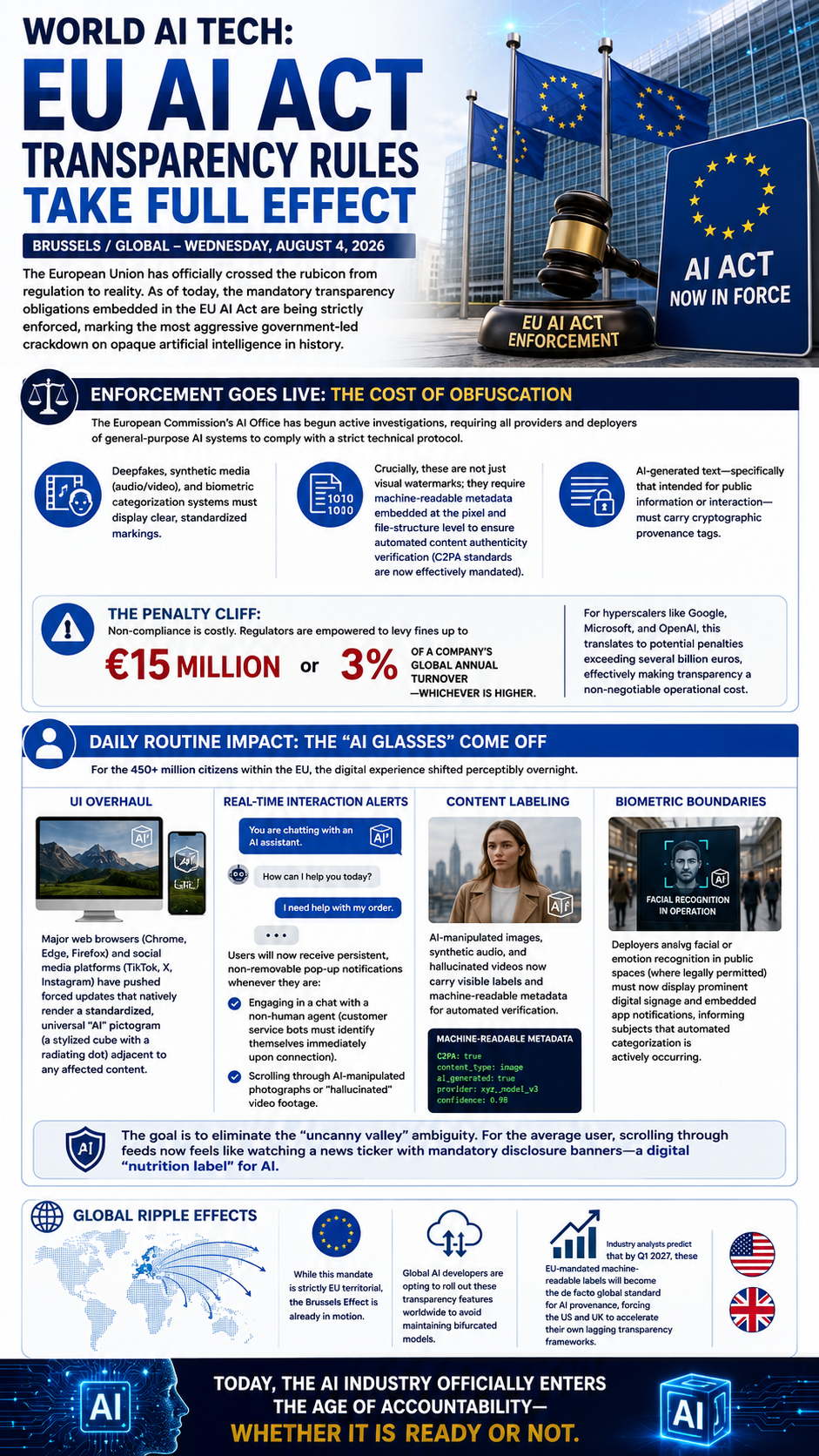
Biometric Boundaries: Deployers using facial or emotion recognition in public spaces (where legally permitted) must now display prominent digital signage and embedded app notifications, informing subjects that automated categorization is actively occurring.
The goal is to eliminate the "uncanny valley" ambiguity. For the average user, scrolling through feeds now feels like watching a news ticker with mandatory disclosure banners—a digital "nutrition label" for AI.
GLOBAL RIPPLE EFFECTS
While this mandate is strictly EU territorial, the Brussels Effect is already in motion. Global AI developers are opting to roll out these transparency features worldwide to avoid maintaining bifurcated models. Industry analysts predict that by Q1 2027, these EU-mandated machine-readable labels will become the de facto global standard for AI provenance, forcing the US and UK to accelerate their own lagging transparency frameworks.
Today, the AI industry officially enters the age of accountability—whether it is ready or not.

Vishal Sable
B.Tech AD @ shri balaji institute of technology and management
Engineering and tech journalist. I love exploring the impact of emerging technologies on global defense, sovereignty, and everyday life. Always looking for the real story behind the headlines.