Back to News
News AlertWorld Money
"Expert-First" AI Becomes the New Multi-Billion Corporate Banking Standard
V
Author
Vishal Sable
Published
July 6, 2026
Reading Time
6 MIN READ
Spread the Word
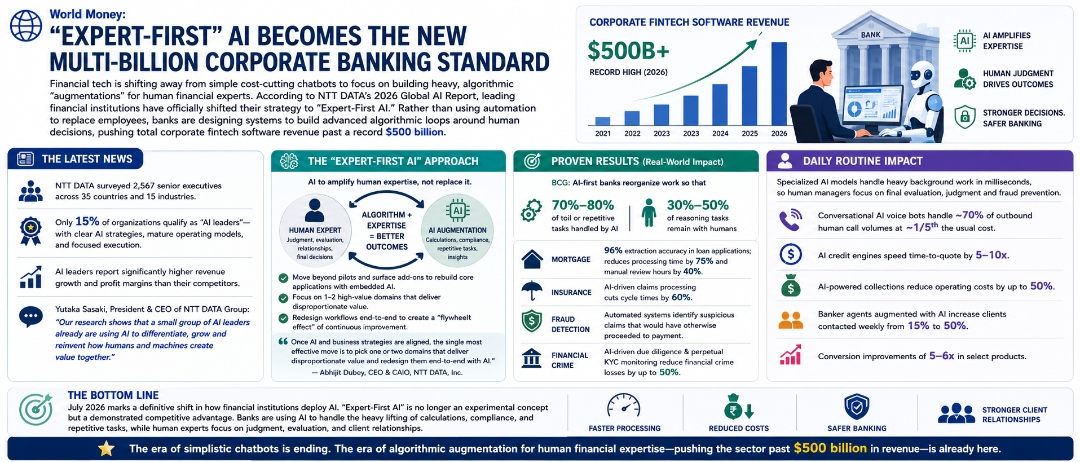
Financial tech is shifting away from simple cost-cutting chatbots to focus on building heavy, algorithmic "augmentations" for human financial experts. According to NTT DATA's newly published 2026 Global AI Report, leading financial institutions have officially shifted their strategy to "Expert-First AI." Rather than using automation to replace employees, banks are designing systems to build advanced algorithmic loops around human decisions, pushing total corporate fintech software revenue past a record $500 billion .
The Latest News
NTT DATA's report, based on a survey of 2,567 senior executives across 35 countries and 15 industries, reveals that only 15% of organizations qualify as "AI leaders." These front-runners are defined by clear AI strategies, mature operating models, and focused execution—and they report significantly higher revenue growth and profit margins than their competitors . According to Yutaka Sasaki, President and CEO of NTT DATA Group, "Our research shows that a small group of AI leaders already are using AI to differentiate, grow and reinvent how humans and machines create value together" .
The report outlines that AI leaders are moving beyond pilot projects and surface-level add-ons to rebuild core applications with embedded AI . They focus on high-value domains that unlock disproportionate economic value and redesign workflows end-to-end. This approach creates a "flywheel effect," where initial investments fuel early success that drives reinvestment for further growth .
The "Expert-First AI" principle emphasizes using AI to amplify the impact of experienced, highly skilled employees rather than replace them . Abhijit Dubey, CEO and CAIO of NTT DATA, Inc., stated: "Once AI and business strategies are aligned, the single most effective move is to pick one or two domains that deliver disproportionate value and redesign them end-to-end with AI" .
The strategy is already producing tangible results. BCG research shows that AI-first banks are reorganizing work so that AI performs 70% to 80% of toil or repetitive tasks and 30% to 50% of reasoning tasks, freeing human experts to focus on higher-value judgment and decision-making . In the mortgage sector, AI models process loan applications with 96% extraction accuracy, automatically matching income documentation and validating employment history—reducing loan processing time by 75% and manual document review hours by 40% . In insurance, AI-driven claims processing cuts cycle times by 60%, while automated fraud detection systems have identified suspicious claims that would have otherwise proceeded to payment .
Daily Routine Impact
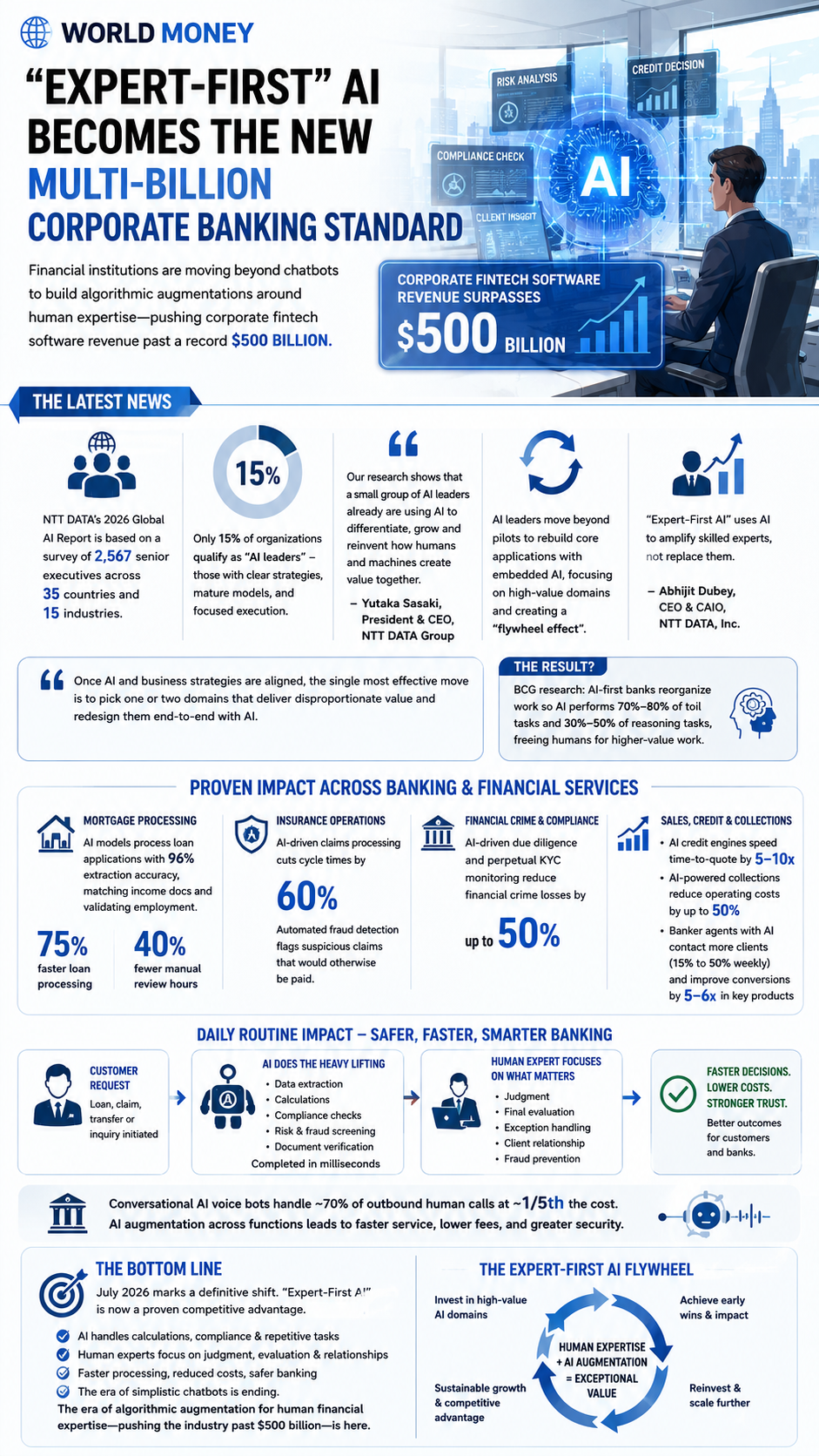
This approach translates to safer, more efficient personal banking. When processing micro-loans, insurance claims, or international money transfers, specialized AI models handle the heavy background calculations and compliance verification in milliseconds, leaving human managers to focus entirely on final evaluation and fraud prevention .
Banks are already deploying this model across multiple functions. Conversational AI voice bots handle approximately 70% of outbound human call volumes at roughly one-fifth the usual cost . AI-driven due diligence and perpetual KYC monitoring have helped financial institutions reduce financial crime losses by up to 50% . AI credit engines speed time-to-quote by five to ten times, while AI-powered collections have reduced operating costs by up to 50% . For wealth management, banker agents augmented with AI have seen the proportion of clients contacted weekly increase from 15% to 50%, with conversion improvements of five to six times in select products .
The Bottom Line
July 2026 marks a definitive shift in how financial institutions deploy AI. The NTT DATA report confirms that "Expert-First AI" is no longer an experimental concept but a demonstrated competitive advantage. Banks are using AI to handle the heavy lifting of calculations, compliance, and repetitive tasks, while human experts focus on judgment, evaluation, and client relationships. The result: faster processing, reduced costs, and safer, more efficient banking. The era of simplistic chatbots is ending. The era of algorithmic augmentation for human financial expertise—pushing the sector past $500 billion in revenue—is already here .

Vishal Sable
B.Tech AD @ shri balaji institute of technology and management
Engineering and tech journalist. I love exploring the impact of emerging technologies on global defense, sovereignty, and everyday life. Always looking for the real story behind the headlines.