Back to News
News AlertWorld Money
Global FinTech Revenue Crosses $500B Amid AI-Native Overhauls
V
Author
Vishal Sable
Published
July 2, 2026
Reading Time
8 MIN READ
Spread the Word
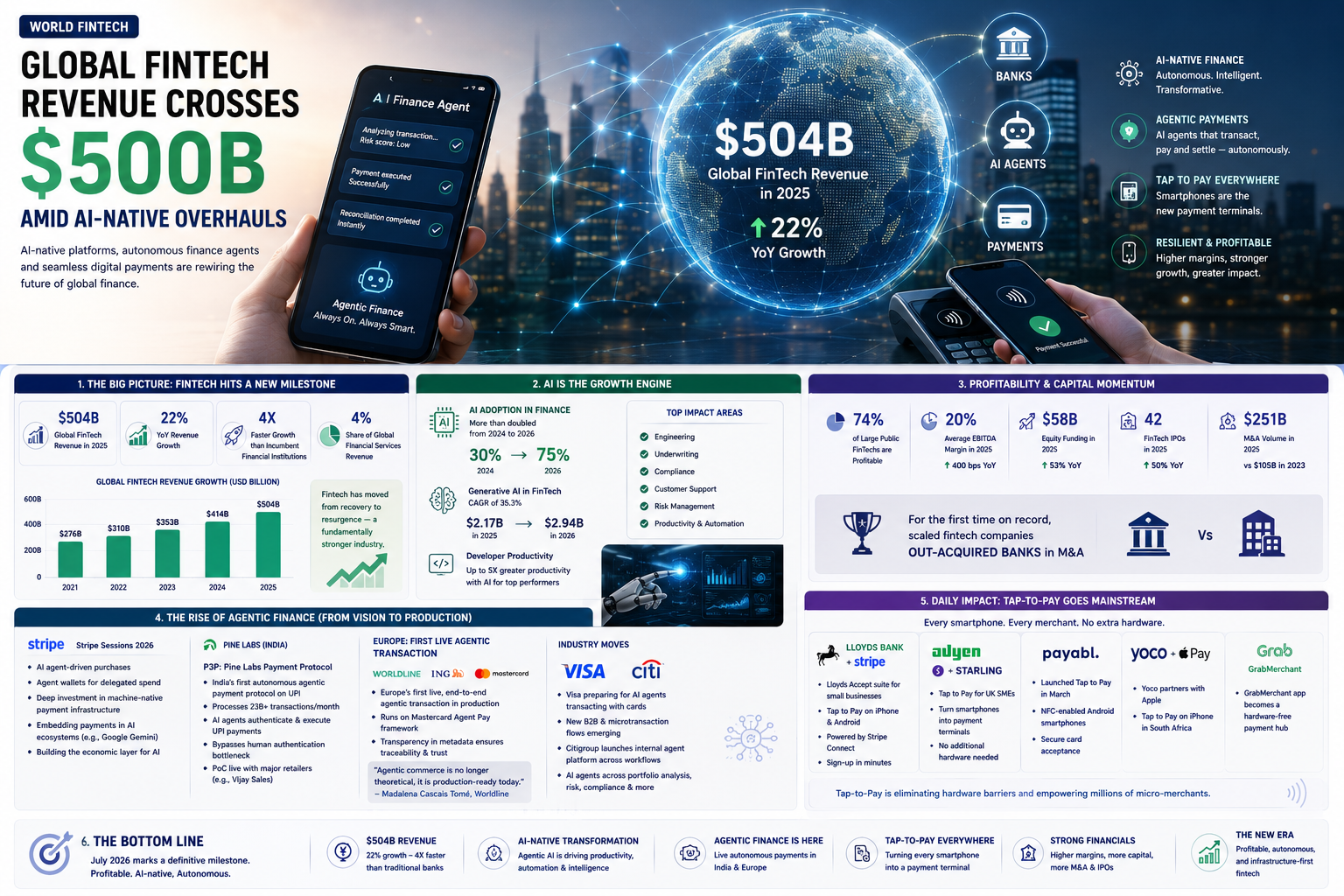
The financial sector is undergoing an infrastructure rewiring, using native AI to automate corporate accounting, risk compliance, and consumer lending. The first week of July 2026 has delivered definitive confirmation that this transformation is not just underway but generating historic returns—with global fintech revenues crossing the half-trillion-dollar mark for the first time, driven by AI adoption, disciplined operating performance, and the rise of autonomous, agentic financial systems.
The Latest News
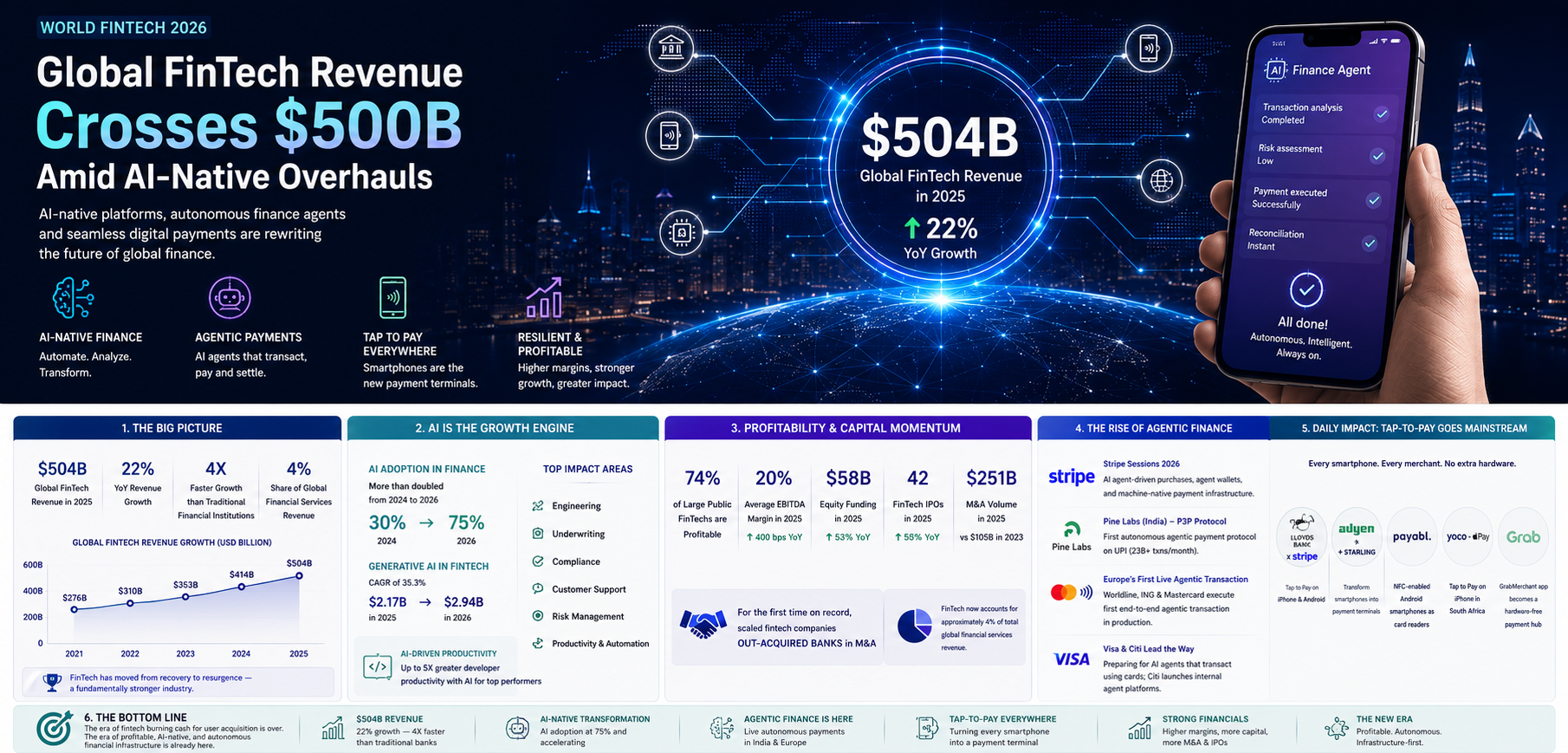
On June 1, Boston Consulting Group and FT Partners released the Global FinTech Report 2026: From Recovery to Resurgence, revealing that global fintech revenues have officially surpassed $504 billion. The sector grew at 22% in 2025—more than four times faster than incumbent financial institutions. The report marks a definitive turning point: fintech has not simply bounced back from the reset years; it has emerged as a fundamentally more mature industry.
The growth is fueled by the integration of Agentic AI—autonomous bots capable of parsing tax laws, executing legal financial transactions, and processing real-time cross-border settlements without human back-office intervention. BCG data shows fintechs using AI effectively are achieving up to five times greater developer productivity, with the strongest gains coming in engineering, underwriting, compliance, and customer support. AI adoption in finance has more than doubled between 2024 and 2026, rising from 30% to 75%. Generative AI in fintech is growing at a CAGR of 35.3%, from $2.17 billion in 2025 to $2.94 billion in 2026.
The profitability metrics are equally striking. 74% of the largest public fintech companies are now profitable, with average EBITDA margins rising 400 basis points to 20% in 2025. Equity funding reached **$58 billion**, up 53% year-over-year. Fintech IPOs rose 50% to 42 deals, while M&A volumes accelerated from $105 billion in 2023 to $251 billion in 2025. For the first time on record, scaled fintech companies out-acquired banks in M&A. The sector now accounts for approximately 4% of total global financial services revenue.
The Rise of Agentic Finance
Agentic AI is moving from theory to production at extraordinary speed. At Stripe Sessions 2026, the company unveiled a sweeping set of updates pointing toward a future where AI agents are not just assisting transactions but executing them—including AI agent-driven purchases, agent wallets enabling delegated spend, and deep investment in machine-native payment infrastructure. Stripe is positioning itself as the economic layer for AI, embedding payments directly inside AI environments like Google's Gemini.
On June 16, India's Pine Labs launched P3P (Pine Labs Payment Protocol), the country's first autonomous agentic payment protocol built directly on top of the Unified Payments Interface network, which processes more than 23 billion transactions a month. The protocol allows AI agents to authenticate and execute UPI payments without human intervention, bypassing the human authentication bottleneck that has historically blocked autonomous commerce. Major retailers including Vijay Sales are already in active proof-of-concept deployments.
Europe is equally active. At Money20/20 Europe in Amsterdam, payment processor Worldline, financial institution ING, and Mastercard announced the successful execution of Europe's first live, end-to-end agentic transaction in production. The solution runs on Mastercard's Agent Pay framework, which embeds transparency directly into transaction metadata—instantly broadcasting agentic origins to issuing banks and ensuring complete traceability. "Agentic commerce is no longer theoretical, it is production-ready today," stated Madalena Cascais Tomé, member of the executive committee at Worldline.
Visa is actively preparing for a world where AI agents transact using cards, predicting new forms of B2B and microtransaction flows driven by autonomous systems. Major banks like Citigroup have launched internal agent platforms to deploy AI agents across workflows from portfolio analysis to risk simulations.
Daily Routine Impact: Tap-to-Pay Goes Mainstream
In daily operations, consumer platforms are merging with traditional banking. Mainstream tech providers are rolling out "Tap-to-Pay" capabilities built directly into localized communication systems, effectively turning every single micro-merchant's smartphone into an enterprise-grade credit card terminal without extra hardware.
In June, Lloyds Bank announced a collaboration with Stripe to launch Lloyds Accept, a suite of payment tools for small businesses. Powered by Stripe Connect, the service includes Tap to Pay on iPhone and Android, enabling merchants to accept contactless payments using only their smartphone and the Lloyds Accept app. Sign-up takes minutes.
Adyen and Starling Bank have partnered to bring Tap to Pay to UK SMEs, transforming eligible smartphones into payment terminals with no additional hardware. European fintech payabl. launched its Tap to Pay solution in March, turning NFC-enabled Android smartphones into secure card readers. In South Africa, Yoco partnered with Apple to enable Tap to Pay on iPhone. Grab has transformed its GrabMerchant app into a hardware-free payment hub.
The Bottom Line
July 2026 marks a definitive milestone for global financial technology. The sector has crossed $504 billion in annual revenue with 22% growth—four times faster than traditional banks. Agentic AI is moving from experimental roadmaps to live production, with Pine Labs enabling autonomous UPI payments in India, Worldline and ING executing Europe's first agentic transaction, and Stripe, Visa, and Mastercard building the infrastructure for machine-native finance. Meanwhile, Tap-to-Pay is eliminating hardware barriers, turning every smartphone into a payment terminal. The era of fintech burning cash for user acquisition is over. The era of profitable, AI-native, and autonomous financial infrastructure is already here.

Vishal Sable
B.Tech AD @ shri balaji institute of technology and management
Engineering and tech journalist. I love exploring the impact of emerging technologies on global defense, sovereignty, and everyday life. Always looking for the real story behind the headlines.