LATEST NEWS
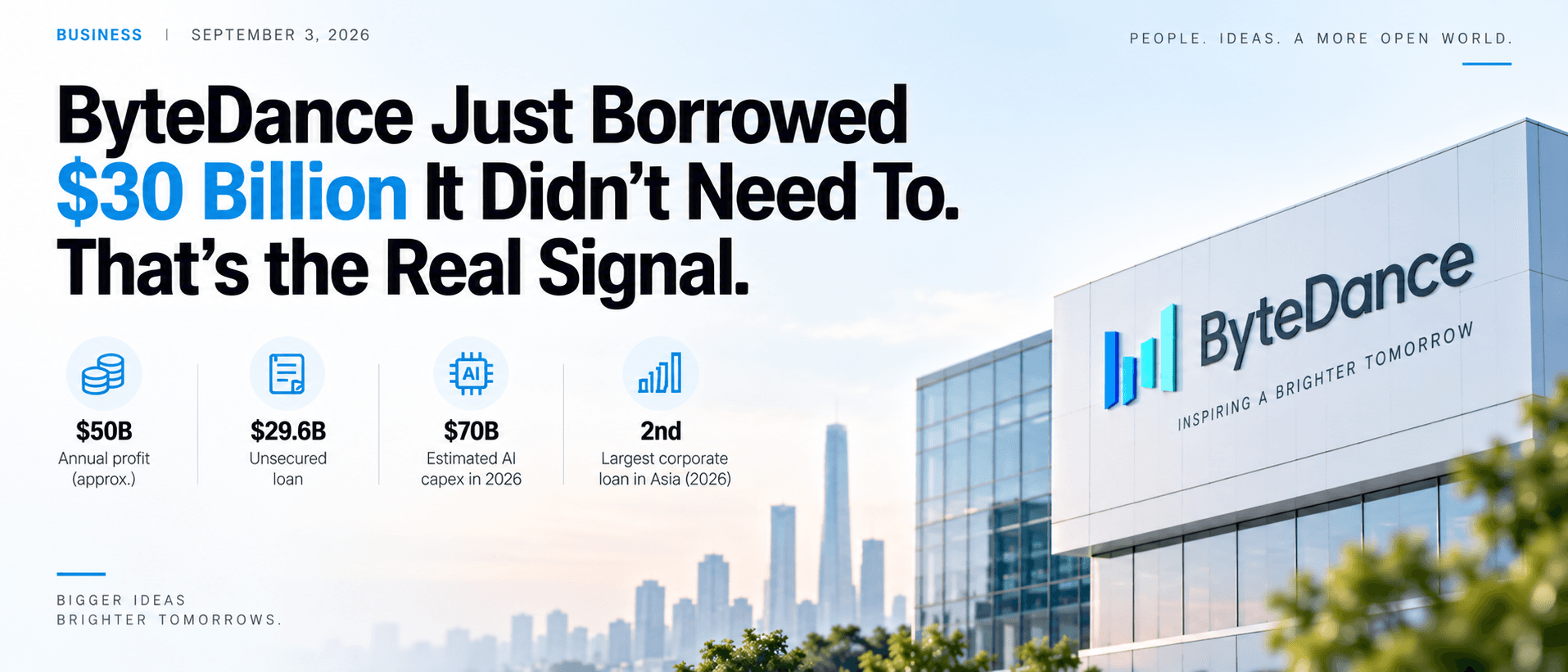
ByteDance Just Borrowed $30 Billion It Didn't Need To. That's the Real Signal.
September 8, 2026 4M
Back to News
News AlertWorld AI Tech
Google Drops Gemma 4 & "Computer Use" Moves to the Edge
V
Author
Vishal Sable
Published
July 9, 2026
Reading Time
8 MIN READ
Spread the Word
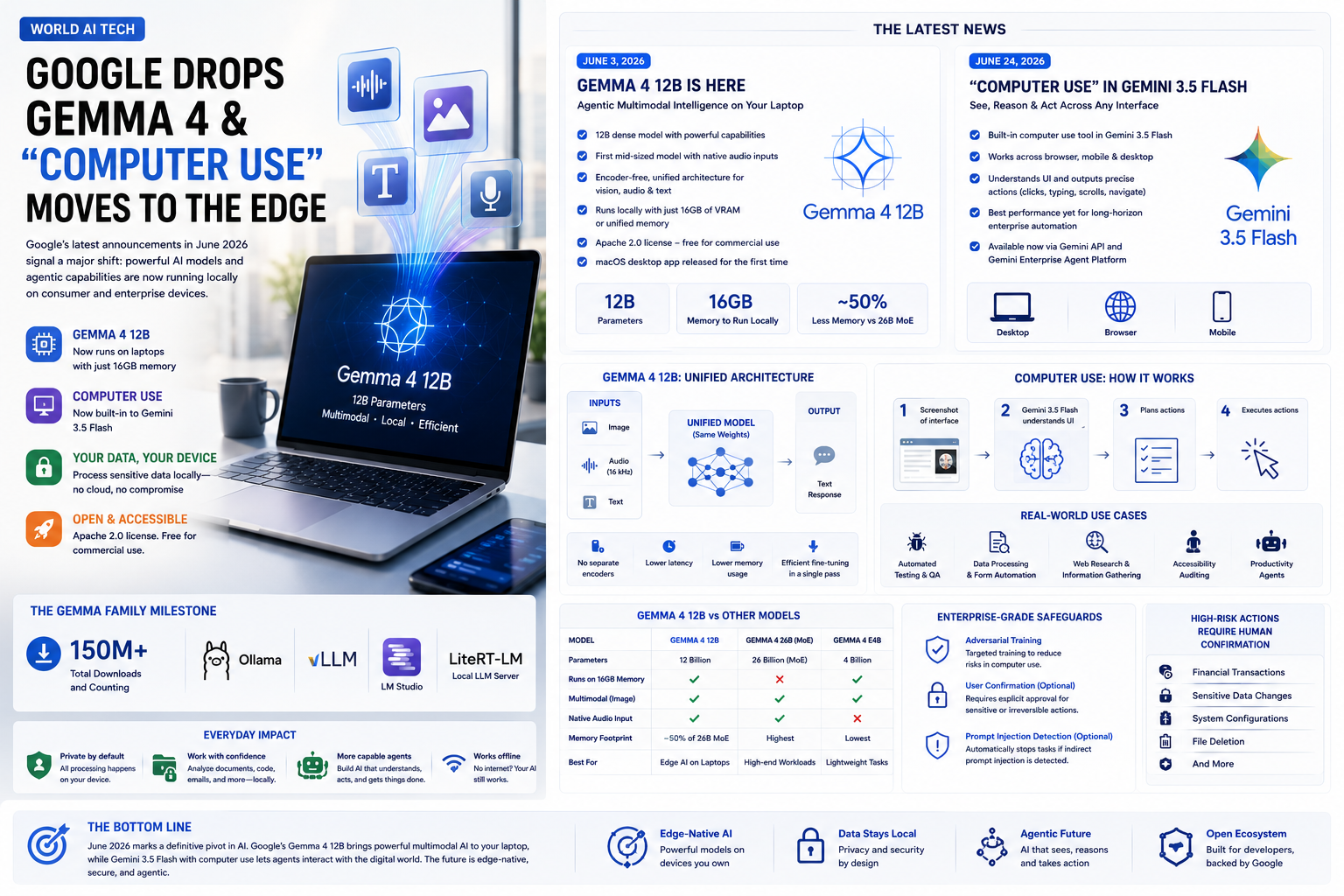
Artificial intelligence is rapidly moving away from cloud dependency and shifting directly onto local consumer and enterprise hardware. The final days of June 2026 have delivered two major announcements from Google that confirm this trajectory: the release of Gemma 4 12B, an open-source model designed to run complex AI agents entirely on consumer laptops, and the native integration of "computer use" capabilities into Gemini 3.5 Flash, enabling enterprises to build software agents that can see, reason, and interact across desktop, mobile, and browser environments.
The Latest News
On June 3, Google DeepMind officially introduced Gemma 4 12B, a 12-billion-parameter dense multimodal model designed to bring "agentic multimodal intelligence directly to laptops". The model bridges the gap between Google's edge-friendly E4B and its more advanced 26B Mixture of Experts (MoE) model, packaging powerful capabilities inside a reduced memory footprint. It is also Google's first mid-sized model to feature native audio inputs.
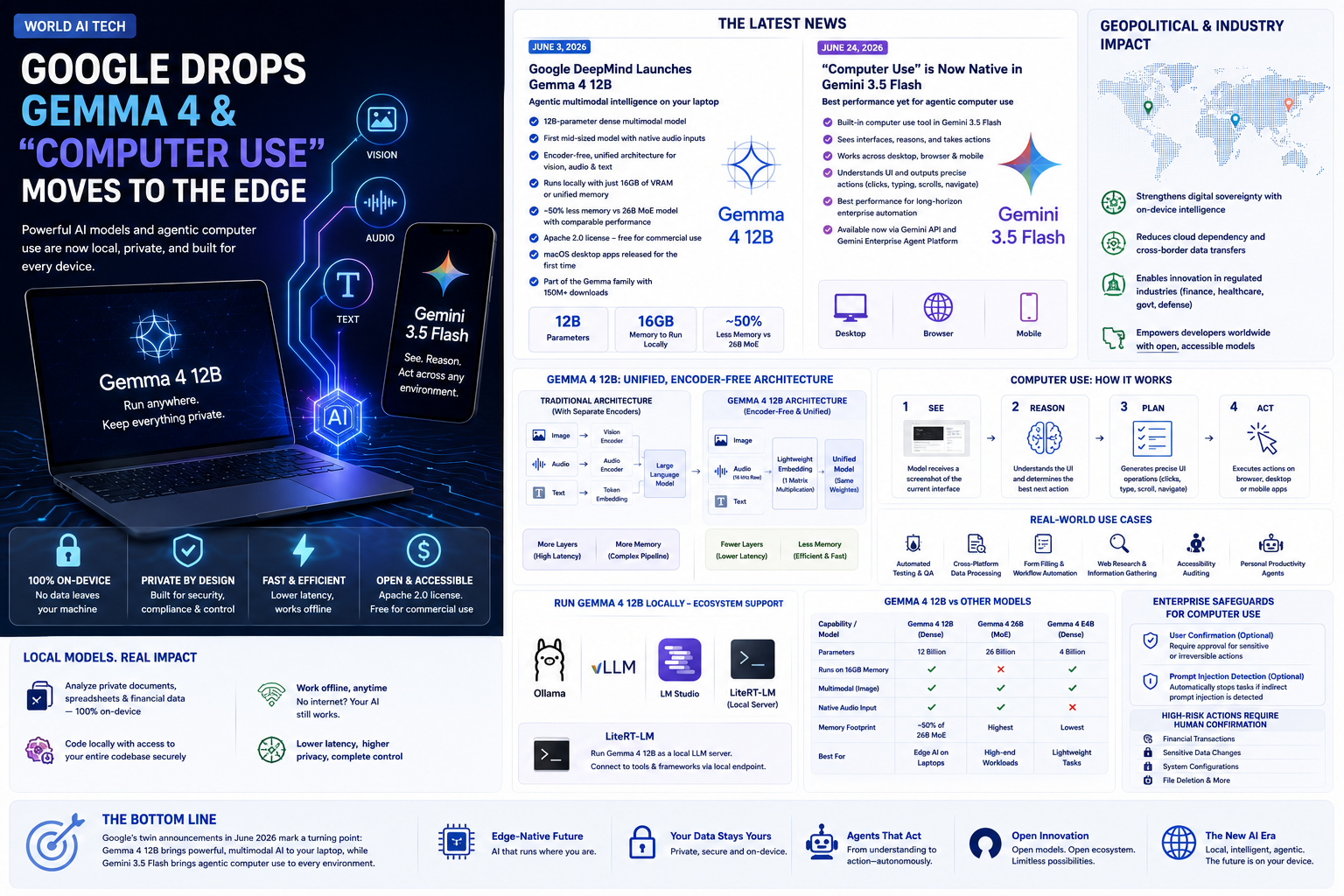
What sets Gemma 4 12B apart is its encoder-free, unified architecture. Traditional multimodal models rely on separate vision and audio encoders to translate images and audio before passing those representations to the language model—a process that adds latency and increases memory usage. Gemma 4 12B eliminates this bottleneck entirely. Vision inputs are processed through a lightweight embedding module consisting of a single matrix multiplication, replacing the 27 vision transformer layers found in other medium-sized Gemma models. Audio processing is even more streamlined: the separate audio encoder is removed entirely, and raw 16 kHz audio signals are projected directly into the same dimensional space as text tokens. Because vision, audio, and text inputs share the exact same weights, downstream fine-tuning naturally updates the entire multimodal token loop in a single pass.
The model is small enough to run locally on consumer laptops with just 16GB of VRAM or unified memory—less than half the total memory footprint of the 26B MoE model, while delivering comparable performance on standard benchmarks. Google has released Gemma 4 12B under an Apache 2.0 license, making it freely available for commercial use, with support across the developer ecosystem including Ollama, vLLM, and LM Studio. The release also includes downloadable macOS desktop applications for the first time, letting developers experience fully local spoken and visual interaction directly on consumer-grade devices. The Gemma family has now crossed 150 million downloads.
Concurrently, on June 24, Google announced that "computer use" is now a built-in tool supported in Gemini 3.5 Flash—delivering the company's best performance yet for agentic computer use tasks. Previously available only as a standalone Gemini 2.5 model, computer use is now integrated natively into the main Gemini Flash model. Developers and enterprises can start using it immediately via the Gemini API and the Gemini Enterprise Agent Platform.
With built-in computer use, Gemini 3.5 Flash enables developers to build custom agents that can "see, reason and take action across browser, mobile and desktop environments". The model receives screenshots, understands the current interface state, and outputs specific UI operation instructions—mouse clicks, keyboard input, scrolling, navigation—across platforms. Google demonstrated the capability in two demos: one where the model automatically analyzed the Gemini app interface and returned a categorized list of features, and another where it audited its own technical documentation for accessibility issues.
The native integration unlocks improved performance for "long-horizon and enterprise automation tasks like continuous software testing and knowledge work across professional applications". Use cases include automated software testing and QA, cross-platform data processing and form automation, intelligent web research and information gathering, accessibility auditing, and personal productivity agents.
To mitigate security risks, Google has implemented targeted adversarial training for computer use in Gemini 3.5 Flash. Two optional enterprise safeguard systems are also available: one requiring explicit user confirmation for sensitive or irreversible actions, and another that automatically stops tasks if an indirect prompt injection is identified. High-risk operations such as financial transactions or sensitive data modifications require human-in-the-loop confirmation.
Daily Routine Impact
The shift to localized models has profound implications for data privacy and security. Because Gemma 4 12B runs entirely on-device, personal and organizational data never has to leave the machine. Organizations that previously found it unacceptable to send confidential internal documents to third-party APIs can now process sensitive multimodal data entirely on-premises or directly on employee laptops. In daily life, users are deploying these edge-AI models to securely analyze private financial documents, local codebase repositories, and sensitive emails locally—without sending data to a third-party cloud. The model-runtime combination supports capabilities such as autonomous data processing, visual insight generation, webpage creation, and tool use. Google has also expanded LiteRT-LM, its lightweight command-line tool, allowing developers to run Gemma 4 12B as a local LLM server and connect it to standard tools and frameworks through a local endpoint.
The Bottom Line
June 2026 marks a definitive pivot in AI deployment strategy. Google's Gemma 4 12B demonstrates that powerful, agentic multimodal AI can now run locally on consumer laptops with just 16GB of memory—eliminating cloud dependency and keeping sensitive data on-device. The native integration of computer use into Gemini 3.5 Flash signals that AI is moving beyond chat and content generation into direct, autonomous interaction with digital environments. Together, these announcements confirm that the era of cloud-dependent AI is giving way to an era of edge-native, agentic intelligence that operates securely on the devices people already own.

Vishal Sable
B.Tech AD @ shri balaji institute of technology and management
Engineering and tech journalist. I love exploring the impact of emerging technologies on global defense, sovereignty, and everyday life. Always looking for the real story behind the headlines.