LATEST NEWS
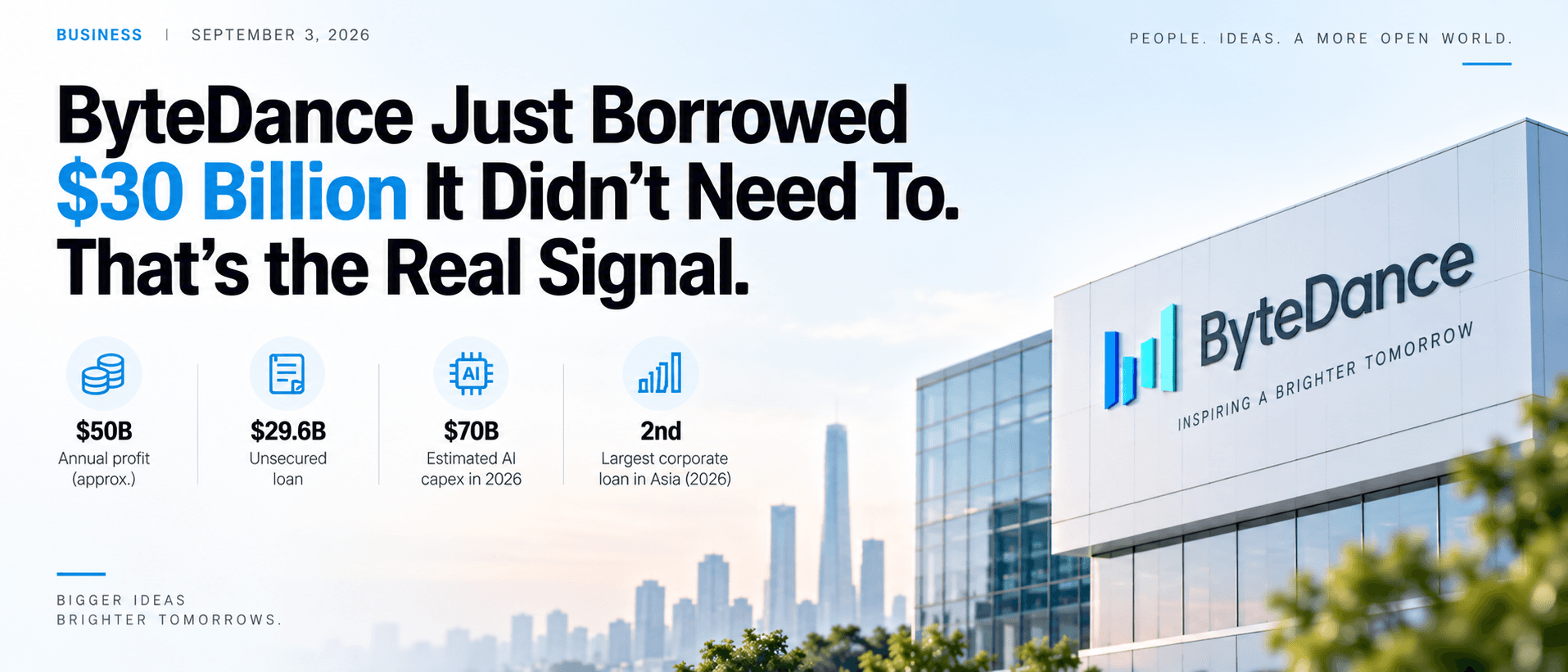
ByteDance Just Borrowed $30 Billion It Didn't Need To. That's the Real Signal.
September 8, 2026 4M
Back to News
News AlertWorld AI Tech
IBM Inks $240M Inference Deal, OpenAI Expands Cyber & Business Tiers, Meta Releases Local AI Model
V
Author
Vishal Sable
Published
August 12, 2026
Reading Time
7 MIN READ
Spread the Word
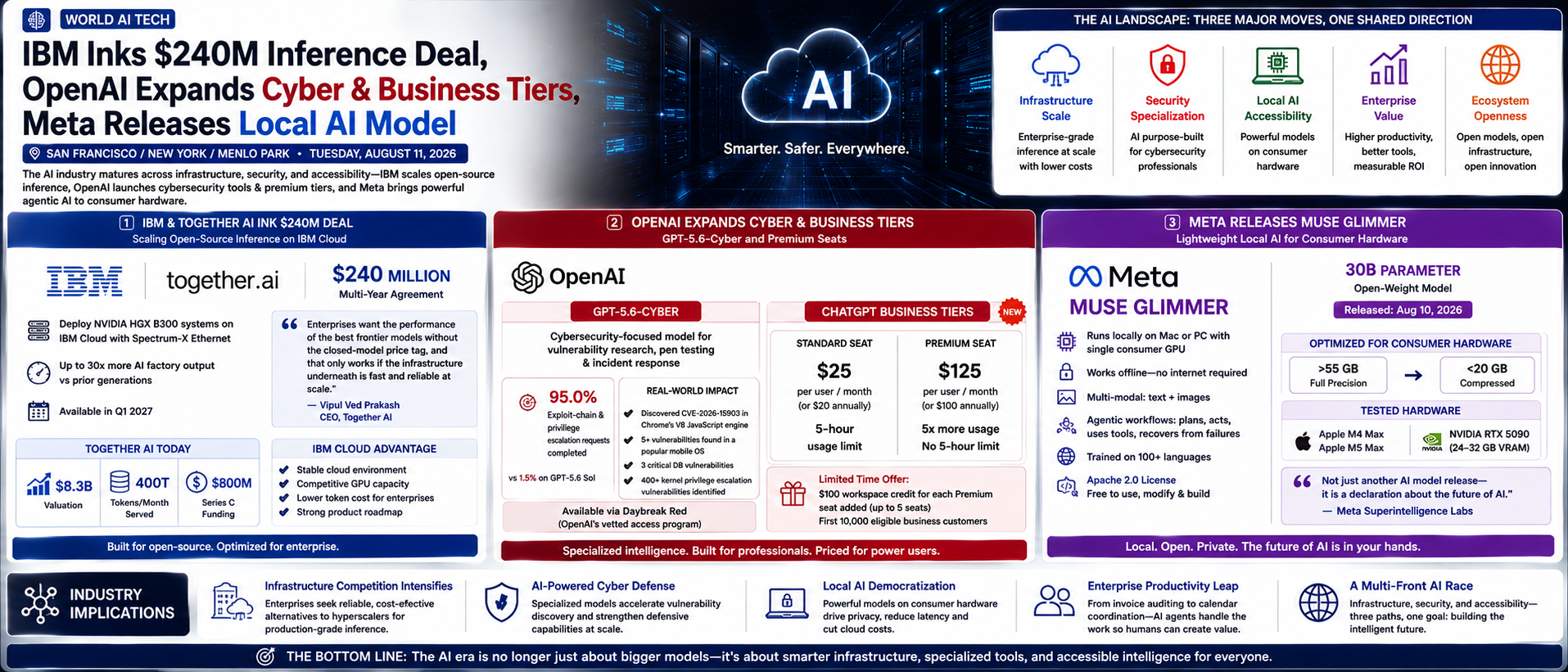
The artificial intelligence industry continues its rapid maturation across infrastructure, security, and accessibility, as IBM deepens its commitment to open-source AI inference, OpenAI rolls out specialized cybersecurity tools and premium enterprise tiers, and Meta pushes the frontier of on-device intelligence with a lightweight local model. Together, these developments signal an industry increasingly defined by specialized use cases, enterprise-grade infrastructure, and the democratization of AI capabilities beyond the cloud.
IBM & TOGETHER AI INK $240M DEAL: Scaling Open-Source Inference on IBM Cloud
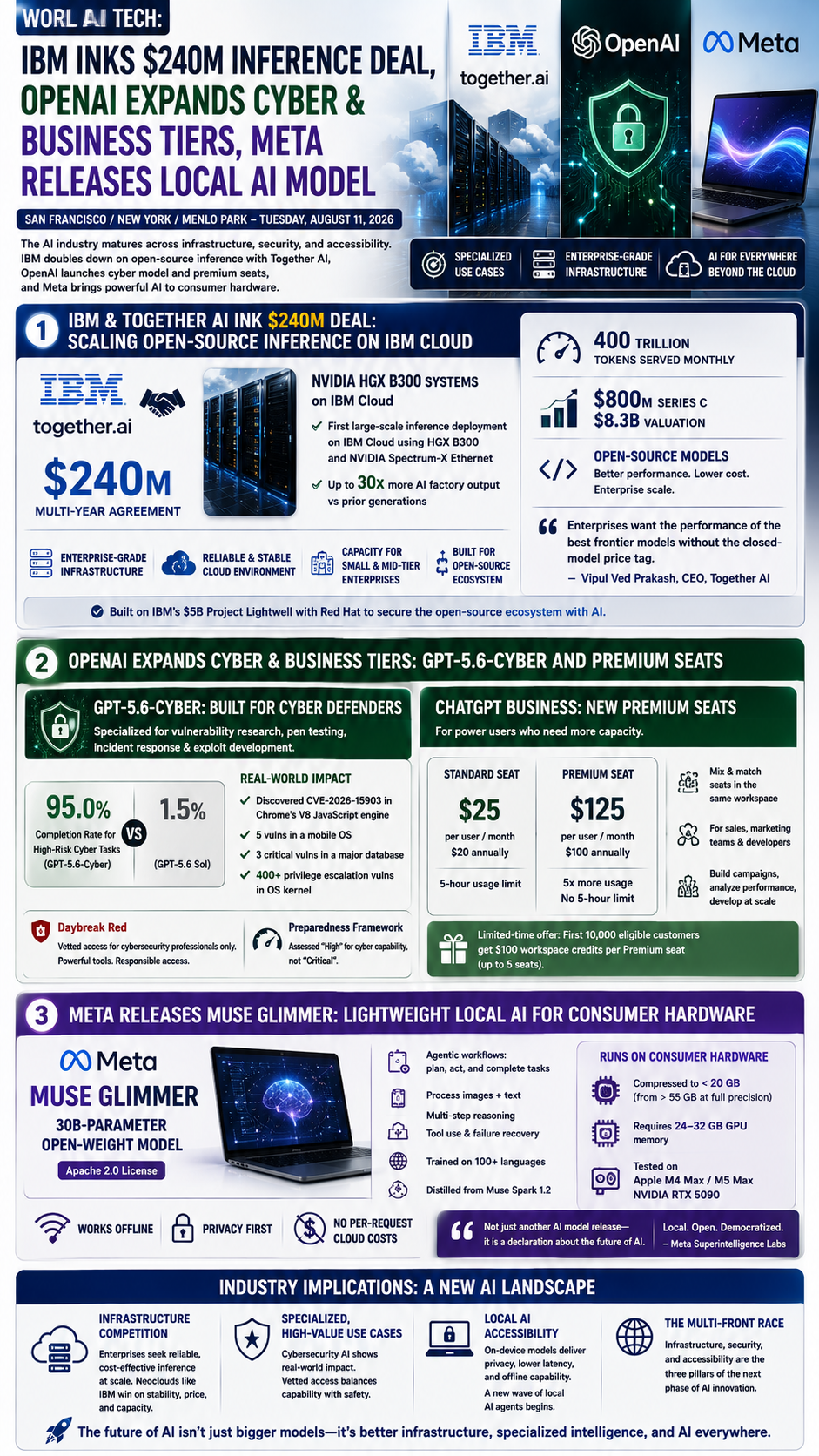
IBM has signed a multi-year $240 million agreement with Together AI to deploy a large-scale cluster of NVIDIA HGX B300 systems on IBM Cloud, with availability expected in the first quarter of 2027. The cluster, the first dedicated large-scale inference deployment on IBM Cloud using HGX B300 systems and NVIDIA Spectrum-X Ethernet networking, is designed to deliver faster and more efficient AI workloads. NVIDIA has indicated the setup can provide up to 30 times more AI factory output compared with prior generations.
Together AI, which recently raised $800 million in a Series C round at an $8.3 billion valuation, will use the infrastructure to expand its open-source model inference services. The company reports serving 400 trillion tokens monthly and aims to improve performance and economics for enterprises scaling AI deployments. "Enterprises want the performance of the best frontier models without the closed-model price tag, and that only works if the infrastructure underneath is fast and reliable at scale," Together AI CEO Vipul Ved Prakash said in a statement. Alan Peacock, general manager of IBM Cloud, said IBM and NVIDIA are "delivering scalable, economical, enterprise-grade AI infrastructure" to help Together AI accelerate innovation.
The deal represents a significant win for IBM's cloud strategy, positioning the company as a credible alternative to hyperscalers for AI inference workloads. Peacock noted that IBM has received strong positive feedback about the stability of its cloud environment versus other providers, and that small to mid-tier enterprises are struggling to get capacity from hyperscalers—an opportunity IBM is actively pursuing. The agreement also builds on IBM's broader commitment to open-source ecosystem, following its earlier announcement of Project Lightwell, a $5 billion initiative with Red Hat to help enterprises secure open-source software using AI tools.
OPENAI EXPANDS CYBER & BUSINESS TIERS: GPT-5.6-Cyber and Premium Seats
OpenAI has unveiled GPT-5.6-Cyber, a new cybersecurity-focused model built on GPT-5.6 Sol and trained specifically for vulnerability research, penetration testing, and incident response. The model is available through Daybreak Red, a new tier of OpenAI's vetted access program for cybersecurity professionals. Unlike standard models with built-in guardrails, GPT-5.6-Cyber is trained to reduce refusals for higher-risk, dual-use cyber tasks such as finding zero-day vulnerabilities and developing exploit chains. Internal testing shows the model completes 95.0% of requests related to exploit-chain development, authentication bypass, and privilege escalation, compared with just 1.5% for GPT-5.6 Sol.
The model has already demonstrated real-world impact. OpenAI researchers used GPT-5.6-Cyber to discover CVE-2026-15903, a high-severity out-of-bounds read and write vulnerability in Chrome's V8 JavaScript engine that could allow remote attackers to execute arbitrary code inside a sandbox. Google patched the flaw in mid-July 2026. The model has also flagged at least five vulnerabilities in a popular mobile operating system, three critical vulnerabilities in a widely used database, and over 400 vulnerabilities that can lead to privilege escalation in a popular operating system kernel. OpenAI noted that under its Preparedness Framework, both GPT-5.6 Sol and GPT-5.6-Cyber were assessed as reaching the "High" threshold for cybersecurity capability but not the "Critical" threshold.
Concurrently, OpenAI has introduced Premium seats for ChatGPT Business, offering 5x more usage than Standard seats and removing the five-hour usage limit. Premium seats cost $125 per user per month, or $100 per user per month when billed annually, while Standard seats remain at $25 per user per month or $20 annually. Workspace owners can mix both seat types within the same workspace. For a limited time, the first 10,000 eligible ChatGPT Business customers can receive $100 in workspace credits for each Premium seat they add, up to five seats. The move targets power users—sales teams, marketers, and developers—who need higher capacity for larger projects such as building marketing campaigns, analyzing business performance, and developing features across larger codebases.
META RELEASES MUSE GLIMMER: Lightweight Local AI for Consumer Hardware
Meta has released Muse Glimmer, a 30-billion-parameter open-weight AI model designed to run locally on a Mac or PC with a single consumer GPU. Released on August 10, 2026, under a permissive Apache 2.0 license, the model is available for download from Hugging Face, allowing developers to use, modify, and build products with the model for free. Crucially, Muse Glimmer can operate without an internet connection, provided the computer running it has sufficient memory and processing power.
Built by Meta Superintelligence Labs and distilled from Muse Spark 1.2, the model is engineered for "agentic" workflows—taking a goal, dividing it into steps, and using connected tools to complete tasks. Meta imagines local agents that could manage schedules, draft messages, organize files, and write or debug code. The model can process images alongside text, perform multi-step tasks, and attempt recovery when a tool fails, and it has been trained on data from more than 100 languages. At full precision, Muse Glimmer would need more than 55 GB of memory, but Meta compressed the model to below 20 GB, fitting within a 24 GB or 32 GB memory envelope. It has been tested on hardware including Apple's M4 Max and M5 Max chips and NVIDIA's RTX 5090.
For developers, the advantages are clear: the model can work offline, eliminates per-request cloud costs, and keeps personal information on the device. Meta's release represents a direct challenge to closed, cloud-dependent AI models from OpenAI and Anthropic, positioning the company at the forefront of the local AI movement. As Meta describes it, Muse Glimmer is "not just another AI model release—it is a declaration about the future of artificial intelligence", betting that the future of AI is local, open, and democratized.
INDUSTRY IMPLICATIONS: Specialization, Infrastructure, and Accessibility
The convergence of these three announcements reflects broader trends reshaping the AI landscape. IBM's $240 million inference deal underscores the intensifying competition in AI infrastructure, where enterprises seek reliable, cost-effective alternatives to hyperscaler cloud providers for production-grade inference. Together AI's selection of IBM Cloud—based on product roadmaps and ability to deliver GPU capacity at low token cost—signals that neocloud providers are increasingly looking beyond the dominant hyperscalers for enterprise credibility and capacity.
OpenAI's dual launch of GPT-5.6-Cyber and Premium seats demonstrates a strategic pivot toward specialized, high-value use cases. The cybersecurity model, available only through a vetted access program, balances the demand for advanced defensive capabilities against the risks of dual-use technology, while the Premium tier targets the enterprise power users who drive the highest-value subscriptions. The discovery of CVE-2026-15903 and hundreds of other vulnerabilities validates the model's practical utility, positioning AI-assisted security research as a new frontier in cybersecurity.
Meta's Muse Glimmer, meanwhile, represents a philosophical and technical counterweight to the cloud-centric AI paradigm. By releasing a 30-billion-parameter model that runs on consumer hardware under an open license, Meta is betting that privacy, latency, and cost advantages will drive adoption of local AI agents, particularly as developers seek to build applications that do not depend on continuous cloud connectivity. While the hardware requirements—a 24-32 GB GPU—remain beyond most average laptops, the trajectory toward increasingly capable on-device AI is clear.
For enterprises and developers, these developments collectively expand the toolkit available for AI deployment: cloud-based inference at scale through IBM and Together AI, specialized cybersecurity capabilities through OpenAI's Daybreak program, and local, privacy-preserving agentic workflows through Meta's Muse Glimmer. The AI industry is no longer a single race toward larger models—it is a multi-front competition across infrastructure, security, and accessibility, with each player staking distinct claims to the future of intelligent systems.

Vishal Sable
B.Tech AD @ shri balaji institute of technology and management
Engineering and tech journalist. I love exploring the impact of emerging technologies on global defense, sovereignty, and everyday life. Always looking for the real story behind the headlines.