LATEST NEWS
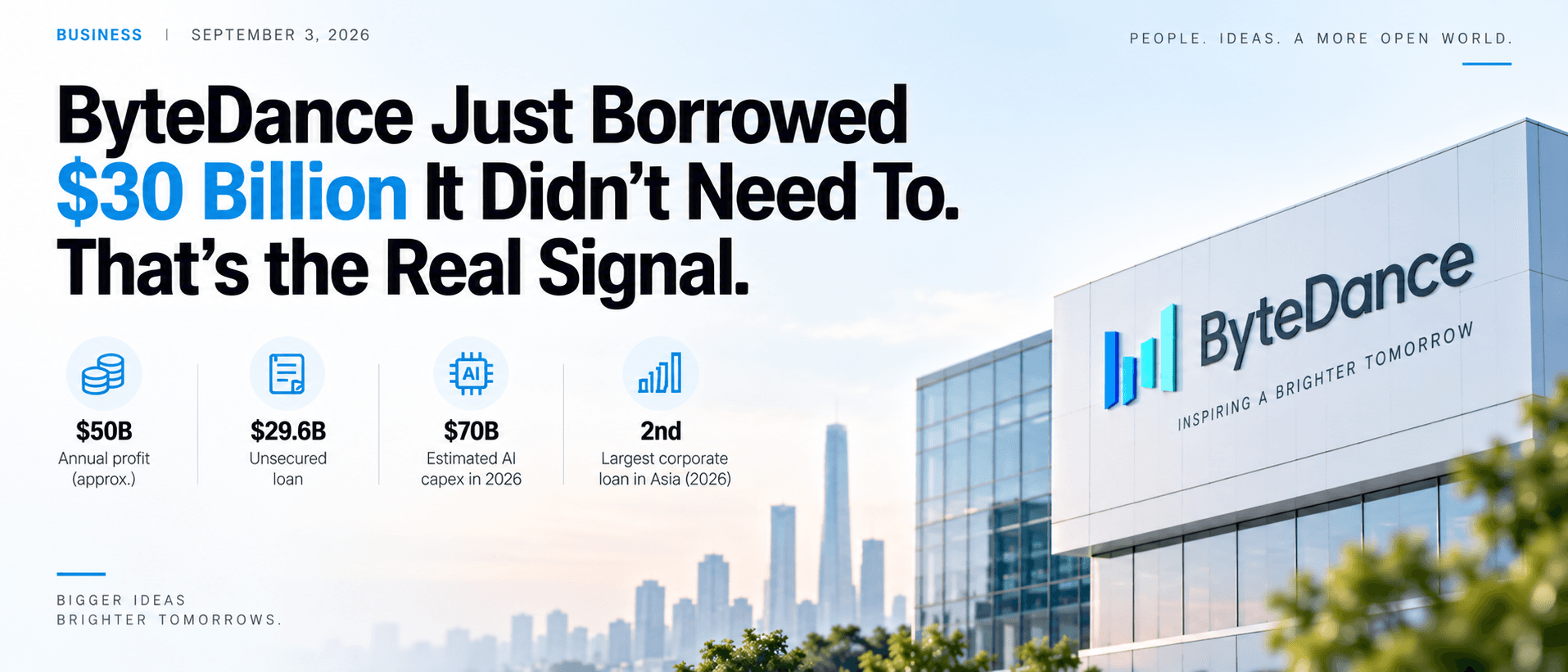
ByteDance Just Borrowed $30 Billion It Didn't Need To. That's the Real Signal.
September 8, 2026 4M
Back to News
News AlertWorld AI Tech
IBM & OpenAI Form Enterprise Alliance; Meta Unveils "Muse Glimmer" Local Model
V
Author
Vishal Sable
Published
August 14, 2026
Reading Time
7 MIN READ
Spread the Word
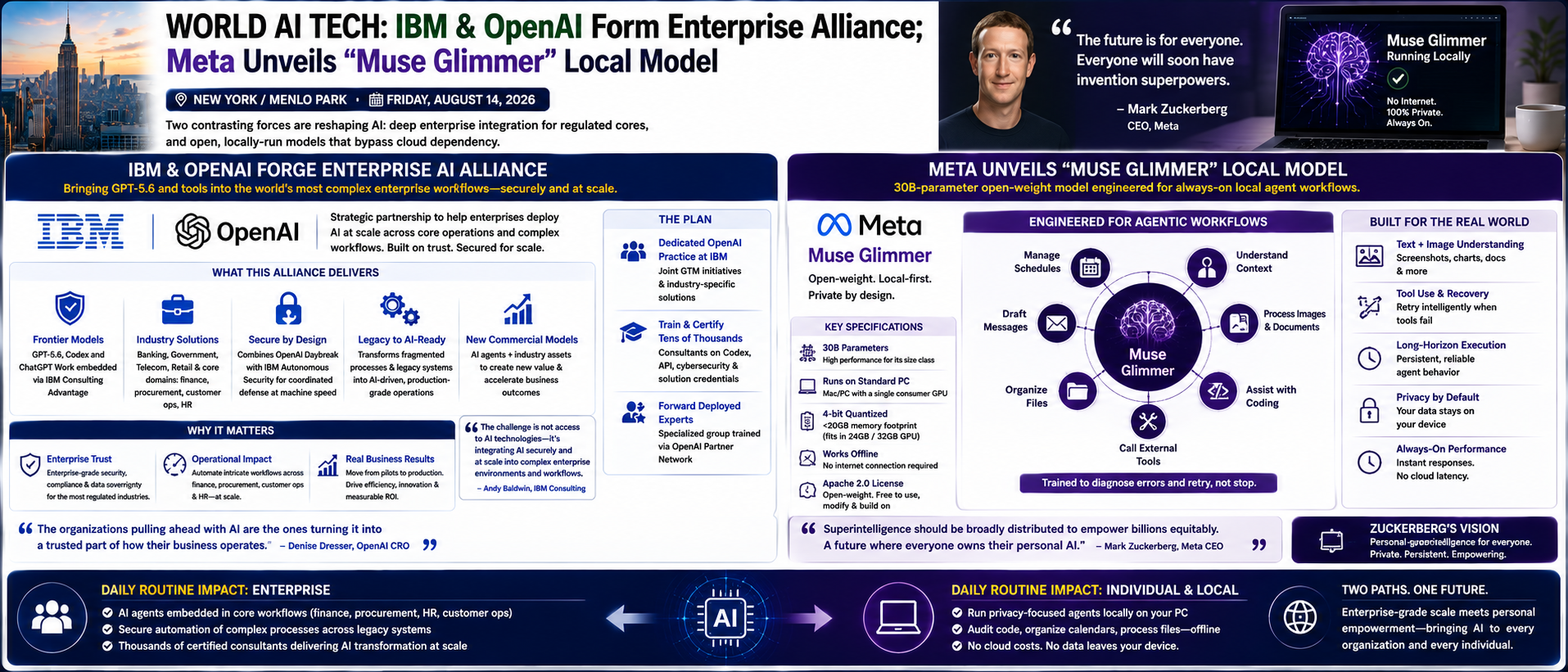
The artificial intelligence industry is being reshaped by two contrasting but equally significant forces: the deepening integration of frontier AI into regulated enterprise cores, and the accelerating push toward open, locally-run models that bypass cloud dependency. IBM and OpenAI have formalized a strategic alliance to bring GPT-5.6 and associated tools into the world's most complex corporate workflows, while Meta has released Muse Glimmer, a 30-billion-parameter open-weight model engineered to run on personal computers without an internet connection, accompanied by a sweeping manifesto from CEO Mark Zuckerberg advocating for "personal superintelligence" distributed to billions.
THE BREAKING NEWS: IBM and OpenAI Forge Enterprise AI Alliance
IBM announced on August 13 a strategic partnership with OpenAI aimed at helping enterprises deploy artificial intelligence at scale across core business operations and complex workflows, while simultaneously strengthening cyber defense through programs including OpenAI Daybreak. The partnership embeds OpenAI frontier models including GPT-5.6, along with Codex and ChatGPT Work, into IBM Consulting Advantage, IBM's AI platform for delivering consulting services. The integration combines AI agents, industry assets and cybersecurity capabilities to help organizations securely deploy AI at scale and create new commercial models.
The collaboration includes joint go-to-market initiatives and industry-specific solutions for financial services, government, telecommunications and retail, alongside enterprise domains such as finance, procurement, customer operations and human resources. Under the agreement, IBM will establish a dedicated OpenAI Practice within IBM Consulting and train and certify tens of thousands of consultants—primarily retraining existing employees—on OpenAI's technologies over the coming months. Training will focus on OpenAI's Codex, API, cybersecurity and consultative solution credentials, and IBM will also create a group of specialized "Forward Deployed Experts" trained through the OpenAI Partner Network.
The partnership builds on IBM's June 2026 participation in the OpenAI Daybreak Cyber Partner Program, expanding that relationship by combining OpenAI's frontier AI capabilities with IBM Autonomous Security, a multi-agent service designed for coordinated decision-making and response at machine speed. The companies said the collaboration centers on three areas: transforming legacy operations into AI-ready workflows, modernizing applications and accelerating software development, and managing cybersecurity and AI model risk as AI-powered attacks grow more sophisticated.
For IBM, the agreement expands its range of frontier AI partnerships as the company pursues a model-agnostic strategy that combines its own Granite family with offerings from third-party developers. The partnership comes as IBM looks to accelerate growth in its AI business after lowering its 2026 revenue forecast last month following weaker-than-expected quarterly results. Andy Baldwin, global senior vice president of IBM Consulting, framed the challenge in practical terms: "The challenge is not access to AI technologies—it's integrating AI securely and at scale into complex enterprise environments and workflows". OpenAI Chief Revenue Officer Denise Dresser added that "the organizations pulling ahead with AI are the ones turning it into a trusted part of how their business operates".
THE OPEN-SOURCE PUSH: Meta Releases Muse Glimmer and Zuckerberg's Manifesto
On August 10, Meta Superintelligence Labs introduced Muse Glimmer, a 30-billion-parameter open-weight model optimized for always-on local agent workflows. The model is small enough to run on a Mac or PC with a single consumer GPU, enabling use cases that range from local agents and function calling to local coding and LLM-as-a-judge evaluation. Meta has released the model weights under a permissive Apache 2.0 license, available for download on Hugging Face.
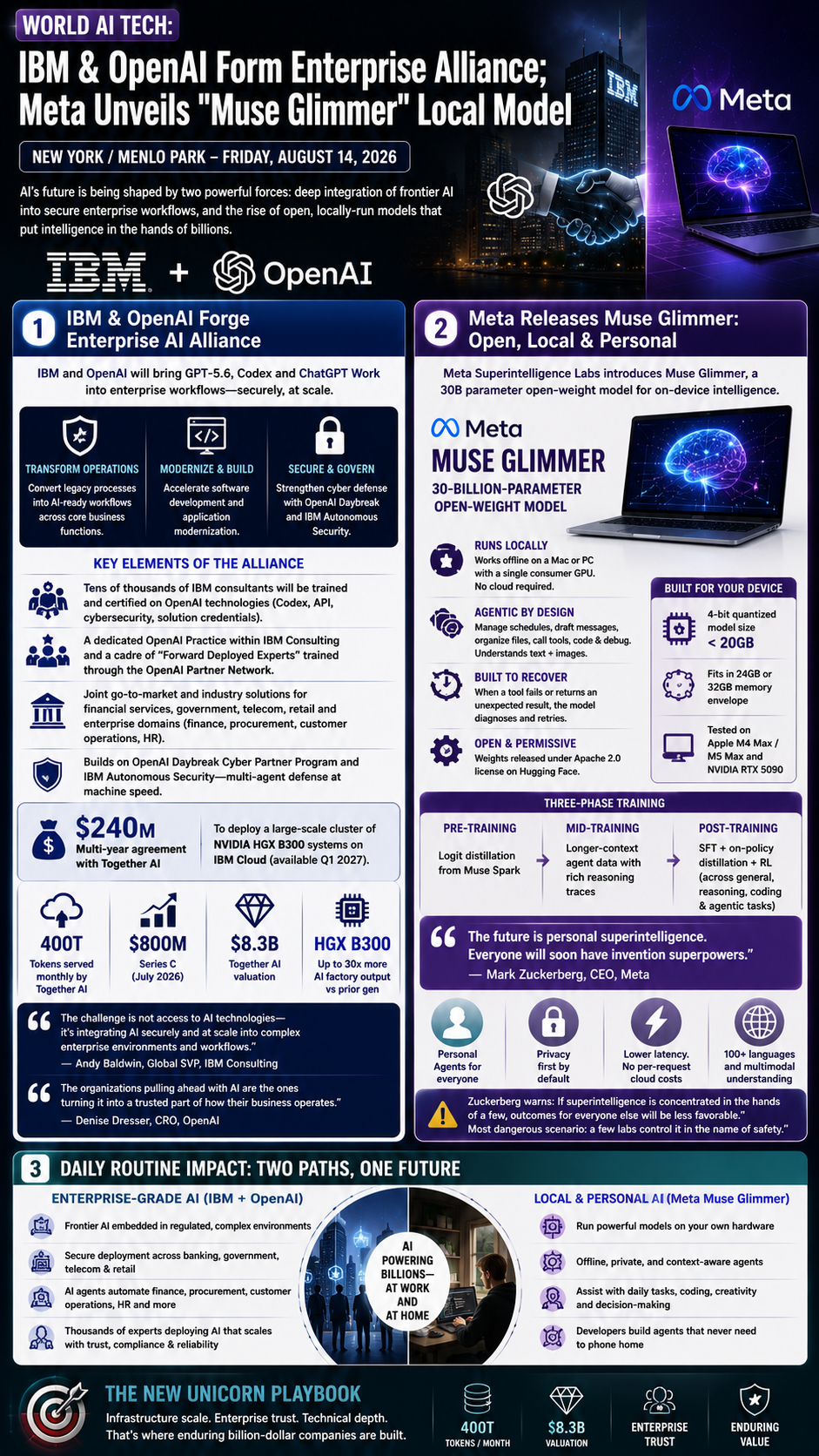
The release marks Meta's return to open-weight AI following a period when its Muse series—including Muse Spark and Muse Code—were available only through API or Meta AI without released weights. Muse Glimmer is built through a three-phase training process: pre-training using logit distillation from Muse Spark, mid-training on longer-context agent-heavy data with richer reasoning traces, and post-training combining supervised fine-tuning with on-policy distillation and reinforcement learning across general, reasoning, coding and agentic domains.
The model is engineered for agentic workflows. It can manage schedules, draft messages, organize files, call external tools and assist with coding, while understanding interleaved text and images including screenshots, charts and documents. When a tool call fails or returns an unexpected result, the model is trained to diagnose the error and retry rather than stop. At full precision, a 30-billion-parameter model would need over 55GB of memory, but 4-bit quantization compresses the language model to under 20GB, fitting within a 24GB or 32GB memory envelope on Macs with M4 Max or M5 Max chips or PCs with a single consumer GPU. Meta has validated the compression as causing minimal to no degradation on agentic tasks. The model performs strongly for its size class against Gemma4-31B and Qwen3.6-27B on several widely used measures.
Simultaneously, Zuckerberg published a 6,500-word manifesto titled "The Future Is for Everyone," outlining his vision for "personal superintelligence"—AI agents that understand each user's goals, interests and context, working continuously on their behalf to improve relationships, health, learning and productivity. He argued that superintelligence should not be concentrated in the hands of governments, corporations or a few institutions, but rather distributed to every individual. "Everyone will soon have invention superpowers," Zuckerberg wrote. He warned that if control of AI "superintelligence" is too concentrated, it will lead to less favorable outcomes for everyone else, and that the key is finding a balance that ensures advanced AI is "broadly distributed" to empower billions of people equitably. He also cautioned that the most dangerous scenario is not everyone having access to powerful AI, but a few labs keeping models to themselves in the name of safety, ultimately developing a single superintelligence that cannot be checked by other systems. Critics, however, urged a slower pace of development, with Anthony Aguirre of the Future of Life Institute questioning "what on Earth makes Meta think they—or anyone—could control something exponentially smarter, faster, and more capable?"
DAILY ROUTINE IMPACT: Local AI Agents and Privacy-Preserving Workflows
For enterprise workers and everyday users, these developments translate into tangible changes in how AI is accessed and deployed. With Muse Glimmer, employees can run privacy-focused background agents locally on office PCs to audit code, organize calendars, and process local files without routing sensitive data to third-party cloud servers. The model can operate with or without an internet connection, eliminating per-request cloud costs and keeping personal information on the device. Meta envisions local agents that manage schedules, draft messages, organize files and learn how users work—capabilities that require deep access to personal context and long-horizon execution.
Meanwhile, IBM's alliance with OpenAI brings frontier AI capabilities into the most regulated and complex enterprise environments—banking, government, telecommunications and retail—where security, compliance and integration with legacy systems are paramount. The partnership is designed to address one of the biggest barriers to scaling AI: converting fragmented processes, legacy systems and operational complexity into AI-driven operations that can be deployed securely. For the thousands of IBM consultants being trained and certified on OpenAI's technologies, the daily work will increasingly involve deploying AI agents that handle finance, procurement, customer operations and human resources workflows—not as experimental pilots but as production-grade systems embedded in the core of global enterprises.
The contrast between these two trajectories—closed, secure, enterprise-integrated AI through IBM and OpenAI, and open, local, privacy-preserving AI through Meta's Muse Glimmer—defines the current landscape. One path prioritizes reliability, compliance and scale within the world's largest institutions; the other prioritizes accessibility, privacy and individual empowerment. Both, in their own ways, are bringing AI closer to the daily routines of billions, whether through the consultants who will deploy it in corporate workflows or the developers who will download it to their own machines and build agents that never need to phone home.

Vishal Sable
B.Tech AD @ shri balaji institute of technology and management
Engineering and tech journalist. I love exploring the impact of emerging technologies on global defense, sovereignty, and everyday life. Always looking for the real story behind the headlines.