Back to News
News AlertWorld Defence Tech
India's Air Force Just Spent Three Days Testing Whether Its Drones Can Fly Without a Pilot Watching Every One
S
Author
Saumya Dawande
Published
September 19, 2026
Reading Time
4 MIN READ
Spread the Word
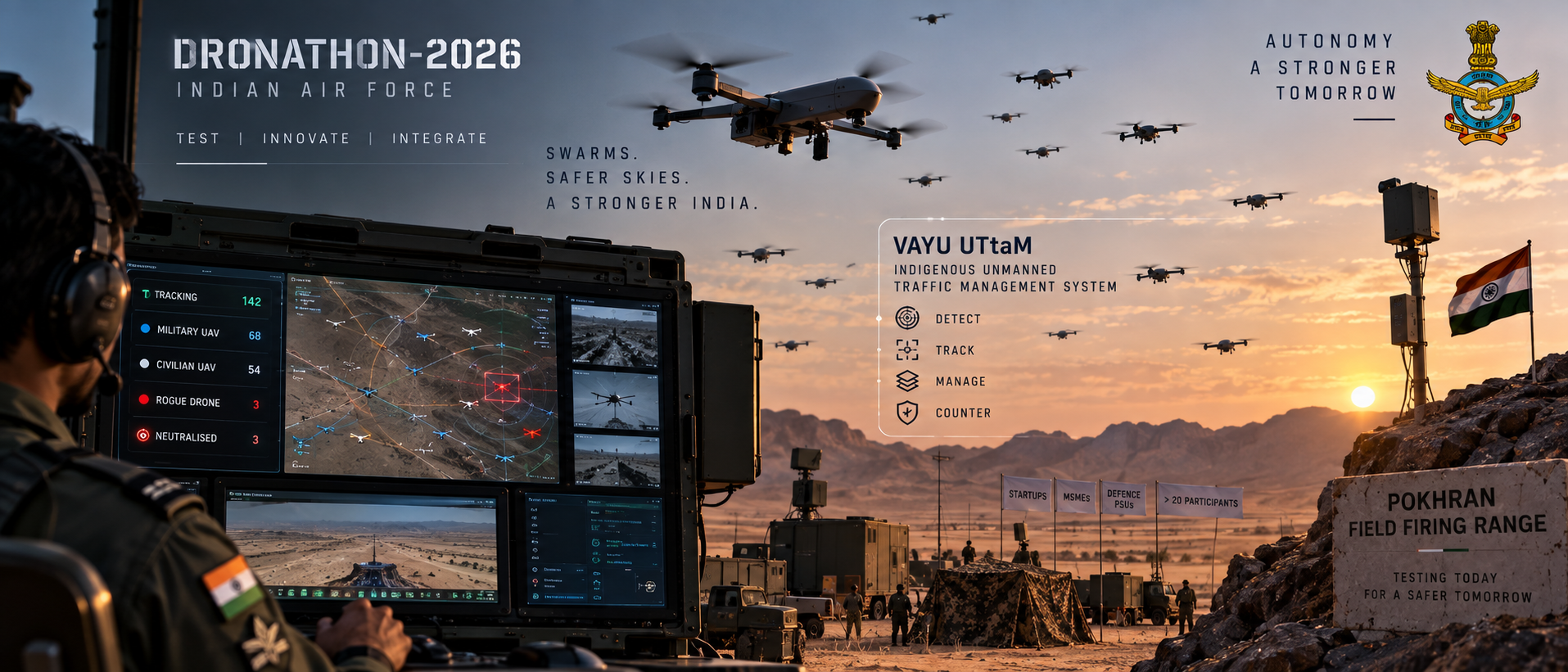
The IAF just ran a three-day exercise testing swarm drones and an indigenous traffic-management system at Pokhran — while China shows one soldier can already fly 200.
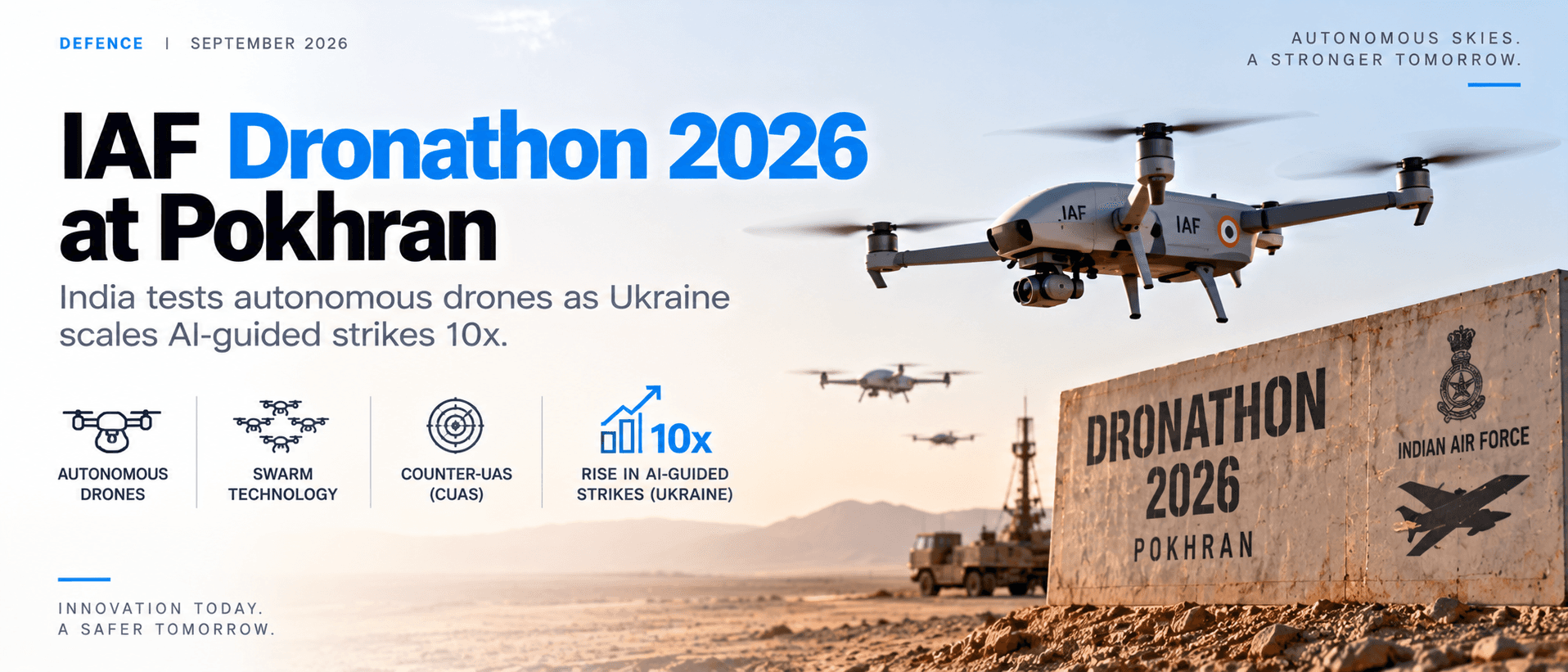
This week, from September 14 to 16, the Indian Air Force ran something it had never done before: Dronathon-2026, a live-fire evaluation of unmanned systems at the Pokhran Field Firing Range in Jaisalmer, with more than 20 defence companies, startups, MSMEs, and defence PSUs putting hardware through real desert operating conditions rather than lab demos. Air Marshal Ashutosh Dixit, the IAF's Vice Chief of Air Staff, opened the event and released an "IAF Unmanned and Autonomous Systems Roadmap" alongside it — a document meant to tell India's drone industry exactly what capabilities the Air Force actually wants built next. SSBCrack , ndian Defence News
The headline system on display was Vayu UTtaM, an indigenously built multi-mode Unmanned Traffic Management platform. In real-time trials at Pokhran, it detected and tracked both military and civilian unmanned aircraft simultaneously — a capability aimed less at combat itself than at the much more mundane problem of not losing control of your own airspace once you've filled it with drones. Vayu UTtaM is also built to flag and help neutralise unauthorised "rogue" drones, a capability with obvious civilian uses too, from protecting airports to securing critical infrastructure. Alongside it, the exercise ran systems across surveillance and reconnaissance, loitering munitions, electronic-warfare payloads, logistics drones, and counter-unmanned aircraft systems — the full stack, not just flashy swarm footage. SSBCrack (Blog)
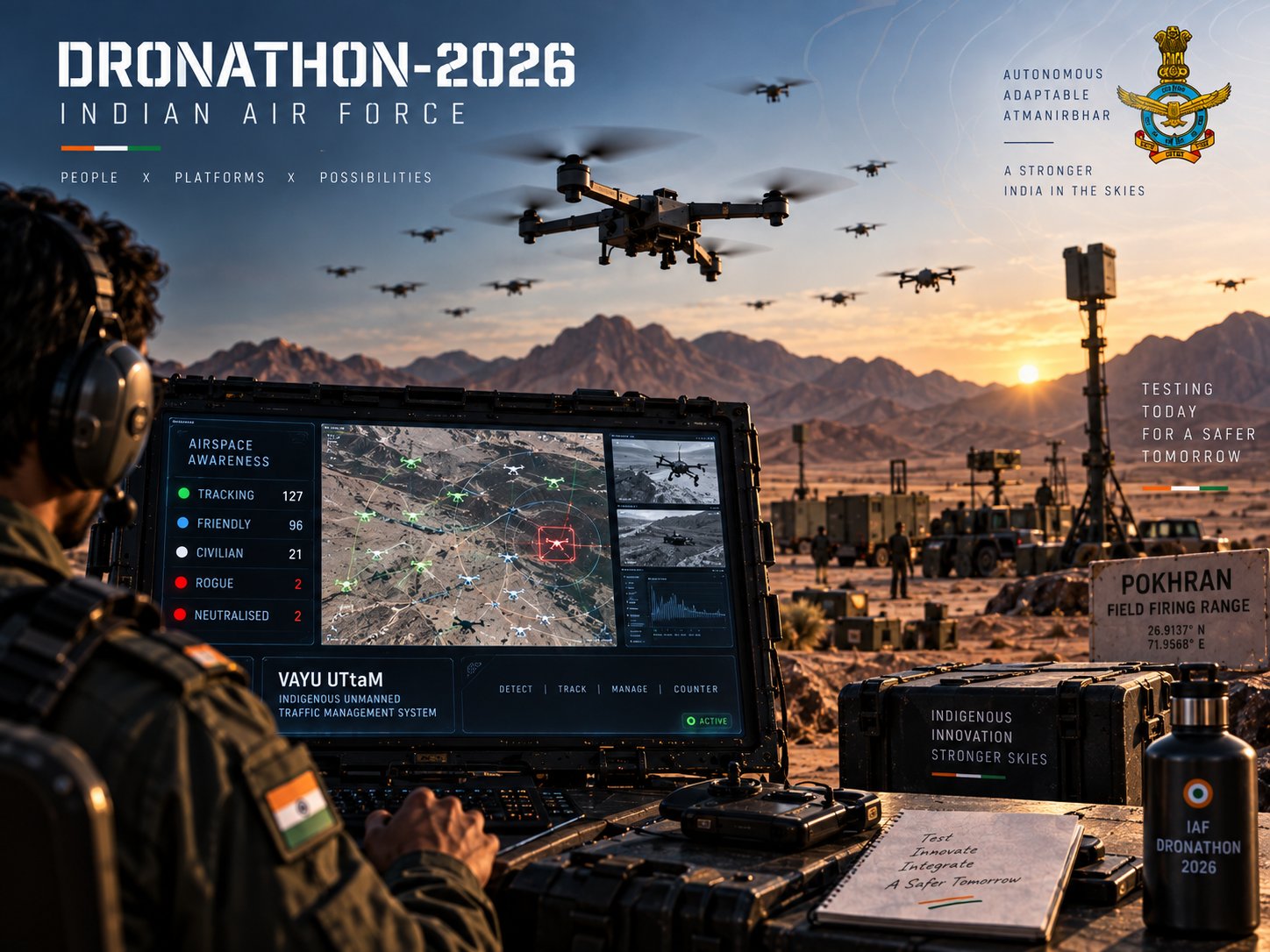
Why run a traffic-management trial before anything flashier? Because the bottleneck your draft correctly identifies — individual human pilots not scaling — is a real, documented constraint elsewhere in the world already. In January, China's PLA publicly demonstrated a single soldier operating a coordinated formation of 200 autonomous drones simultaneously. That's the practical argument for indigenous UTM systems like Vayu UTtaM: before you can trust a swarm to fly itself, you need infrastructure that can even track what dozens or hundreds of autonomous aircraft are doing in shared airspace without a human staring at 200 individual video feeds. Dronathon-2026 is India testing that foundational layer, not skipping straight to swarm combat demos. Vision of Humanity
The push fits a broader Indian defence policy goal — Atmanirbharta, or self-reliance — that the IAF has stated outright as a motivation for the exercise, engaging domestic startups and MSMEs directly rather than relying on imported systems. It's a sensible hedge given how fast this category is moving internationally and how expensive it's proven to depend on someone else's supply chain for it: DARPA is separately soliciting industry proposals for autonomous, containerized drone launch hubs, and multiple reports on the Ukraine war note that both sides are now producing and expending drones at rates that would strain any procurement pipeline built around traditional, imported hardware. SSBCrack , Army Recognition
The honest caveat worth putting next to all of this: real-world combat has already exposed the limits of the "fully autonomous swarm" pitch. Reporting from the Ukraine war notes that true swarming — drones dynamically coordinating with each other in real time, not just flying pre-set routes en masse — remains rare even among the most drone-saturated militaries in the world, precisely because electronic warfare keeps degrading the communication links autonomy depends on. Massed drone strikes are common; genuinely leaderless, adaptive swarms surviving contested electronic warfare are still closer to the frontier than the norm. Forbes
That's the real story Dronathon-2026 represents: not India unveiling a finished swarm-warfare capability this week, but India building the unglamorous traffic-management and testing infrastructure a real one would eventually need — at exactly the moment global evidence suggests the gap between "impressive drone demo" and "reliable autonomous swarm under jamming" is still the hardest problem in the category.

Saumya Dawande
B.Tech AIML @ oriental institute of science technology bhopal
Engineering and tech journalist. I love exploring the impact of emerging technologies on global defense, sovereignty, and everyday life. Always looking for the real story behind the headlines.