Back to News
News AlertWorld Defence Tech
NATO Just Published Its Quantum Roadmap — and Even Its Own Experts Aren't Sure What "AI Meets Quantum" Means for Security Yet
S
Author
Saumya Dawande
Published
September 30, 2026
Reading Time
4 MIN READ
Spread the Word
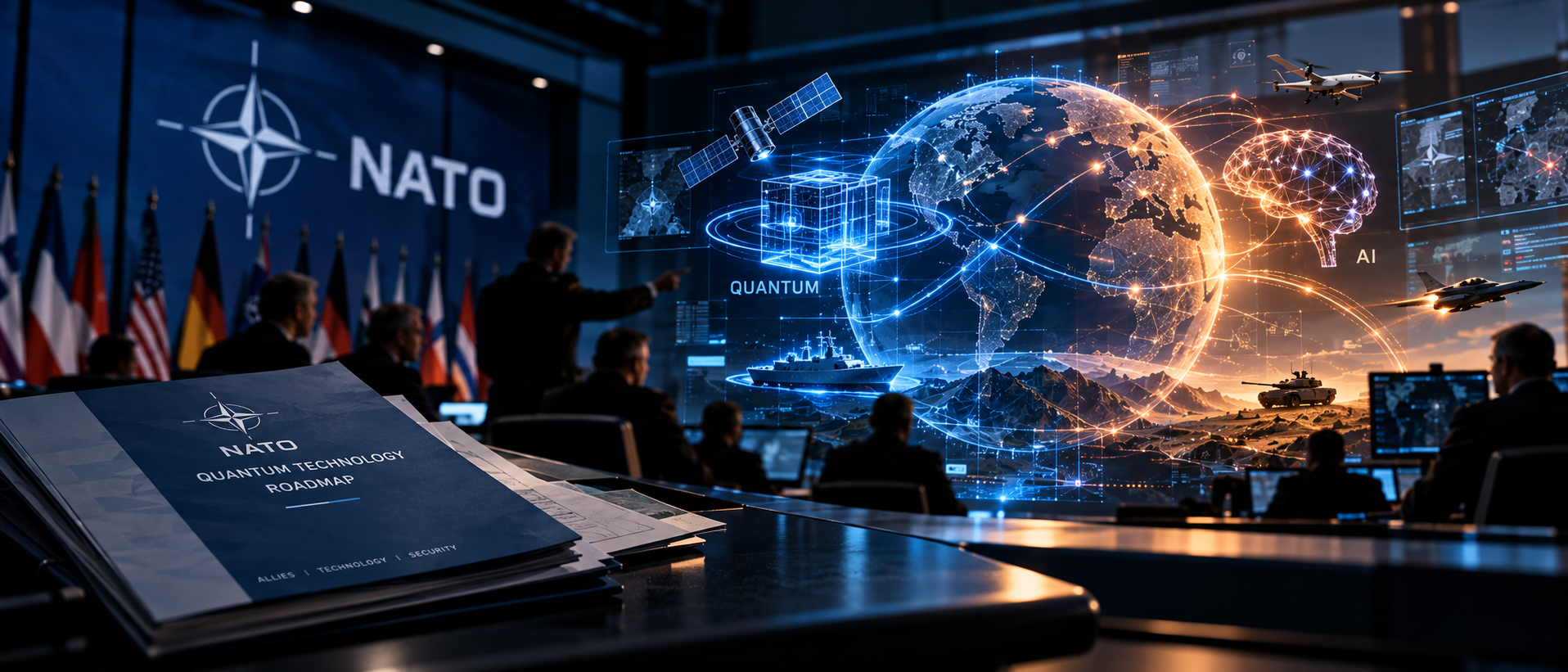
NATO published its quantum roadmap today. Days earlier, its quantum experts met in Washington to discuss something with no settled answer yet: AI-quantum convergence.
Today, September 29, NATO released the public summary of a quantum technology roadmap that Allies had actually approved back on July 30. The gap between approval and publication is itself telling: this isn't a hastily announced initiative, it's a document that took two months to turn into something releasable, built to guide quantum adoption across NATO and allied armed forces while managing the risks of falling behind rivals in the field. NATO
The roadmap itself covers three areas — quantum computing, quantum communication, and quantum sensing — and builds on a quantum strategy NATO first approved back in 2023. What's new is the explicit acknowledgment that quantum doesn't sit in its own lane: the roadmap states that how quantum technologies interact with other dual-use fields, specifically AI, space, and next-generation communications, will be central to NATO's work going forward. That's a meaningfully different framing from a pure quantum-computing roadmap. It's an admission that the interesting risks and opportunities show up at the seams between technologies, not inside any one of them. NATO

The clearest evidence of that came from NATO's Transatlantic Quantum Community, which met in Washington D.C. just five days ago, on September 24 and 25. Their agenda read like a list of unresolved problems rather than a victory lap: how advances in quantum computing could affect secure communications, critical infrastructure, intelligence work, strategic stability, and crisis decision-making. They specifically addressed the implications of AI-quantum convergence for defence and security — language that signals a topic being actively worked through, not one with settled conclusions ready to publish. NATO
The concrete, less speculative work is happening in positioning and navigation. Earlier this month, NATO's Centre for Maritime Research and Experimentation ran an exercise called Questor 26 in La Spezia, Italy, together with the Transatlantic Quantum Community's Industry Network, specifically testing how quantum technologies could be harnessed for positioning, navigation, and sensing. That's a direct answer to the GPS-jamming problem already reshaping how militaries navigate — the same pressure that pushed the Indo-Pacific edge-AI navigation shift covered earlier this month — except here the proposed fix is quantum sensing rather than onboard AI processing. It's a reminder that GPS-denial has more than one candidate solution competing to solve it, and nobody's picked a winner yet. NATO
The community itself is also growing. Belgium and Bulgaria formally joined the Transatlantic Quantum Community at this month's meeting, bringing the group to 22 Allies plus six partner nations. The Netherlands has chaired the community since May, with Canada as vice-chair — a non-binding, informal structure of experts from governments, industry, academia, and research institutions, established only in 2024. That informality is worth noting: unlike a binding NATO capability commitment, this is a coordination body, which means its influence depends on whether member states actually act on what it recommends rather than on any enforcement mechanism. NATO
The one piece of this that's furthest from ambiguous is cryptography. NATO's underlying 2023 quantum strategy already commits the alliance to transitioning its cryptographic systems to quantum-safe encryption — the defensive side of the AI-quantum story, protecting today's communications against a future quantum computer capable of breaking them. That's the part of "quantum readiness" that isn't waiting on convergence with AI to become urgent; a sufficiently powerful quantum computer built by an adversary years from now could still retroactively decrypt data intercepted today, which is why post-quantum migration is treated as current work rather than a future problem.
The open question the roadmap doesn't answer, and that this week's meeting in Washington suggests NATO itself hasn't settled, is what AI-quantum convergence actually changes operationally — whether it's mainly a sensing and navigation story, a cryptographic vulnerability story, or something genuinely new that current defence planning categories don't have a name for yet. A roadmap that takes two months to go from approval to public release, built around a community that only formed in 2024, is evidence of a field still figuring out what it's building toward, not one that's arrived.

Saumya Dawande
B.Tech AIML @ oriental institute of science technology bhopal
Engineering and tech journalist. I love exploring the impact of emerging technologies on global defense, sovereignty, and everyday life. Always looking for the real story behind the headlines.