LATEST NEWS
ByteDance Just Borrowed $30 Billion It Didn't Need To. That's the Real Signal.
September 8, 2026 4M
Back to News
News AlertWorld AI Tech
NIST Launches TEVV-Athlon Framework as AI Startups Reach $305.6B in Collective Revenue Run-Rate
V
Author
Vishal Sable
Published
August 7, 2026
Reading Time
5 MIN READ
Spread the Word
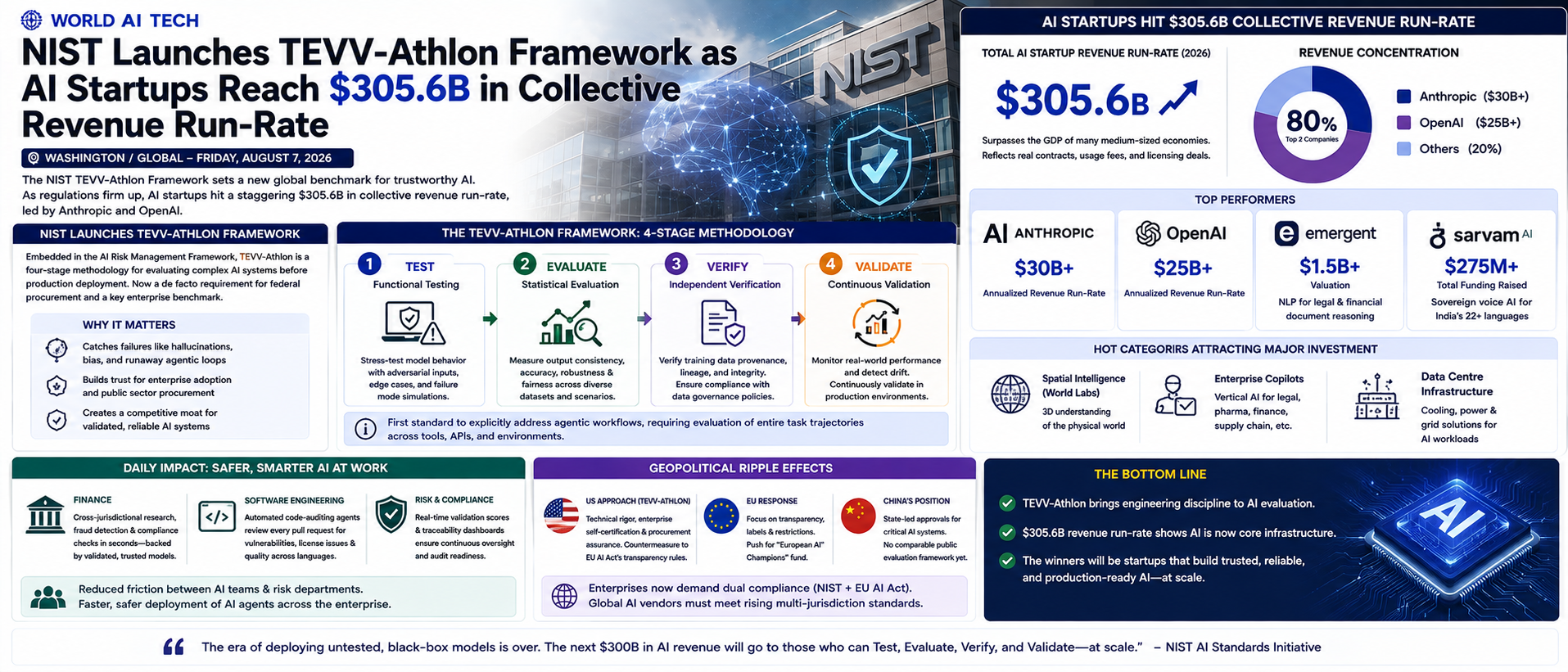
The United States has taken a decisive step toward taming the wild frontier of enterprise artificial intelligence with the official release of the TEVV-Athlon Framework by the National Institute of Standards and Technology. Embedded within the broader AI Risk Management Framework, this new standard offers organizations a rigorous four-stage methodology covering test, evaluate, verify, and validate procedures for complex multimodal models, agentic workflows, and domain-specific AI systems before they are permitted to operate in production environments. The framework arrives not as a voluntary guideline but as a de facto prerequisite for federal procurement and an increasingly expected benchmark for Fortune 500 vendors, effectively creating a compliance moat that separates vetted AI from experimental demos. Its four phases—functional testing under adversarial inputs, statistical evaluation of output consistency, independent verification of training-data provenance, and continuous validation against real-world drift—are designed to catch the subtle failures that have plagued earlier deployments, such as hallucinated legal citations, biased credit-scoring outputs, and agentic loops that consume unbounded cloud resources. Industry observers note that TEVV-Athlon is the first standard to explicitly address "agentic workflows," meaning autonomous AI systems that chain multiple tools and external APIs, requiring evaluators to simulate entire task trajectories rather than isolated prompt-response pairs, a complexity that has already prompted major consultancies to launch dedicated TEVV-certification practices.
While the regulatory architecture solidifies, the financial scale of the AI sector continues to astound. Fresh metrics from Forbes' 2026 AI 50 reveal that the collective revenue run-rate of AI startups has surged to $305.6 billion, a figure that surpasses the GDP of many medium-sized economies and underscores the technology's transition from speculative research to core infrastructure. The concentration of this wealth, however, is staggering: Anthropic, having crossed a $30 billion annualized revenue run-rate, and OpenAI, now exceeding $25 billion in annualized revenue, together account for approximately 80 percent of the top-tier funding and revenue generation within the elite cohort. This duopoly has reshaped investor sentiment, driving a pronounced market shift away from general-purpose chat interfaces and toward specialized enterprise tools that offer measurable ROI, such as vertical legal copilots, pharmaceutical discovery engines, and supply-chain optimisation suites. Simultaneously, emerging categories like spatial intelligence, championed by World Labs, and direct data-centre power infrastructure startups, which design liquid-cooling and grid-stabilisation systems for AI clusters, have captured outsized attention, as hyperscalers grapple with the physical constraints of scaling trillion-parameter models. The $305.6 billion figure is not merely a vanity metric; it represents real subscription contracts, usage-based fees, and on-premise licensing deals that have replaced the early "free tier" frenzy with hard-nosed procurement negotiations, forcing even the most experimental startups to demonstrate clear cost-benefit calculus within six to nine months of closing their Series B rounds.
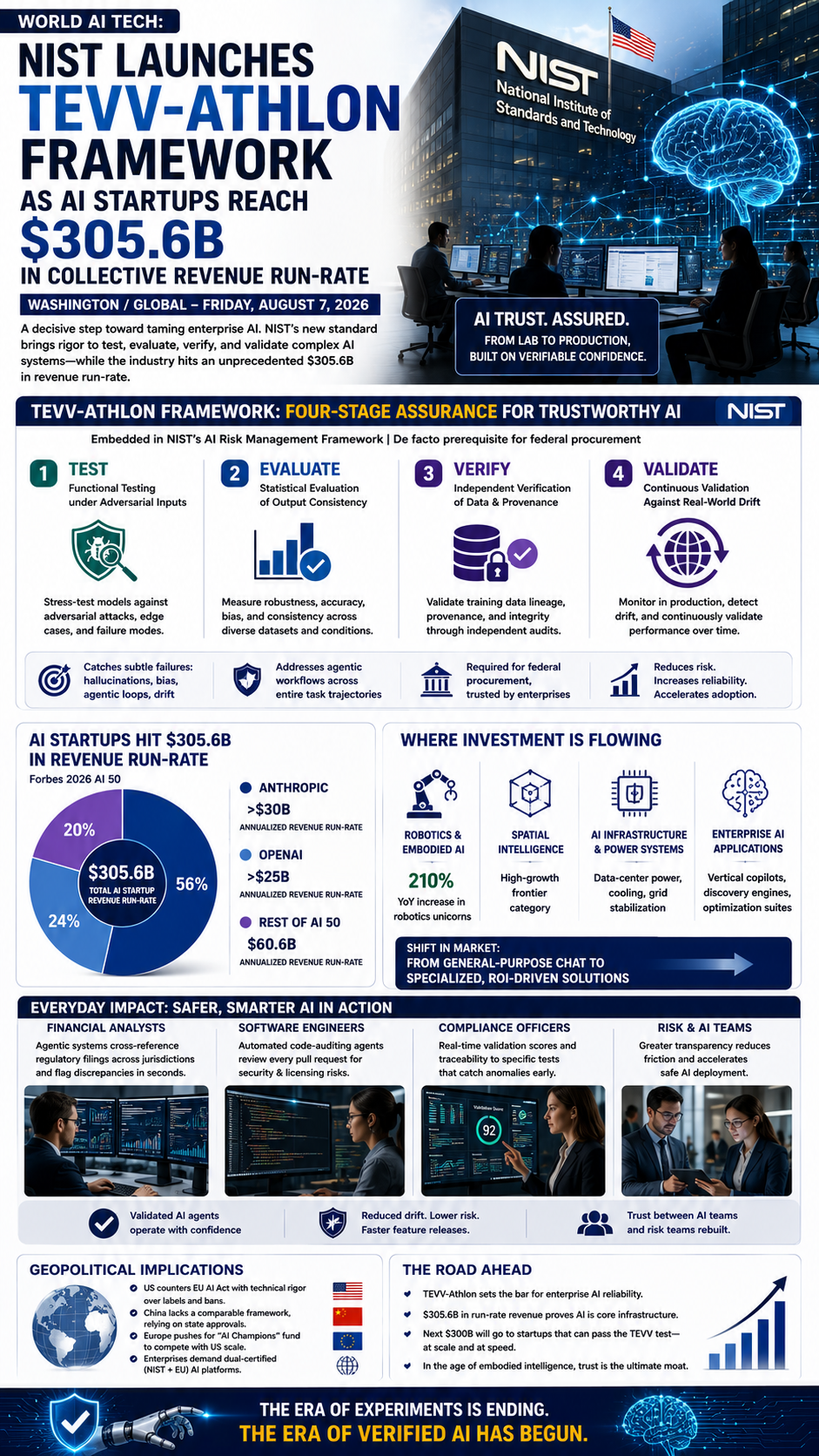
For the average enterprise worker and technology decision-maker, the TEVV-Athlon standard translates directly into a safer, more predictable daily operating environment. Platforms that have completed the NIST-mandated validation now deploy vetted background AI agents that handle real-time data analysis, automated code auditing, and continuous compliance checks without the risk of unmonitored model drift undermining critical decisions. A financial analyst at a multinational bank can rely on an agentic system to cross-reference regulatory filings across five jurisdictions and flag discrepancies within seconds, knowing that the underlying model has been stress-tested against historical fraud patterns and adversarial data-poisoning attempts. A software engineering team can schedule automated code-auditing agents to review every pull request for security vulnerabilities and licensing violations, with the validation framework ensuring that the agent's reasoning remains consistent across programming languages and framework versions. Perhaps most significantly, compliance officers now receive dashboards that display real-time "validation scores" for each deployed agent, allowing them to trace any anomalous output back to the specific evaluation test that would have caught similar anomalies during pre-deployment trials. This transparency is already reducing the friction between AI teams and risk-management departments, which had previously been locked in a cycle of suspicion and ad-hoc testing that delayed feature releases by weeks or months.
Geopolitically, the NIST TEVV-Athlon release represents a calculated countermeasure to the EU AI Act's transparency mandates, offering a distinctly US-style approach that emphasises technical rigour and enterprise self-certification rather than blanket labelling and prescriptive bans. While the European framework focuses on consumer-facing notifications and biometric restrictions, the American standard prioritises backend reliability and procurement-grade assurance, appealing to global enterprises that require both EU and US compliance and are now demanding dual-certified platforms. China, meanwhile, has yet to release a comparable evaluation framework, preferring instead to mandate state-led approvals for any AI system deployed in critical sectors, a slower but potentially more centralised process that could disadvantage Chinese startups seeking Western enterprise customers. The $305.6 billion revenue figure also fuels transatlantic tensions, as European regulators question why US-based AI giants capture such disproportionate global market share while European rivals remain fragmented and underfunded, prompting fresh calls for a "European AI Champions" fund that would rival the scale of US venture commitments. For the broader technology ecosystem, the TEVV-Athlon framework and the revenue concentration at the top signal a maturation phase: the era of deploying untested, black-box models into live production is ending, replaced by an engineering discipline that treats AI evaluation as seriously as semiconductor validation or pharmaceutical trials. As enterprises rush to certify their agentic fleets against the new NIST standard, the startups that can navigate the four-stage gauntlet quickly and cost-effectively will likely claim the lion's share of the next $300 billion in revenue, while those that treat evaluation as an afterthought may find themselves locked out of the enterprise market entirely, regardless of their model's raw performance on academic benchmarks.

Vishal Sable
B.Tech AD @ shri balaji institute of technology and management
Engineering and tech journalist. I love exploring the impact of emerging technologies on global defense, sovereignty, and everyday life. Always looking for the real story behind the headlines.