LATEST NEWS
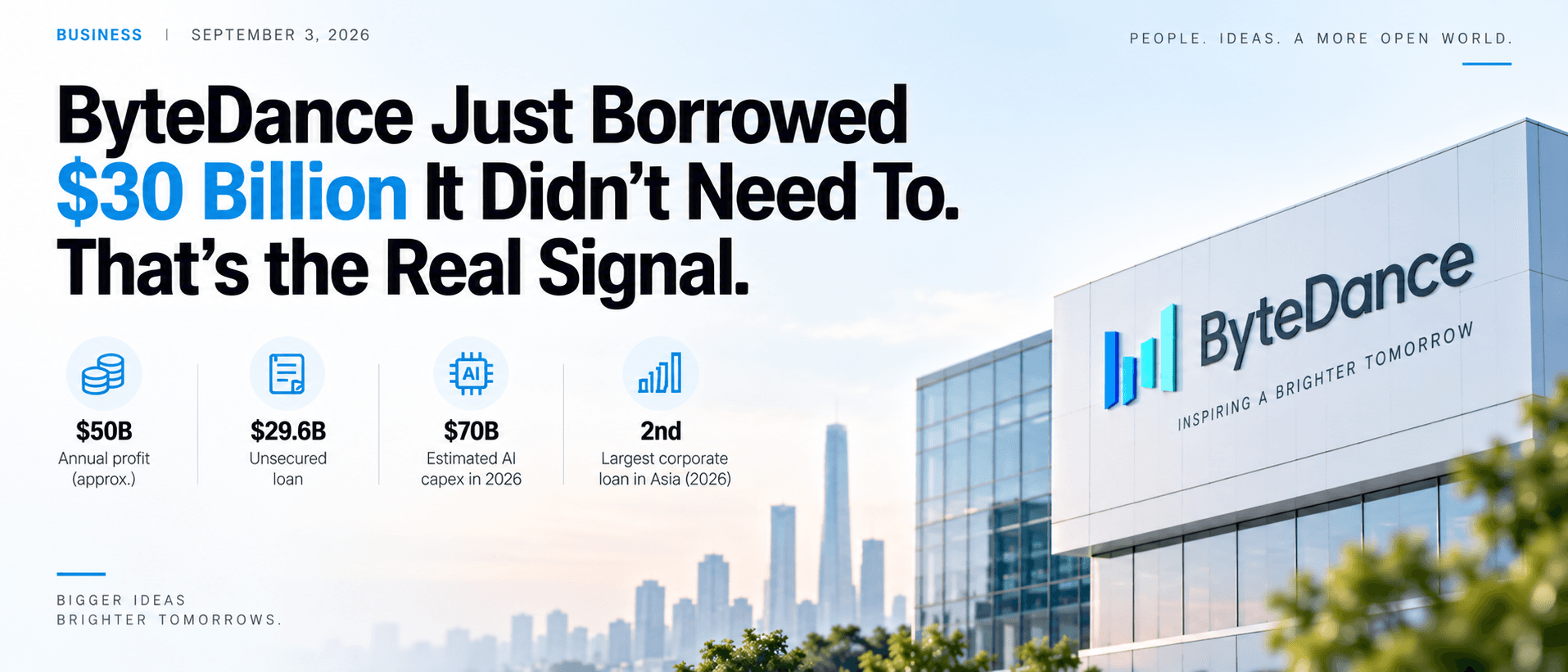
ByteDance Just Borrowed $30 Billion It Didn't Need To. That's the Real Signal.
September 8, 2026 4M
Back to News
News AlertWorld AI Tech
Nobody's Getting Fired. Nobody's Getting Hired. That's the AI Jobs Story Nobody's Telling.
V
Author
Vishal Sable
Published
August 28, 2026
Reading Time
4 MIN READ
Spread the Word
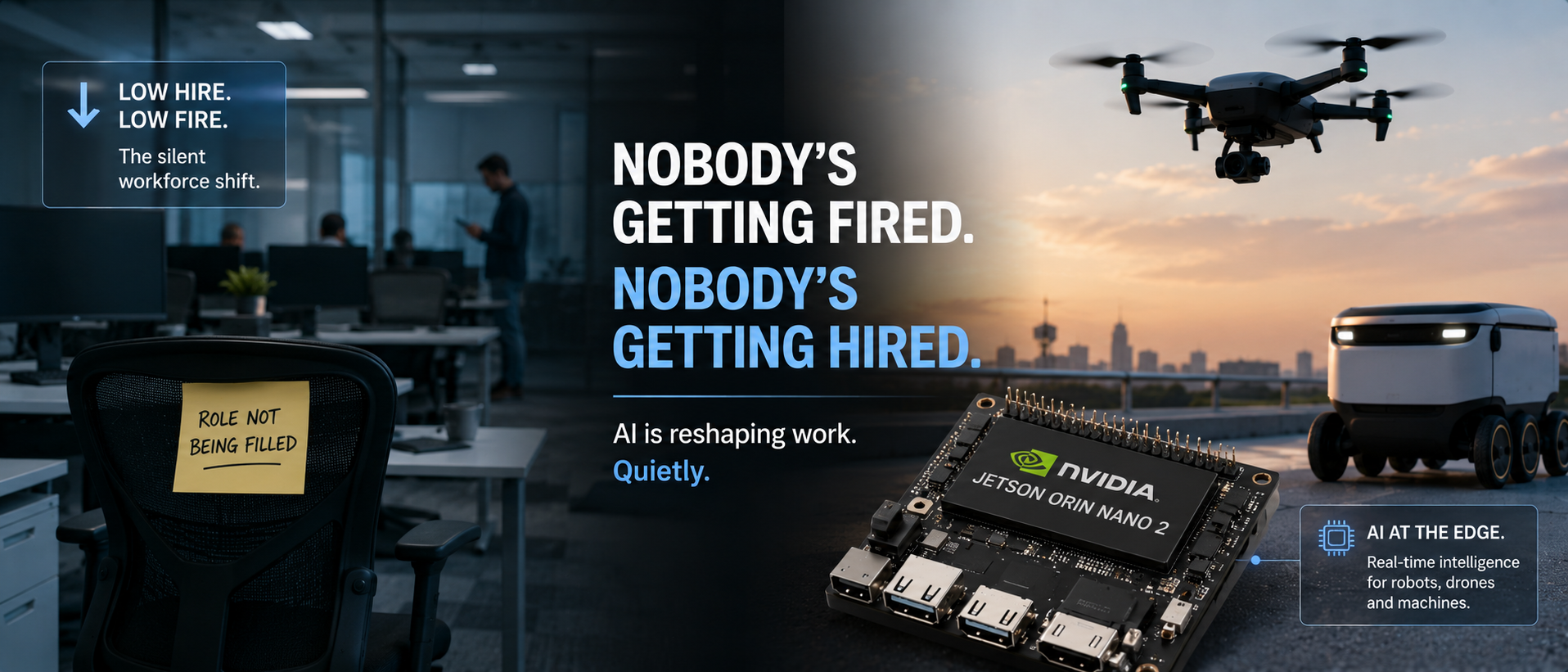
AI isn't triggering mass layoffs — it's freezing hiring instead. Meanwhile Nvidia's new Jetson Orin Nano 2 puts generative AI directly on drones and robots. Two quiet shifts, one workforce being reshaped without headlines.
The layoff headlines are hiding the real story
Every few weeks another company announces AI-linked layoffs, and every time, it drives the same panic cycle online. But the data tells a quieter, stranger story — and it's arguably the more important one.
U.S. labor economists have a specific term for what's actually happening: "low hire, low fire." Layoffs aren't spiking. Job openings, quits, and terminations have all stayed roughly flat for more than a year. What's changed is what happens between the headlines — when someone leaves a company voluntarily, more employers are just... not replacing them. AI absorbs the workload instead. The position quietly disappears, and no press release ever gets written.
U.S. labor economists have a specific term for what's actually happening: "low hire, low fire." Layoffs aren't spiking. Job openings, quits, and terminations have all stayed roughly flat for more than a year. What's changed is what happens between the headlines — when someone leaves a company voluntarily, more employers are just... not replacing them. AI absorbs the workload instead. The position quietly disappears, and no press release ever gets written.
On the same week this pattern kept showing up in fresh workforce data, Nvidia launched a piece of hardware built for the other half of this shift: getting AI out of chat windows and directly into physical machines doing the work itself.
Attrition, not layoffs — the strategy nobody announces
The mechanism is almost boringly simple, which is exactly why it doesn't make headlines: an employee leaves, the role stays open, AI tools absorb the workload, and the team just... shrinks. No announcement, no press cycle, no public backlash. Multiply that across thousands of companies and you get workforce reduction that never shows up as a single dramatic event.
Some of the clearest public examples of this pattern predate this year but set the template: one major fintech company cut roughly 700 customer service roles over two years by routing the work through an AI assistant, then held a hiring freeze for over a year — headcount fell by more than a fifth almost entirely through people leaving on their own, not through cuts. Enterprise software leaders have made similar promises in public: no mass layoffs, but also no guarantee every vacancy gets refilled with a human.
This matters more than a splashy layoff headline because it's harder to see coming. A round of layoffs is a single, countable, reportable event. A hiring freeze plus quiet attrition is a slow leak — and by the time it shows up in aggregate labor statistics, it's already reshaped an entire industry's headcount.
Nvidia's answer: put the AI on the machine itself
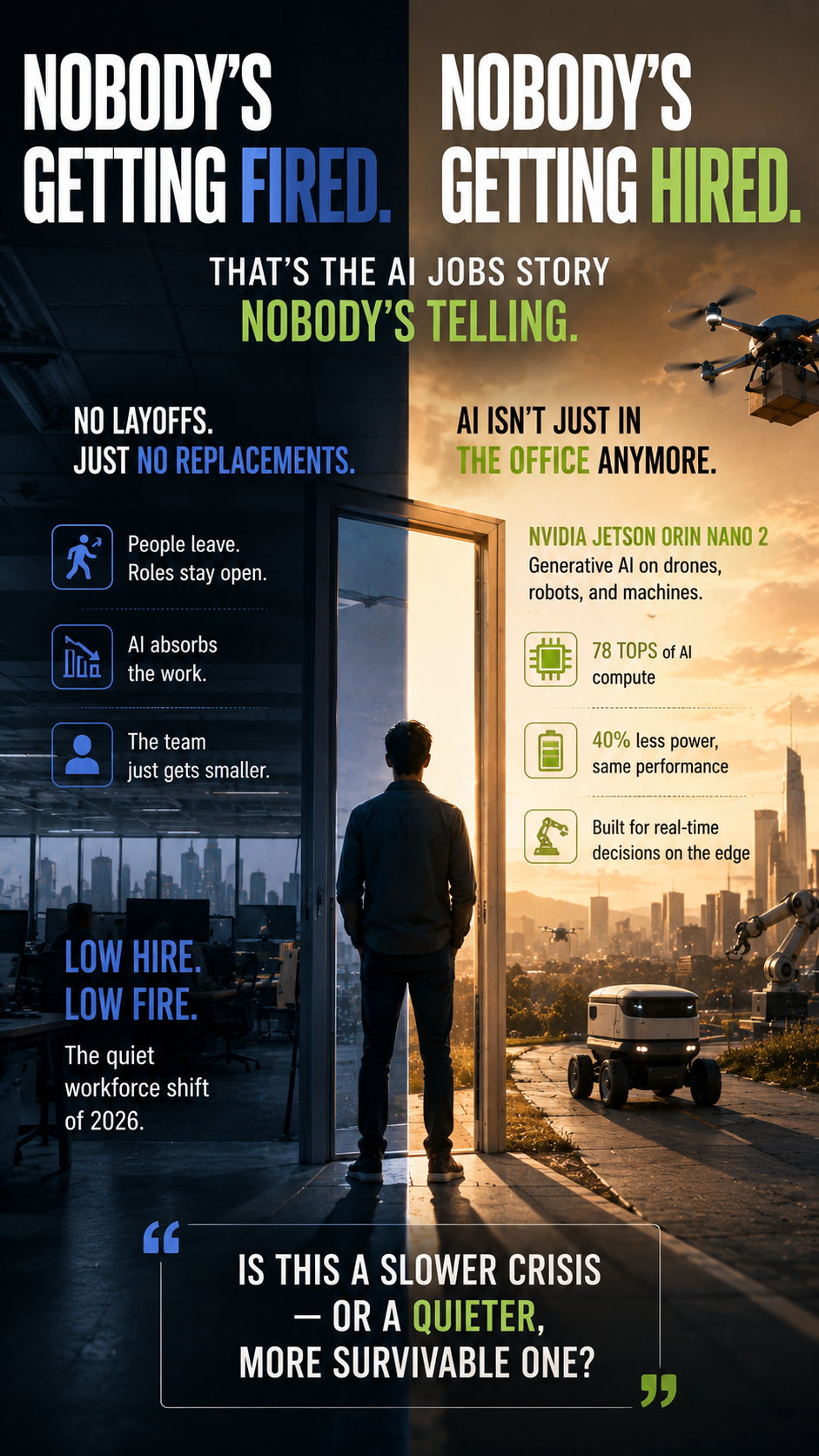
While that shift plays out in offices, Nvidia just made the physical side of AI automation dramatically more accessible. The company launched the Jetson Orin Nano 2, a compact robotics computer built to run generative AI models directly on drones, delivery robots, inspection equipment, and vision systems — without needing a connection back to a data center.
The specs matter here: the new board delivers roughly double the inference performance of its predecessor in the same physical size, while using 40% less power at matched performance. It packs 78 trillion operations per second of AI compute into an 8GB, eight-core board designed to run in real time, at the edge, on battery power. Nvidia says more than 3 million developers are already building on its robotics stack, with early partners including Cognex, Doosan Bobcat, delivery-drone company Wing, and home-robotics maker Matic.
The pitch, in Nvidia's own framing, is that small AI models have finally gotten as accurate as last year's largest frontier models — which means a drone or delivery robot can now carry real reasoning ability onboard, instead of needing to phone home to a cloud server to understand what it's looking at.
Two different automations, one shared direction
Put side by side, these aren't really separate stories. Office attrition is AI quietly absorbing entry-level administrative and data work that used to require a hire. Jetson Orin Nano 2 is AI quietly absorbing physical inspection and delivery work that used to require a person on-site. Neither shows up as a dramatic announcement. Both show up, eventually, as a job that simply never gets posted.
That's the throughline worth paying attention to: 2026's AI disruption isn't arriving as a single wave of layoffs or a single robot uprising headline. It's arriving as thousands of small, unannounced decisions — a vacancy left open here, a drone route automated there — that only look big once you zoom out.
If nobody's actually being laid off, but nobody's being hired either, is that a slower crisis than mass layoffs — or a quieter, more survivable one?
---
Sources: Truflation, HR Dive, NVIDIA Newsroom, The Robot Report, Forbes.

Vishal Sable
B.Tech AD @ shri balaji institute of technology and management
Engineering and tech journalist. I love exploring the impact of emerging technologies on global defense, sovereignty, and everyday life. Always looking for the real story behind the headlines.