LATEST NEWS
ByteDance Just Borrowed $30 Billion It Didn't Need To. That's the Real Signal.
September 8, 2026 4M
Back to News
News AlertWorld AI Tech
Nvidia and Japan Launch World's First National "Physical AI" Infrastructure
V
Author
Vishal Sable
Published
July 16, 2026
Reading Time
2 MIN READ
Spread the Word
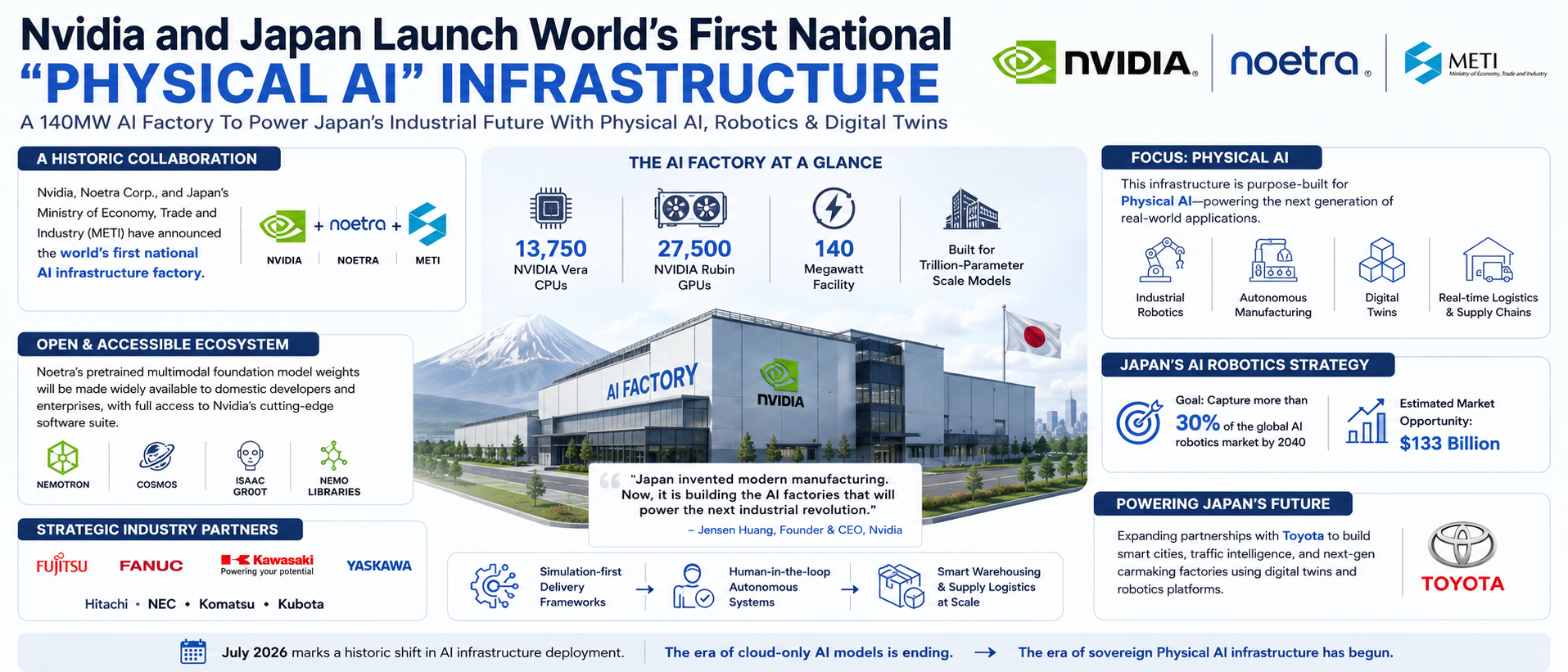
Artificial intelligence is moving aggressively away from generic online chatbots to capture physical computing infrastructure, heavy manufacturing, and real-world logistics. On July 16, Nvidia officially announced a monumental partnership with Noetra Corp. and Japan's Ministry of Economy, Trade and Industry (METI) to launch the world's first national AI infrastructure factory . Powered by 13,750 Nvidia Vera CPUs and 27,500 Rubin GPUs, the massive 140-megawatt data center will serve as the computing bedrock for Japan's FRONTia Project .
The facility is specifically designed to bypass text-centric models to focus exclusively on Physical AI—building open multimodal foundation models that power industrial robotics, real-time autonomous manufacturing lines, and advanced digital twins . Noetra's pretrained multimodal foundation model weights will be made broadly available to domestic model developers and enterprises alongside Nvidia's software suite including Nemotron, Cosmos, Isaac GR00T open models, and NeMo libraries . The AI factory will support training trillion-parameter-scale models, giving organizations across Japan access to one of the world's most advanced AI environments .
Japan's AI Robotics Strategy, released in March, sets a goal for the country to capture more than 30% of the global AI robotics market by 2040, representing an estimated $133 billion opportunity . Nvidia is expanding its AI partnerships across Japan's industrial base. Fujitsu, Fanuc, Kawasaki Heavy Industries, and Yaskawa Electric have joined the Nvidia-led Cosmos Coalition to accelerate adoption of Nvidia platforms for physical AI, with Hitachi, NEC, Komatsu, and Kubota also joining . Nvidia is also expanding its partnership with Toyota to power smart cities, traffic intelligence systems, and carmaking factories through digital twins and robotics platforms .
Physical AI is integrating seamlessly into enterprise workflows. Market tracking data reveals that major global service firms are rapidly deploying simulation-first delivery frameworks. In everyday business settings, companies are shifting from basic software automation to using trusted, human-in-the-loop autonomous robotic systems to handle complex warehousing and supply logistics natively. Jensen Huang, Nvidia's founder and CEO, framed the strategic significance: "Japan invented modern manufacturing. Now, it is building the AI factories that will power the next industrial revolution" . July 2026 marks a historic shift in AI infrastructure deployment. The era of cloud-only AI models is ending. The era of sovereign physical AI infrastructure, built for real-world robotics and manufacturing at national scale, is already here.

Vishal Sable
B.Tech AD @ shri balaji institute of technology and management
Engineering and tech journalist. I love exploring the impact of emerging technologies on global defense, sovereignty, and everyday life. Always looking for the real story behind the headlines.