LATEST NEWS
ByteDance Just Borrowed $30 Billion It Didn't Need To. That's the Real Signal.
September 8, 2026 4M
Back to News
News AlertWorld AI Tech
NVIDIA Just Paid MediaTek $3.5 Billion to Not Compete With It
V
Author
Vishal Sable
Published
August 31, 2026
Reading Time
4 MIN READ
Spread the Word
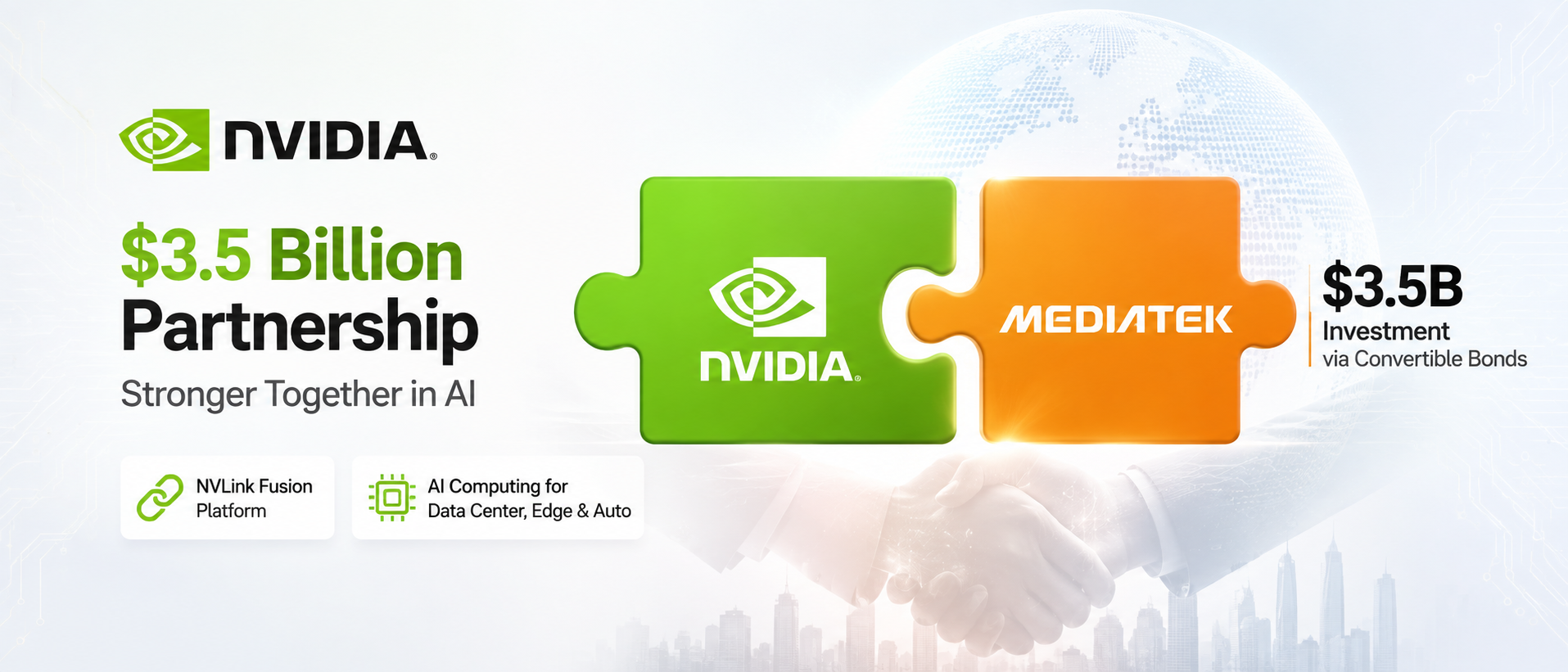
NVIDIA invested $3.5B in MediaTek and expanded NVLink Fusion — its second major chip-partner buy-in after Marvell, aimed at defusing the custom-silicon threat to its GPU dominance.
The real news isn't the partnership — it's the price tag
NVIDIA MediaTek partnership, NVLink Fusion platform, custom XPU AI chips, NVIDIA chip investment 2026, agentic AI edge computing hardware
The real news isn't the partnership — it's the price tag
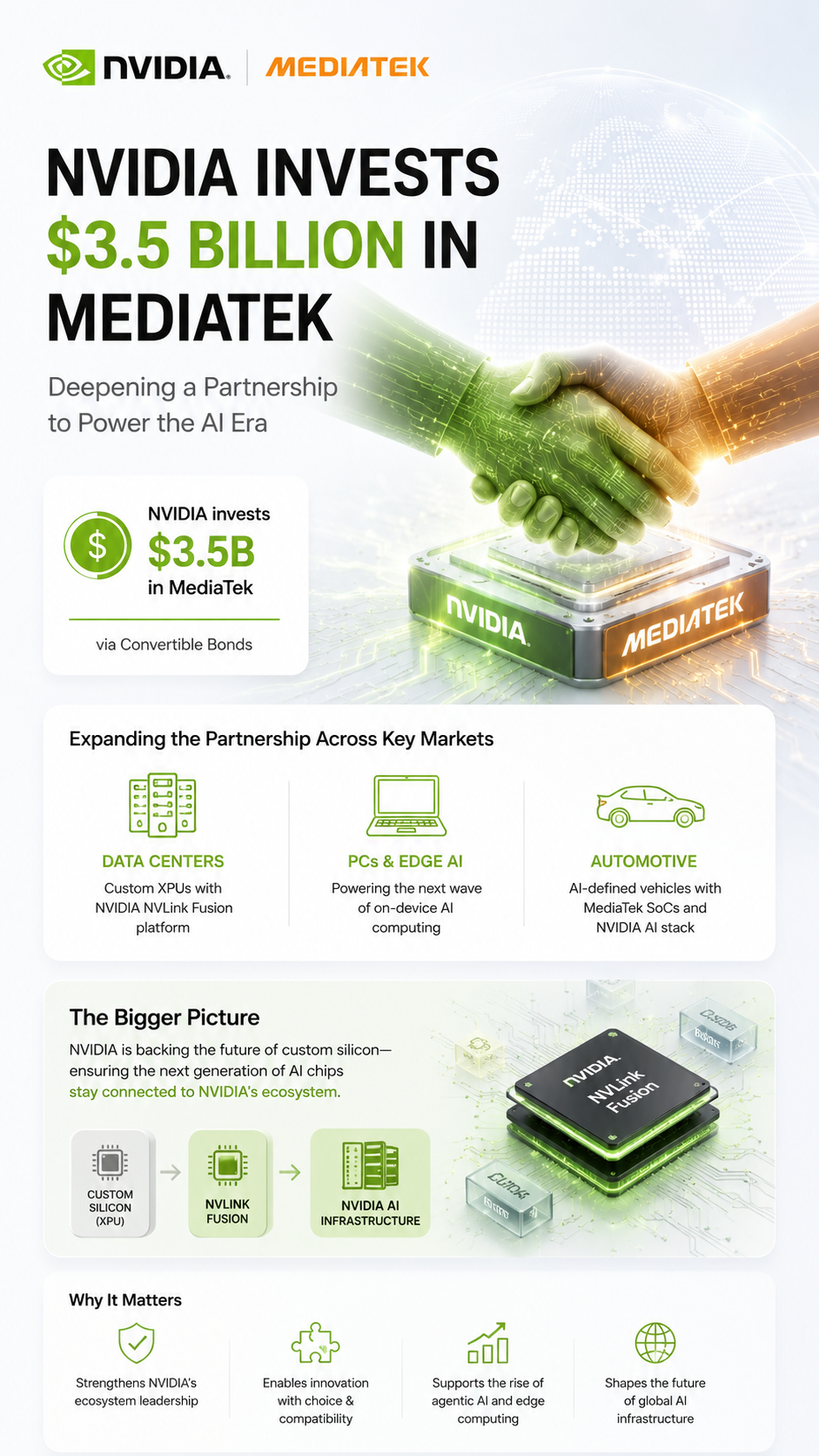
NVIDIA and MediaTek announced a "deepened" partnership this week to build AI computing platforms spanning data centers, PCs, and cars. Partnership announcements between these two are routine — they co-developed the chip powering NVIDIA's DGX Spark. What's not routine is the number attached: NVIDIA is putting $3.5 billion into MediaTek via convertible bonds, its second nine-figure-plus bet in five months on a chipmaker joining its NVLink Fusion ecosystem.
The pattern underneath is more interesting than the press release lets on.
What MediaTek actually gets
Under the deal, MediaTek will adopt NVIDIA's **NVLink Fusion** platform — a prebuilt, prevalidated foundation that lets hyperscalers and cloud providers design their own custom AI chips (XPUs) while still plugging into NVIDIA's rack-scale AI infrastructure. The stack includes NVIDIA's chiplet interconnect, NVLink-C2C for high-bandwidth chip-to-chip connectivity, and NVIDIA's memory-integration technology, all pre-integrated so a company building a custom chip doesn't have to solve NVIDIA-compatible interconnect design from scratch.
Beyond the data center, the companies are also extending the partnership to **local AI computing** — low-latency, on-device silicon aimed at PCs — and to **automotive**, where MediaTek's SoC expertise gets paired with NVIDIA's AI stack for AI-defined vehicle systems.
Watch - Nvidia CEO Huang on the $3.5 Billion Deal With MediaTek
Watch - Nvidia CEO Huang on the $3.5 Billion Deal With MediaTek
The precedent that explains the price
This isn't NVIDIA's first big check written to a chip partner this year. In March, NVIDIA invested $2 billion in Marvell Technology under the same NVLink Fusion program, with Marvell developing its own custom XPUs and NVLink Fusion-compatible networking gear. MediaTek's $3.5 billion deal is the larger, second installment of the same playbook.
That pattern matters more than either deal in isolation. NVIDIA doesn't need to buy a partnership with companies it already works with — MediaTek and NVIDIA have collaborated for years. What it's buying is exclusivity of architecture: making sure that when Marvell, MediaTek, or their hyperscaler customers design custom silicon, that silicon is built to plug into NVIDIA's ecosystem rather than a rival's.
Why now — the custom silicon threat NVIDIA is hedging against
The backdrop here is the industry's growing appetite for **custom AI chips**. Google has its TPUs, Amazon has Trainium, and a wave of hyperscalers have been building or commissioning custom silicon specifically to reduce their dependence on NVIDIA GPUs — both for cost reasons and to avoid being at the mercy of NVIDIA's supply and pricing. Every custom chip a hyperscaler successfully deploys is, in principle, GPU revenue NVIDIA doesn't get.
NVLink Fusion is NVIDIA's answer to that trend: rather than fight the shift to custom silicon, NVIDIA is positioning itself as the connective tissue *underneath* it. If a hyperscaler is going to build its own chip anyway, NVIDIA would rather that chip still depend on NVIDIA's interconnect, memory architecture, and rack-scale infrastructure than end up in a fully NVIDIA-free stack. The multi-billion-dollar investments in Marvell and now MediaTek aren't just partnership sweeteners — they're NVIDIA buying influence over how the next generation of "NVIDIA-independent" chips actually gets built.
Why it matters
For companies and governments building AI infrastructure — India's own data center and semiconductor ambitions included — this is a signal about where real bargaining power sits in AI hardware. It isn't just in who makes the fastest chip anymore; it's in who controls the interconnect standard that chips need to talk to each other at rack scale. NVIDIA is trying to own that layer regardless of who wins the custom-silicon race underneath it.
If NVIDIA is willing to pay billions just to make sure competing custom chips still run on its interconnect standard, is the real AI hardware moat shifting from the chip itself to the plumbing that connects it — and who else is positioned to own that layer if NVIDIA doesn't?
---
Sources-
Nvidia Newsroom - https://nvidia.com/news/nvidia-and-mediatek-deepen-long-standing-partnership-to-build-ai-edge-to-cloud-computing-platforms
---
Sources-
Nvidia Newsroom - https://nvidia.com/news/nvidia-and-mediatek-deepen-long-standing-partnership-to-build-ai-edge-to-cloud-computing-platforms

Vishal Sable
B.Tech AD @ shri balaji institute of technology and management
Engineering and tech journalist. I love exploring the impact of emerging technologies on global defense, sovereignty, and everyday life. Always looking for the real story behind the headlines.