LATEST NEWS
ByteDance Just Borrowed $30 Billion It Didn't Need To. That's the Real Signal.
September 8, 2026 4M
Back to News
News AlertWorld AI Tech
NVIDIA Vera CPU Deploys for Orbit-Scale Agents as Local AI Models Shrink
V
Author
Vishal Sable
Published
August 25, 2026
Reading Time
7 MIN READ
Spread the Word
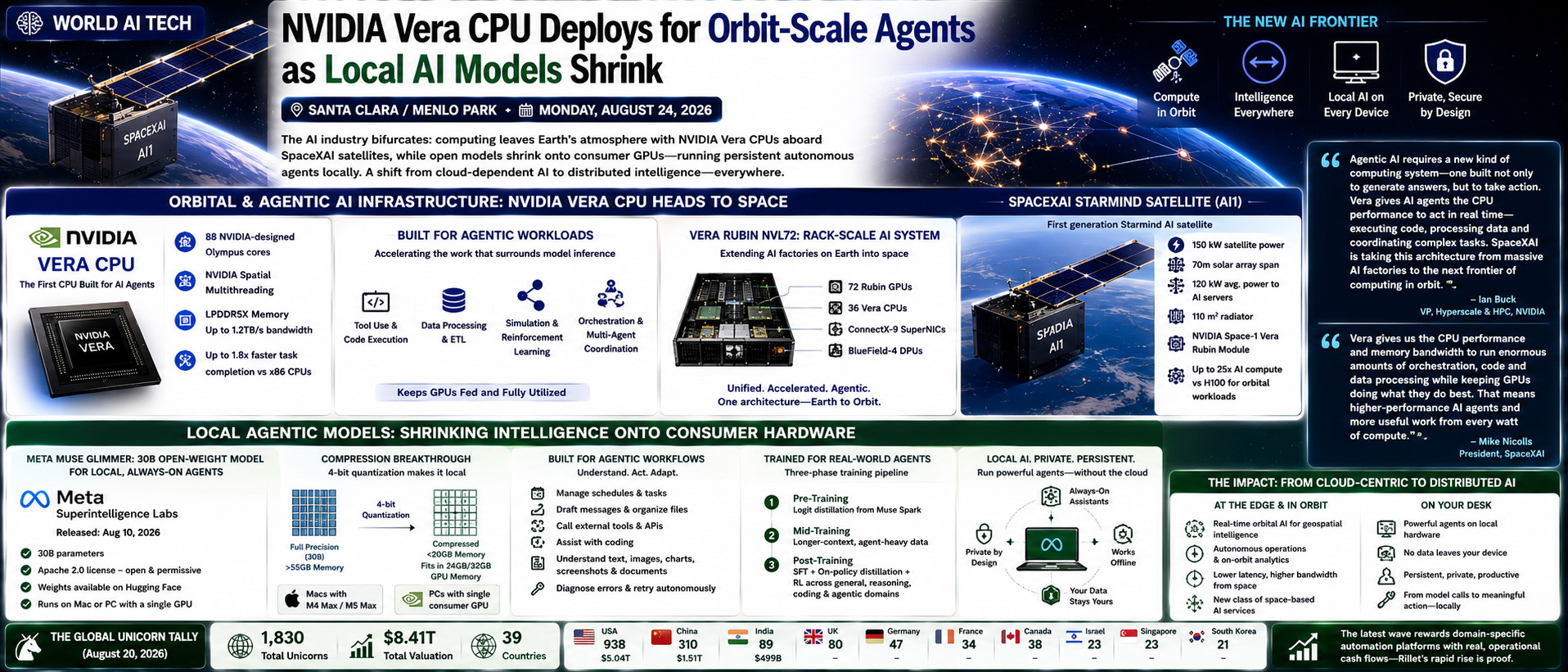
The artificial intelligence industry is witnessing a historic bifurcation this week: at one extreme, computing power is leaving Earth's atmosphere entirely, with NVIDIA's first CPU built for AI agents heading to orbit aboard SpaceXAI's Starmind satellites; at the other, open-weight models are shrinking onto consumer GPUs, running persistent autonomous agents on single workstations without ever touching the cloud. Together, these developments mark a definitive shift from centralized, cloud-dependent AI toward a distributed architecture where intelligence operates everywhere—from low-Earth orbit to the desktop PC.
ORBITAL & AGENTIC AI INFRASTRUCTURE: NVIDIA Vera CPU Heads to Space
NVIDIA today announced that SpaceXAI will deploy NVIDIA Vera CPUs to accelerate its next generation of agentic AI applications, bringing the first CPU built for AI agents to one of the world's most ambitious AI deployments. Agentic AI applications increasingly rely on CPUs to orchestrate tools, execute code, process data and run simulations between model calls. SpaceXAI will use Vera to accelerate these application workloads, helping AI agents act faster while keeping GPUs fed and fully utilized.
NVIDIA Vera is the first CPU built for AI agents, designed to accelerate the CPU-intensive work that surrounds model inference—from tool use and code execution to data processing, orchestration and simulation. Vera features 88 NVIDIA-designed Olympus cores, NVIDIA Spatial Multithreading technology and high-bandwidth LPDDR5X memory, delivering up to 1.2TB/s of bandwidth. Vera enables up to 1.8x faster task completion compared with x86 CPUs across workloads including agentic AI, reinforcement learning and data processing.
SpaceXAI plans to expand its AI infrastructure behind Grok on the NVIDIA Vera Rubin platform, while extending an optimized Vera Rubin NVL72 into space with its first-generation Starmind satellite. The Vera Rubin NVL72 unifies 72 Rubin GPUs, 36 Vera CPUs, ConnectX-9 SuperNICs, and BlueField-4 DPUs in a rack-scale platform. SpaceXAI's planned first-generation Starmind AI satellite will be based on the optimized NVIDIA Vera Rubin NVL72 rack-scale system, extending the same accelerated computing architecture powering next-generation AI factories on Earth into space.
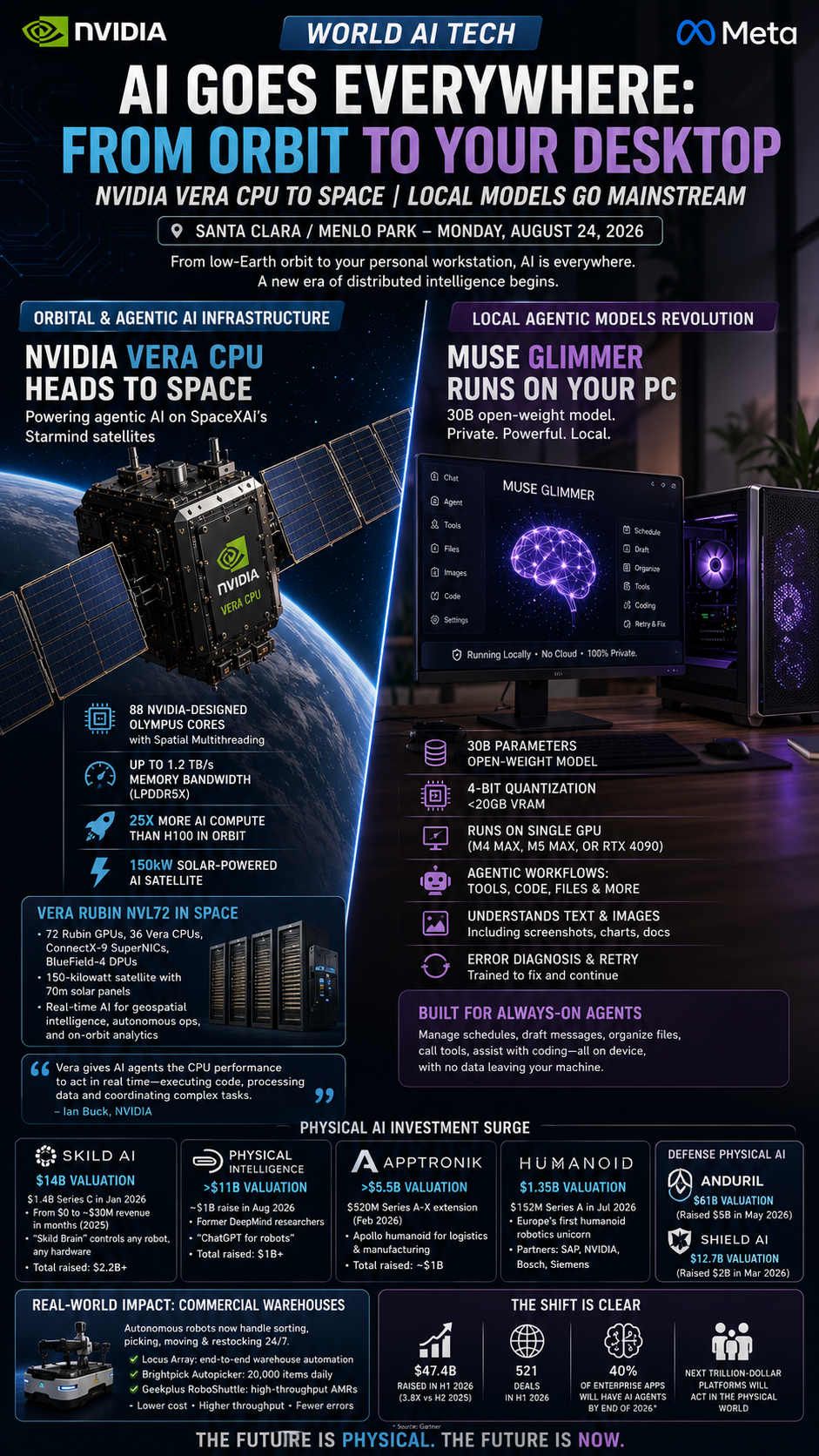
The 150-kilowatt satellite SpaceXAI AI1 brings an adapted version of the NVIDIA Vera Rubin NVL72 into space, powered by solar energy with a peak output of 150 kilowatts from solar panels spanning 70 meters. The system feeds water-cooled AI servers with an average power of 120 kilowatts, with a 110-square-meter radiator dissipating waste heat into space. The NVIDIA Space-1 Vera Rubin module offers up to 25 times the AI compute capability of the previous H100 GPU for orbital workloads, enabling real-time AI processing for geospatial intelligence, autonomous operations, and on-orbit analytics.
"Agentic AI requires a new kind of computing system—one built not only to generate answers, but to take action," said Ian Buck, vice president of hyperscale and high-performance computing at NVIDIA. "Vera gives AI agents the CPU performance to act in real time—executing code, processing data and coordinating complex tasks. SpaceXAI is taking this architecture from massive AI factories to the next frontier of computing in orbit".
"Vera gives us the CPU performance and memory bandwidth to run enormous amounts of orchestration, code and data processing while keeping GPUs doing what they do best," said Mike Nicolls, president of SpaceXAI. "That means higher-performance AI agents and more useful work from every watt of compute".
LOCAL AGENTIC MODELS: Shrinking Intelligence onto Consumer Hardware
While SpaceXAI pushes AI to orbit, Meta and NVIDIA are simultaneously pulling AI onto local devices. On August 10, Meta Superintelligence Labs released Muse Glimmer, a 30-billion-parameter open-weight model optimized for local, always-on agent workflows. Released under a permissive Apache 2.0 license with weights available on Hugging Face, Muse Glimmer is designed to run on a Mac or PC with a single consumer GPU.
The engineering breakthrough lies in compression: at full precision, a 30-billion-parameter model would need over 55GB of memory, beyond any consumer GPU. Meta's 4-bit quantization compresses the language model to under 20GB, fitting within a 24GB or 32GB memory envelope on Macs with M4 Max or M5 Max chips, or PCs with a single consumer GPU. Meta validated the compression as causing minimal to no degradation on agentic tasks.
The model is built for agentic workflows—managing schedules, drafting messages, organizing files, calling external tools and assisting with coding, while understanding interleaved text and images including screenshots, charts and documents. When a tool call fails or returns an unexpected result, the model is trained to diagnose the error and retry rather than stop. Training ran in three phases: pre-training using logit distillation from Muse Spark, mid-training on longer-context agent-heavy data, and post-training combining supervised fine-tuning with on-policy distillation and reinforcement learning across general, reasoning, coding and agentic domains. Meta measured throughput on a K-Quant-17GB configuration running on MacBook M4-Max and M5-Max machines and an RTX-5090. Benchmarking covered DeepSearch QA, MCP-Atlas, Agent-Bench and SWE-Bench, with Muse Glimmer performing strongly for its size class against Gemma4-31B and Qwen3.6-27B.
NVIDIA simultaneously expanded its Nemotron 3 model family with Nemotron 3.5 Lightning, a 30-billion-parameter mixture-of-experts model with open weights designed for "always-on" agents handling repeated or specialized tasks on local systems. The model activates only 3 billion parameters per token, making it fast enough for repeated calls throughout long-running agent workflows. It runs across NVIDIA RTX PCs, DGX Spark, DGX Station, and Jetson devices. With up to 1 million tokens of context, Nemotron 3.5 Lightning is one of the fastest and most accurate open execution models for its size. NVIDIA claims the model delivers up to 4x faster token generation and 30% faster task completion compared .
DAILY WORKFLOW IMPACT: The Rise of On-Device Background Agents
For knowledge workers, developers, and everyday users, the convergence of orbital AI infrastructure and local model deployment translates into a fundamental shift in daily productivity. Instead of manually querying chatbots, local systems now run 24/7 on desktop memory to monitor application logs, automate multi-step administrative workflows, and transcribe real-time voice meetings locally.
Enterprise workers can deploy persistent, privacy-focused background agents that manage file organization, audit code repositories, and process local data without routing sensitive information to third-party cloud servers. Muse Glimmer eliminates per-request cloud costs and keeps personal information on the device. For developers, the model can operate with or without an internet connection, enabling local coding assistance, LLM-as-a-judge evaluation, and function calling across extended workflows.
The NVIDIA RTX Spark superchip—announced in June 2026—can run 120-billion-parameter LLMs with up to 1 million tokens context using agents locally. Combined with tools like NVIDIA Sync, which lets users cluster multiple DGX Spark systems together, developers can now run larger models such as GLM 5.2 and DeepSeek V4 Flash when a single system does not provide enough memory or throughput.
At the enterprise level, Meta envisions local agents that manage schedules, draft messages, organize files and learn how users work—capabilities that require deep access to personal context and long-horizon execution. The company lists local agents, function calling, local coding and LLM-as-a-judge evaluation as target use cases. Meanwhile, SpaceXAI's Vera-powered infrastructure—both terrestrial and orbital—will power the next generation of agentic AI at massive scale, from AI factories on Earth to real-time processing in low-Earth orbit.
The AI industry is no longer a single race toward larger models. It is now a multi-front competition across orbital compute, enterprise infrastructure, and local deployment—each bringing intelligence closer to where it is needed, whether in space, in the data center, or on the desktop. The age of distributed, persistent, autonomous AI agents has arrived.

Vishal Sable
B.Tech AD @ shri balaji institute of technology and management
Engineering and tech journalist. I love exploring the impact of emerging technologies on global defense, sovereignty, and everyday life. Always looking for the real story behind the headlines.