LATEST NEWS
ByteDance Just Borrowed $30 Billion It Didn't Need To. That's the Real Signal.
September 8, 2026 4M
Back to News
News AlertWorld AI Tech
OpenAI Expands Academic Research Access; Hardware & Agentic Workflow Focus Grows
V
Author
Vishal Sable
Published
August 2, 2026
Reading Time
3 MIN READ
Spread the Word
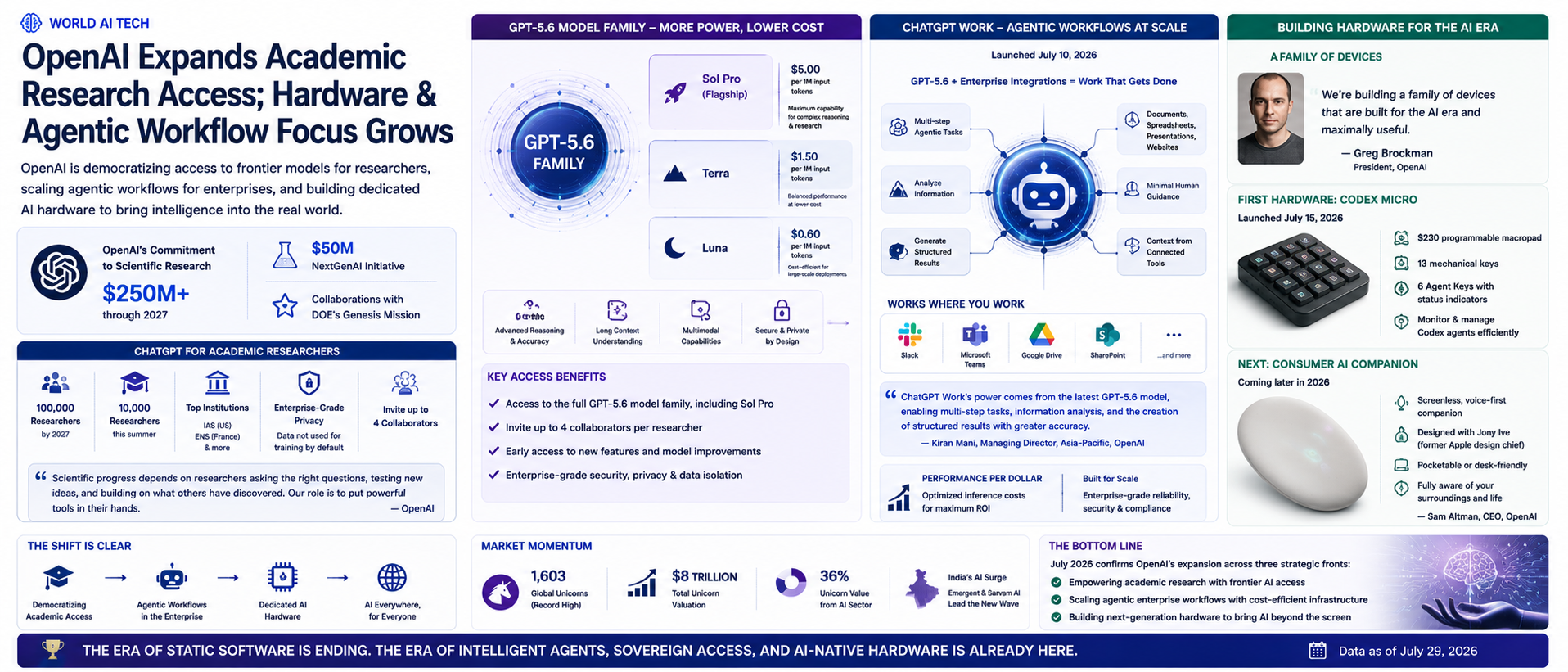
On July 29, OpenAI announced ChatGPT for Academic Researchers, a program providing free access to its frontier AI models for 100,000 scientists, mathematicians, and engineers at selected academic institutions. The initiative begins with 10,000 researchers this summer at institutions including the Institute for Advanced Study (IAS) in the US and France's École normale supérieure (ENS), expanding to 100,000 through 2027. Participants receive access to the GPT-5.6 family, including the flagship GPT-5.6 Sol Pro model, can invite up to four collaborators, and benefit from enterprise-grade privacy protections with data not used for training by default. The program is part of OpenAI's broader commitment of over $250 million through 2027 to support external scientific research, including its $50 million NextGenAI initiative and collaborations with the US Department of Energy's Genesis Mission. "Scientific progress depends on researchers asking the right questions, testing new ideas, and building on what others have discovered," OpenAI stated. "Our role is to put powerful tools in their hands".
The rollout of the GPT-5.6 model family continues to focus on optimizing inference costs while expanding "agentic workflows"—allowing AI agents to complete complex, multi-step tasks across desktop and developer environments with minimal human guidance. On July 10, OpenAI launched ChatGPT Work, a new agentic platform that combines GPT-5.6 with enterprise integrations to automate workplace tasks. ChatGPT Work operates across applications, files, and workflows, gathering context from connected tools to produce finished documents, spreadsheets, presentations, and websites. It connects with popular business tools including Slack, Microsoft Teams, Google Drive, and SharePoint. The platform is designed to help organizations move beyond isolated AI experiments, with Kiran Mani, OpenAI's Managing Director for Asia-Pacific, stating: "ChatGPT Work's power comes from the latest GPT-5.6 model, enabling multi-step tasks, information analysis, and the creation of structured results with greater accuracy". OpenAI has priced GPT-5.6 models to emphasize performance per dollar—Sol at $5 per million input tokens, with Terra and Luna providing progressively lower-cost options for organizations scaling AI deployments.
OpenAI confirmed it is actively developing a proprietary family of hardware devices, signaling an effort to introduce dedicated physical interfaces for conversational and agentic software outside standard web browsers and smartphones. Company president Greg Brockman stated: "We're building a family of devices" that would be "built for the AI era" and "maximally useful". On July 15, OpenAI launched its first hardware product—the Codex Micro, a $230 programmable macropad developed in collaboration with keyboard maker Work Louder. The device features 13 mechanical keys, including six Agent Keys that display AI agent status through color indicators, and is designed to help developers monitor and manage their Codex agents more efficiently. A more consumer-friendly device, developed in collaboration with former Apple design chief Jony Ive, is expected to be unveiled later this year—described as a screenless, voice-first "companion" that can be carried in a pocket or placed on a desk. OpenAI CEO Sam Altman has described it as a "third core device" that will be "capable of being fully aware of a user's surroundings and life". July 2026 confirms that OpenAI is expanding its footprint across three strategic dimensions: democratizing academic access to frontier models, scaling agentic enterprise workflows with cost-efficient infrastructure, and building dedicated hardware to bring conversational AI beyond the screen.

Vishal Sable
B.Tech AD @ shri balaji institute of technology and management
Engineering and tech journalist. I love exploring the impact of emerging technologies on global defense, sovereignty, and everyday life. Always looking for the real story behind the headlines.