LATEST NEWS
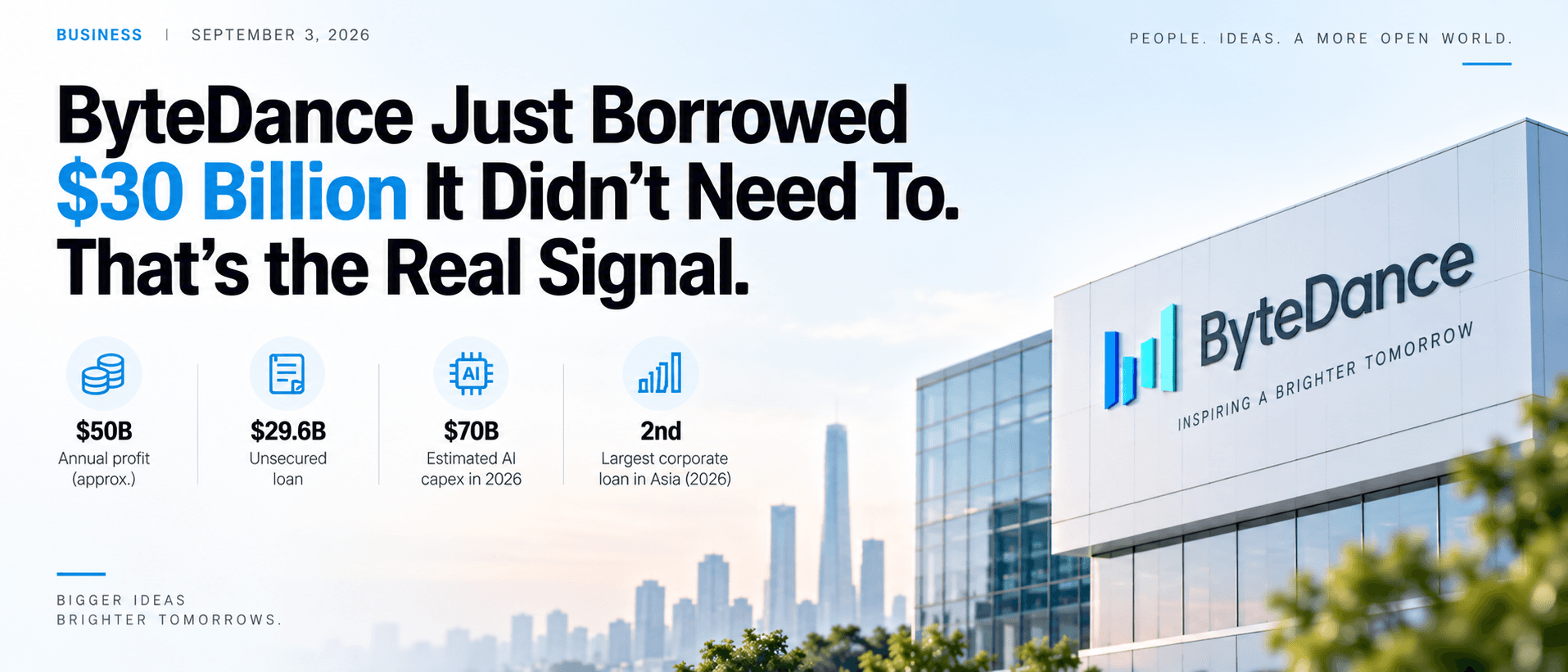
ByteDance Just Borrowed $30 Billion It Didn't Need To. That's the Real Signal.
September 8, 2026 4M
Back to News
News AlertWorld AI Tech
OpenAI Shifts Strategy to Specialized Model Clusters
V
Author
Vishal Sable
Published
July 18, 2026
Reading Time
4 MIN READ
Spread the Word
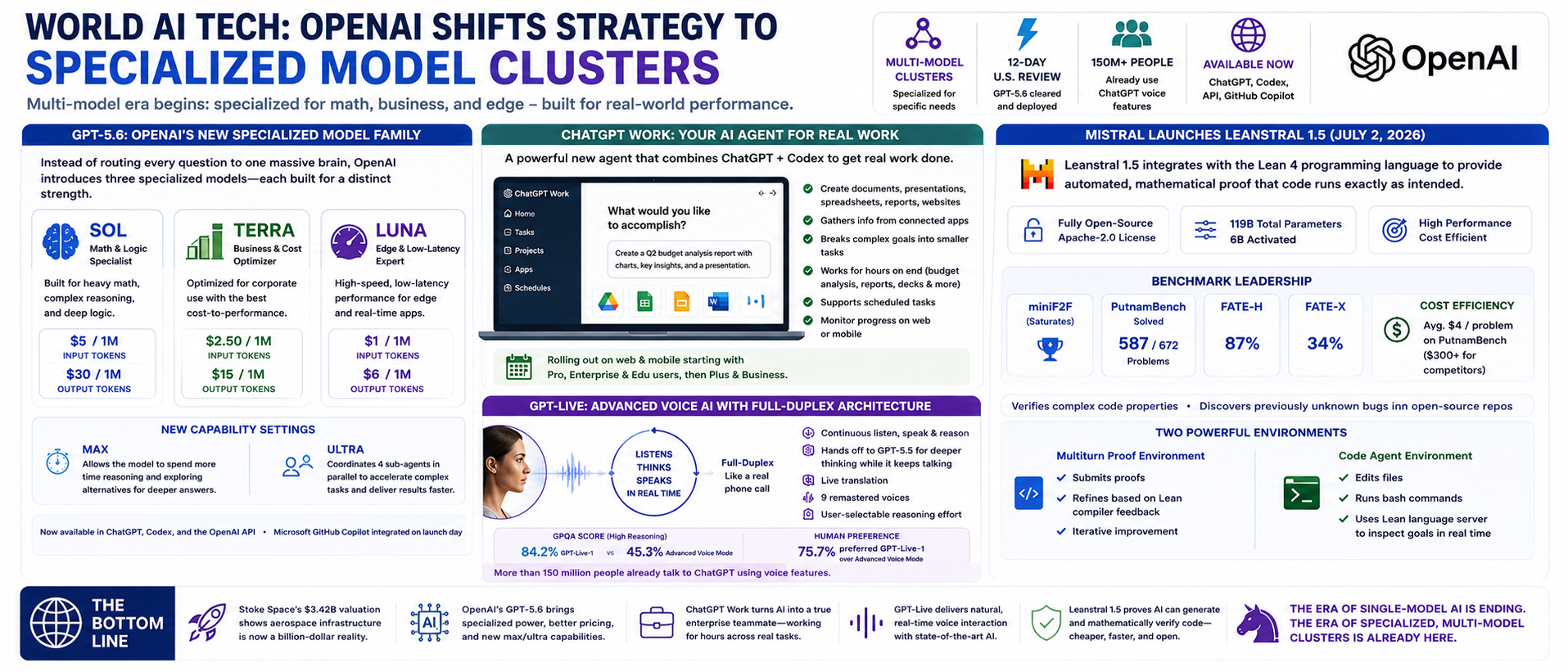
Artificial intelligence architecture is rapidly evolving past a single general-purpose system, moving into natural, multi-model workflows tailored to specific operational needs. On July 9, OpenAI officially deployed its new GPT-5.6 specialized family of models—Sol, Terra, and Luna—following a 12-day U.S. government review. Instead of routing every question to a single massive brain, Sol is targeted exclusively at heavy math and logic, Terra optimizes corporate cost-to-performance, and Luna handles high-speed, low-latency edge computing. The flagship Sol model is priced at $5 per million input tokens and $30 per million output tokens; Terra at $2.50 and $15; and Luna at $1 and $6. GPT-5.6 also introduces "max" and "ultra" capability settings—the former allowing the model to spend more time reasoning and exploring alternatives, the latter coordinating four sub-agents in parallel to accelerate complex tasks. The models are now available in ChatGPT, Codex, and the OpenAI API, with Microsoft's GitHub Copilot also integrating support on the same day.
Simultaneously, OpenAI rolled out ChatGPT Work, a new AI agent that combines its popular chatbot with its AI coding tool Codex to create documents, presentations, spreadsheets, reports, and websites. The service is powered by GPT-5.6 and is a direct answer to Anthropic's Claude Cowork, launched in January. ChatGPT Work can gather information from connected applications, break complex goals into smaller tasks, and continue working for hours on projects such as budget analysis, report generation, and presentation creation. It supports scheduled tasks and can be monitored from mobile devices. The agent will roll out on web and mobile beginning with Pro, Enterprise and Edu users, expanding to Plus and Business users over the following days. OpenAI also announced a new ChatGPT desktop application and a hosted websites feature. Alongside these releases, OpenAI introduced GPT-Live, an advanced voice AI using a full-duplex architecture that allows it to listen, speak, and reason seamlessly in real-time. Unlike the previous Advanced Voice Mode, which processed speech in discrete turns, GPT-Live processes incoming and outgoing audio continuously—like a telephone call rather than a walkie-talkie. When a response requires deeper thinking, the voice model hands the question to GPT-5.5 in the background and keeps talking while that model works. The system supports live translation, nine remastered voices, and user-selectable reasoning effort. In OpenAI's tests, GPT-Live-1 at high reasoning scored 84.2% on GPQA versus 45.3% for its predecessor, and human raters preferred GPT-Live-1 to Advanced Voice Mode 75.7% of the time. More than 150 million people already talk to ChatGPT using voice features.
Not to be outdone, European open-source pioneer Mistral launched Leanstral 1.5 on July 2, integrating with the Lean 4 programming language to give enterprises automated, mathematical proof that their code will run exactly as intended. The model is fully open-sourced under an Apache-2.0 license, with 119 billion total parameters but only 6 billion activated during processing, making it both performant and cost-effective. Leanstral 1.5 saturates the miniF2F formal mathematics benchmark, solving 587 out of 672 PutnamBench problems, and achieves state-of-the-art results on FATE-H (87%) and FATE-X (34%). In terms of cost efficiency, it averages just $4 per problem on PutnamBench—compared to an estimated $300 or more for competitors. Beyond benchmarks, the model verifies complex code properties and uncovers previously unknown bugs in open-source repositories. It operates in two environments: a multiturn environment where it submits proofs and refines based on Lean compiler feedback, and a code agent environment where it edits files, runs bash commands, and uses the Lean language server to inspect goals in real time.
AI is integrating directly into core business tools. Rather than simply text-generating outlines, professionals are using local model clusters to natively manage desktop workspaces, execute real-time audio translation, and securely analyze deep financial logs without sending data to an external cloud provider. With GPT-5.6's three-tiered architecture, ChatGPT Work's enterprise agent capabilities, GPT-Live's full-duplex voice interaction, and Mistral's Leanstral 1.5 for mathematically verified code, July 2026 marks a decisive shift in AI deployment. The era of single-model, general-purpose systems is ending. The era of specialized, multi-model clusters and mathematically verified AI-generated code is already here.

Vishal Sable
B.Tech AD @ shri balaji institute of technology and management
Engineering and tech journalist. I love exploring the impact of emerging technologies on global defense, sovereignty, and everyday life. Always looking for the real story behind the headlines.