LATEST NEWS
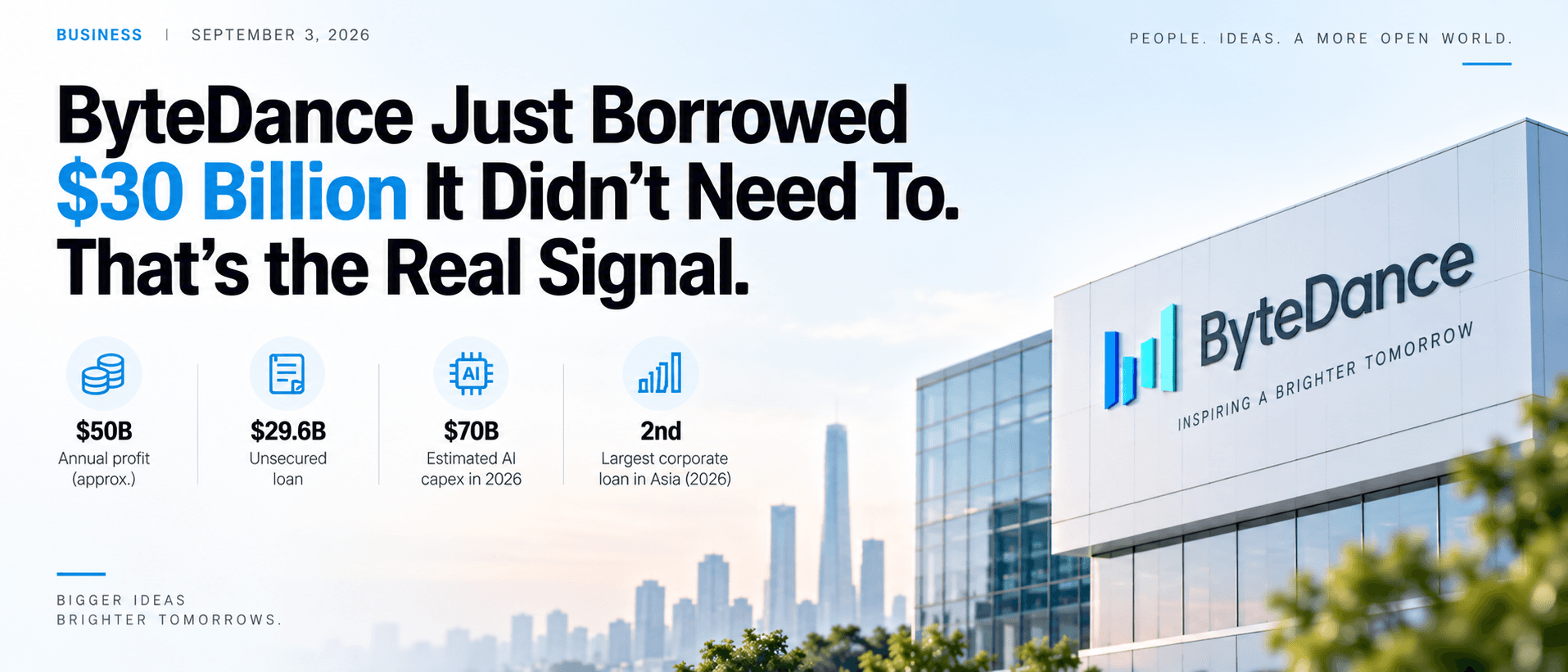
ByteDance Just Borrowed $30 Billion It Didn't Need To. That's the Real Signal.
September 8, 2026 4M
Back to News
News AlertWorld AI Tech
Tech Horizon 2026: Agentic AI, Physical World Takeovers, and the New Arms Race
V
Author
Vishal Sable
Published
June 30, 2026
Reading Time
9 MIN READ
Spread the Word
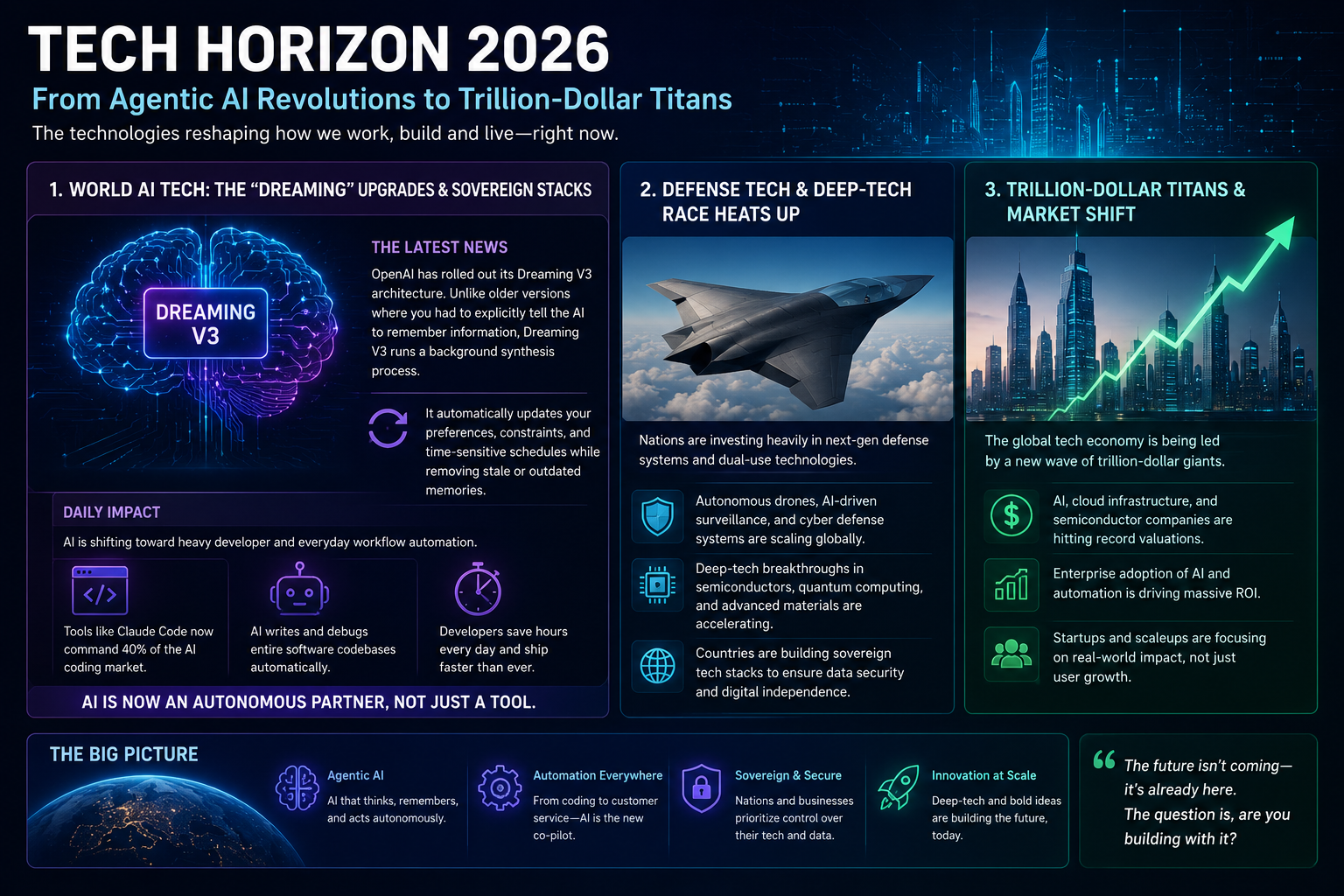
The final week of June 2026 has cemented a definitive shift: the tech industry has officially moved past the era of generative chatbots and entered the age of autonomous agents that act, build, and even fight.
OpenAI’s Memory Revolution
On June 4, OpenAI unveiled Dreaming V3, a major upgrade to ChatGPT’s memory system. Unlike earlier versions that required manual prompts, Dreaming V3 automatically synthesizes user preferences from past conversations, uploaded files, and connected applications. It can now distinguish between temporary states and long-term facts—recognizing that “going to Singapore in July” doesn’t mean “living in Singapore”. The results are dramatic: preference-following success rates jumped to 71.3% (up from 31.4% in 2024), while time-correctness reached 75.1% (up from just 9.4%). Crucially, OpenAI reduced compute costs for Free users by fivefold, making advanced memory widely accessible.
Claude Code’s Dominance
In the enterprise arena, Anthropic’s Claude Code has become the undisputed leader. The AI coding agent now commands 54% market share in the enterprise coding agent sector. Its annualized revenue has reached nearly $63 billion. A Jellyfish survey of 636 developers on June 9 found Claude Code leading with 39% of mentions, closely followed by Gemini Code Assist at 35%. More significantly, Anthropic’s overall valuation has surged to **$965 billion**, surpassing OpenAI for the first time, with the company reportedly冲刺 a fall IPO. On June 9, Anthropic also released Claude Fable 5 and Mythos 5, achieving an 80.3% score on the SWE-Bench Pro coding benchmark—far exceeding GPT-5.5’s 58.6%.
The Agentic Enterprise Takes Off
The message from industry leaders is unmistakable: the era of AI experimentation is over. At the Google Cloud London Summit on June 18, the company declared that businesses must prepare for production-scale deployment of agentic AI. Google unveiled the Gemini Enterprise Agent Platform for deploying and managing AI agents at scale. Meanwhile, Cognizant announced on June 18 that ServiceNow AI Agents now work with its Neuro AI Multi-Agent Accelerator, giving enterprises a unified environment to orchestrate AI agents across different platforms. As Cognizant’s Chief AI Officer Babak Hodjat stated: “Multi-agent systems are the future of enterprise AI”. An EY survey released June 25 found that 66% of enterprises have already invested in or plan to invest in agentic AI within the next year.
Physical AI Enters the Real World
At the Summer Davos Forum in Dalian on June 24, physical AI—systems that perceive and操控 real-world physical laws—emerged as the next major frontier. Experts showcased robots and autonomous systems that interact with the physical environment. According to a March report from UK-based Future Markets, the global physical AI market is projected to grow from approximately $383 billion in 2026 to $3.26 trillion by 2040.
Defense Tech Goes Operational
The defense sector is rapidly integrating AI. Japanese semiconductor firm EdgeCortix successfully demonstrated its SAKURA-II edge AI platform with the U.S. Air Force in a large-scale military exercise, receiving a Success Memorandum from the U.S. Defense Innovation Unit. The platform passed rigorous NASA heavy-ion radiation testing, validating its deployment in space environments. On June 30, the UK government announced a defense investment plan committing over £21 billion to unmanned systems, aiming to transform traditional forces into AI-driven “human-machine collaborative” next-generation.
The Sovereign AI Race
Nations are racing to secure AI independence. The European Union enacted its landmark Tech Sovereignty Package on June 3. India’s Sarvam raised $234 million in the first close of its $300 million Series B at a $1.5 billion valuation on June 15, as the country pushes for domestic AI capabilities amid U.S. export controls.
The Bottom Line
June 2026 marks the definitive arrival of agentic AI, physical-world intelligence, and sovereign tech strategies. The era of passive tools is over. The era of active agents—building software, orchestrating enterprises, and securing nations—has fully begun.

Vishal Sable
B.Tech AD @ shri balaji institute of technology and management
Engineering and tech journalist. I love exploring the impact of emerging technologies on global defense, sovereignty, and everyday life. Always looking for the real story behind the headlines.