LATEST NEWS
ByteDance Just Borrowed $30 Billion It Didn't Need To. That's the Real Signal.
September 8, 2026 4M
Back to News
News AlertWorld AI Tech
The Rise of "Deskside Agentic AI" and Tiered Regulation
V
Author
Vishal Sable
Published
July 15, 2026
Reading Time
3 MIN READ
Spread the Word
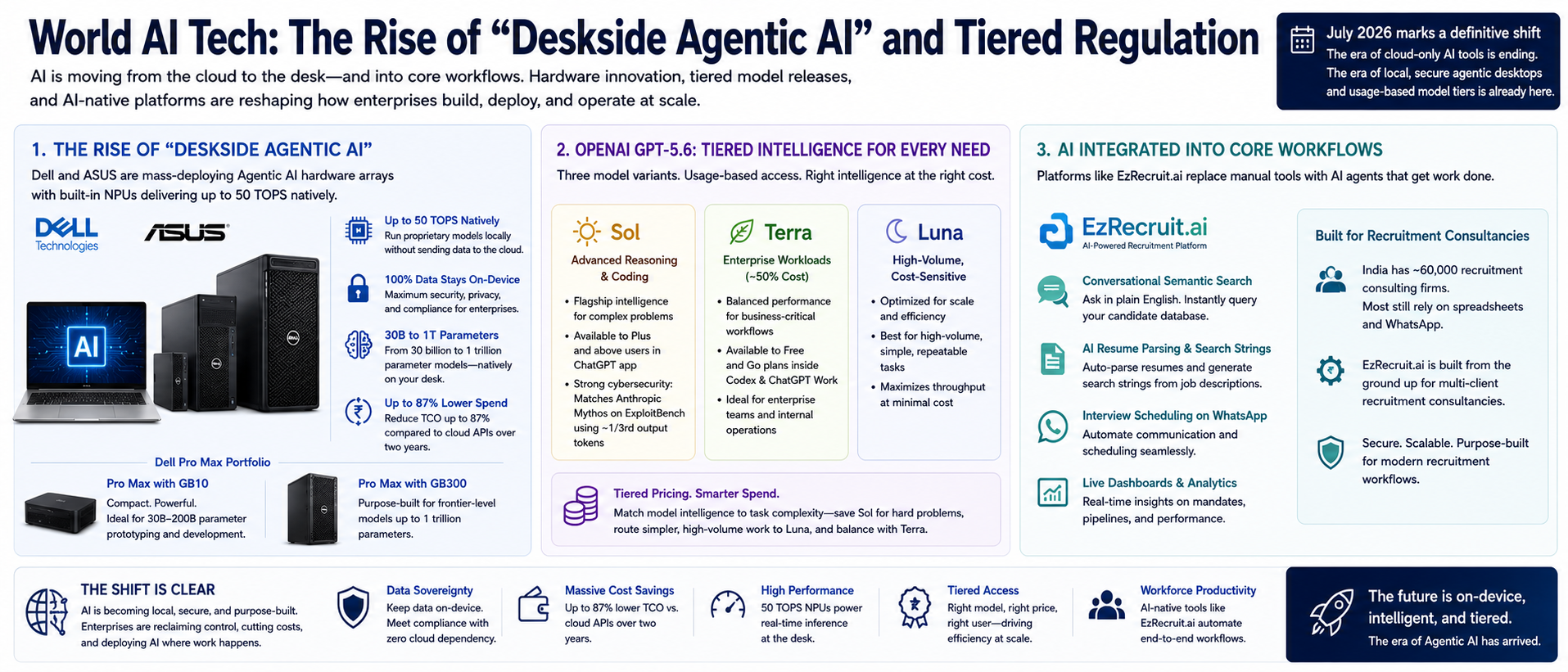
Artificial intelligence is rapidly migrating away from slow, turn-based cloud text tools to live natively on heavy, localized enterprise hardware. Hardware giants Dell and ASUS have officially initiated the mass deployment of their newest Agentic AI hardware arrays. Devices like the Dell Pro Precision series feature built-in NPUs delivering up to 50 TOPS natively . This allows enterprises to deploy "Deskside Agentic AI"—running proprietary models ranging from 30 billion to 1 trillion parameters locally without sending data to an external cloud . Dell's solution, built around the reality that over 50% of agentic workflows run on open-weight models, offers organizations the ability to reduce spend up to 87% compared to cloud APIs over two years . The company provides a range of hardware options from the compact Dell Pro Max with GB10 for 30–200 billion parameter prototyping to the Pro Max with GB300 for frontier-level models up to 1 trillion parameters .
Concurrently, OpenAI's rolling releases of its GPT-5.6 architectures are introducing tightly tiered, usage-based structures designed to balance mass compute efficiency with shifting compliance frameworks . The family comprises three variants: Sol for advanced reasoning and coding, Terra for enterprise workloads at roughly half the cost of previous flagships, and Luna for high-volume, cost-sensitive applications . The flagship Sol model is available to Plus and above users in the ChatGPT app, while Free and Go plans get Terra inside Codex and ChatGPT Work . GPT-5.6 Sol also demonstrated strong cybersecurity capabilities, reportedly matching Anthropic's Mythos Preview on ExploitBench while using roughly one-third of the output tokens . The tiered pricing model allows organizations to match model intelligence to task complexity—saving Sol for genuinely hard problems and routing simpler, high-volume work to Luna.
AI is integrating directly into core operational tasks. Instead of standard chat templates, professionals are utilizing automated systems like EzRecruit.ai to manage multiple client mandates concurrently, leveraging conversational semantic search tools to instantly query database silos using plain natural language . The platform automates resume parsing, generates search strings directly from job descriptions, and includes a natural-language search assistant that lets recruiters query their internal candidate database conversationally instead of through rigid keyword filters . It also handles interview scheduling over WhatsApp and surfaces performance data through live dashboards . DeepTalent Technologies, which launched EzRecruit.ai, estimates India's recruitment consulting sector comprises roughly 60,000 firms, most of which still rely on manual tools like spreadsheets and WhatsApp rather than purpose-built software . The platform was built from the ground up around the multi-client structure typical of recruitment consultancies, rather than retrofitting corporate ATS tools . July 2026 marks a definitive shift toward on-device agentic AI and tiered infrastructure. The era of cloud-only AI tools is ending. The era of local, secure agentic desktops and usage-based model tiers is already here.

Vishal Sable
B.Tech AD @ shri balaji institute of technology and management
Engineering and tech journalist. I love exploring the impact of emerging technologies on global defense, sovereignty, and everyday life. Always looking for the real story behind the headlines.