Back to News
News AlertWorld AI Tech
The Shift to Embedded "Agentic AI" and Invisible Computing
V
Author
Vishal Sable
Published
July 25, 2026
Reading Time
4 MIN READ
Spread the Word
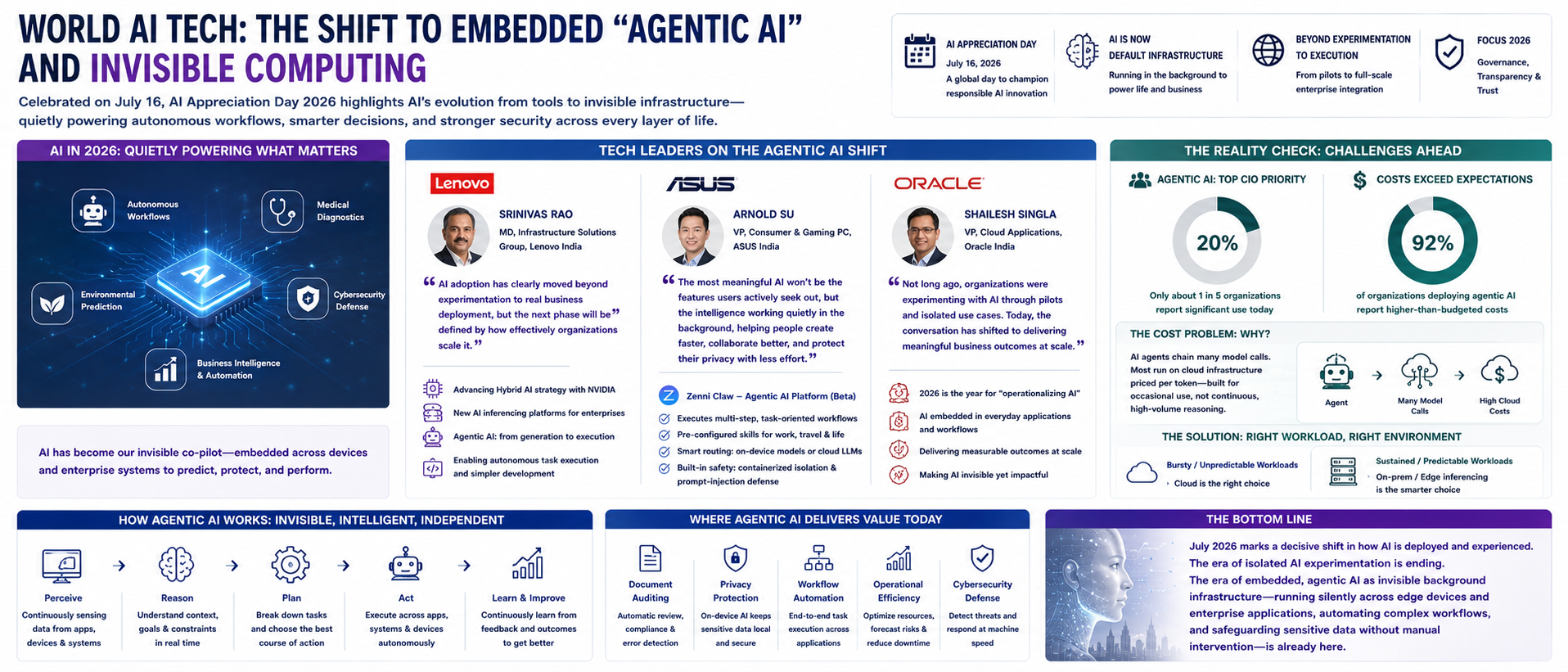
Celebrated annually on July 16, AI Appreciation Day 2026 marks a profound shift in how humanity interacts with artificial intelligence. The core theme of AI Appreciation Day 2026 extends far beyond celebrating raw computational capability—the conversation now focuses on governance, transparency, and trust. In 2026, AI is no longer viewed merely as a futuristic novelty or a basic productivity tool. Instead, it has become our default infrastructure—quietly operating behind the scenes to power autonomous workflows, assist medical diagnostics, predict environmental patterns, and defend critical networks against machine-speed cybersecurity threats.
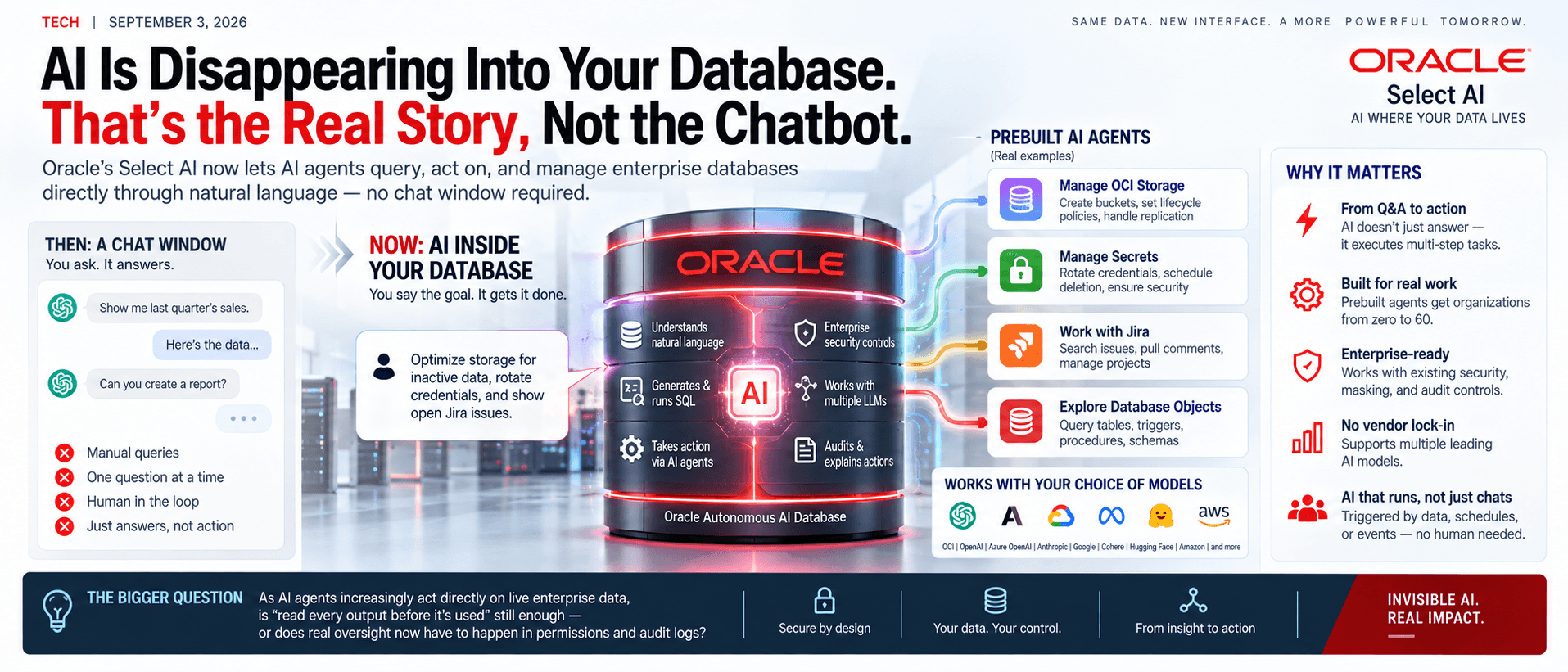
Following global discussions around AI Appreciation Day 2026, tech leaders from Lenovo, ASUS, and Oracle emphasized that the AI market has officially moved past isolated experimentation to full-scale infrastructure integration. Rather than active user prompts, the new frontier focuses on "Agentic AI"—background engines that run natively across edge devices and enterprise applications to forecast financial risk, optimize supply chains, and defend critical networks without manual prompting. As agentic AI systems independently execute complex tasks, the tech community, policymakers, and the public are using this day to champion responsible innovation.
Srinivas Rao, Managing Director of Infrastructure Solutions Group at Lenovo India, noted that "AI adoption has clearly moved beyond experimentation to real business deployment, but the next phase will be defined by how effectively organizations scale it". Lenovo has been advancing its Hybrid AI strategy with NVIDIA, positioning agentic AI as the next phase where AI shifts from generation to execution. The company has introduced new AI inferencing platforms and agentic AI capabilities for enterprises, enabling autonomous task execution and simplified development.
Arnold Su, Vice President of Consumer & Gaming PC at ASUS India, stated that "the most meaningful AI won't be the features users actively seek out, but the intelligence working quietly in the background, helping people create faster, collaborate more effectively, safeguard their privacy, and get more from their devices with less effort". ASUS has launched the beta version of Zenni Claw, an agentic AI platform designed to transform how users interact with AI on Windows 11 PCs. Unlike traditional chatbots, Zenni Claw enables users to execute multi-step, task-oriented workflows through pre-configured assistant skills across work, travel, and daily life. The platform dynamically routes tasks between local on-device models and cloud-based LLMs based on hardware capabilities and privacy needs, with built-in safety protections including containerized workspace separation and prompt-injection defense.
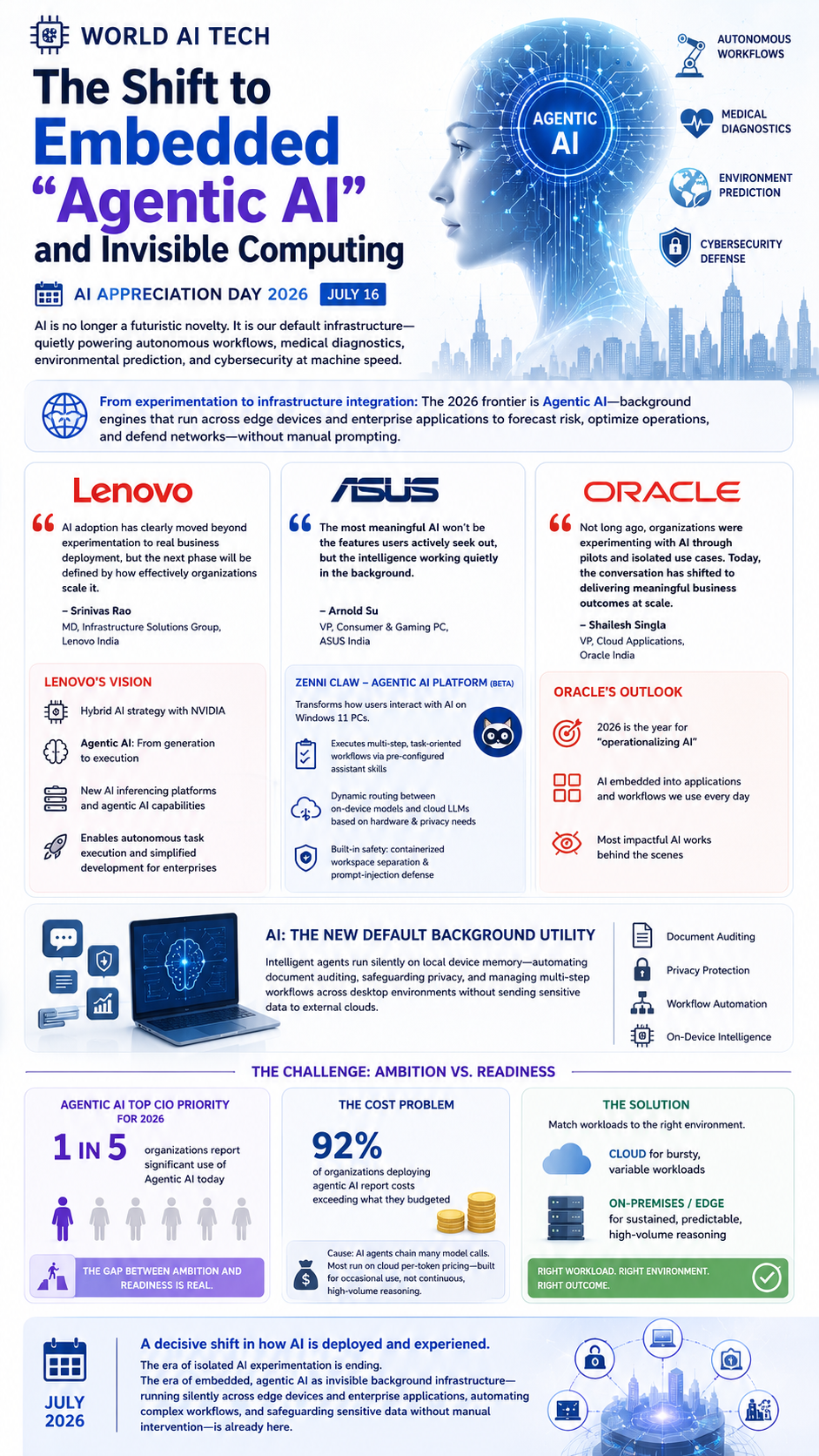
Shailesh Singla, Vice President of Cloud Applications at Oracle India, observed: "Not long ago, organizations were experimenting with AI through pilots and isolated use cases. Today, the conversation has shifted to delivering meaningful business outcomes at scale". According to Oracle, 2026 is the year for "operationalizing AI", with the most impactful AI often working behind the scenes—embedded into the applications and workflows people use every day.
AI is becoming default background utility software. In everyday business and personal computing, intelligent agents are running silently on local device memory—automating document auditing, safeguarding user privacy, and managing multi-step workflows across desktop environments without sending sensitive data to external clouds. However, the shift to agentic AI comes with significant challenges. Agentic AI has overtaken generative AI as the top CIO priority for 2026, but only about one in five organizations report significant use of it today. The gap between ambition and readiness is real. Agentic AI also has a cost problem: 92% of organizations deploying agentic AI report costs exceeding what they budgeted. The cause is structural—an AI agent chains together many model calls, and most of that work runs on cloud infrastructure priced per token, built for occasional use, not for continuous, high-volume reasoning. The solution lies in matching workloads to the right environment: while bursty work belongs in the cloud, sustained, predictable, high-volume reasoning is better suited to on-premises or edge inferencing.
July 2026 marks a decisive shift in how AI is deployed and experienced. The era of isolated AI experimentation is ending. The era of embedded, agentic AI as invisible background infrastructure—running silently across edge devices and enterprise applications, automating complex workflows, and safeguarding sensitive data without manual intervention—is already here.

Vishal Sable
B.Tech AD @ shri balaji institute of technology and management
Engineering and tech journalist. I love exploring the impact of emerging technologies on global defense, sovereignty, and everyday life. Always looking for the real story behind the headlines.