Back to News
News AlertWorld Defence Tech
Two Militaries, Two Announcements, One Week: Robots Are Moving From the Sky to the Ground
S
Author
Saumya Dawande
Published
September 30, 2026
Reading Time
4 MIN READ
Spread the Word

Ukraine launched its "Army of Robots" project this week. The same week, the US Army handed out $7 billion in counter-drone contracts to 10 companies.
This week produced two defense-tech announcements that, read together, show where autonomous systems are actually headed next — not drones getting smarter, but ground robots and the infrastructure to stop other people's drones both scaling at once.
On September 26, Ukraine's digital minister Mykhailo Fedorov announced the launch of "Army of Robots," a project to develop and scale robotic systems that can carry out combat missions in place of soldiers. The near-term goal is deliberately unglamorous: affordable humanoid platforms built for tasks like reloading machine guns, swapping sensor batteries, and launching drones, not replacing infantry outright. Fedorov was blunt about the strategic logic — Russia can quickly copy and deploy whatever technology Ukraine fields, so speed and cost matter as much as capability. Ground robotics is already load-bearing in Ukraine's war, not theoretical: the country's unmanned ground systems completed roughly 112,000 logistics and evacuation missions on the frontline in 2026 alone, and German-made Gereon unmanned ground vehicles from ARX Robotics and DEUTZ have already started arriving under a separate contract . Mezha
The US Army moved in a similar direction, though earlier in the pipeline. Reporting from this week shows the Army selecting a ballistic-protected humanoid robot for high-risk battlefield mission experiments, alongside separate evaluations of power generation, tactile sensing, and command-and-control technology — the Army explicitly framing this as figuring out whether humanoid robots can progress from experimental systems to defined military roles, not declaring that they already have. South Korea offers the clearest sign this isn't just an American or Ukrainian preoccupation: its navy tested a humanoid robot serving as a helmsman in July, following an army test-deployment of quadruped robots for counter-terrorism back in 2024.
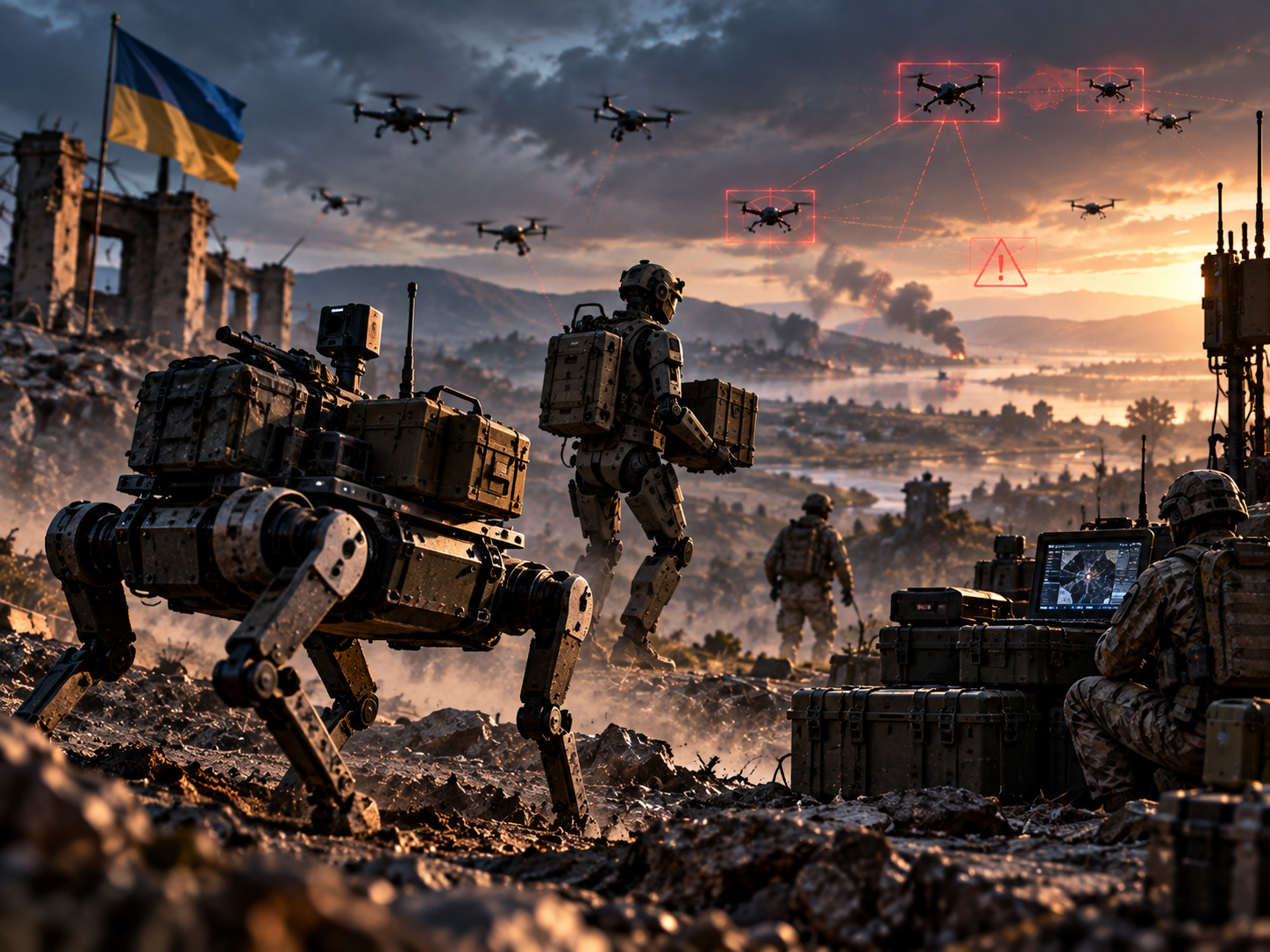
The money question your draft raised — where the capital is actually going — has its clearest answer not in ground robots but in the sky above them. On September 29, the same day as this reporting, the US Army announced it had awarded up to $7 billion in counter-drone contracts, spread across 10 companies, as part of an indefinite-delivery, indefinite-quantity vehicle under Joint Interagency Task Force 401's "Domestic Shield" initiative. Officials were explicit about the reasoning: spreading the ceiling across 10 vendors rather than one is meant to avoid dependence on a single company and let smaller firms raise capital against the expectation of continued Army orders. Roughly $5 billion has already been obligated across this and earlier awards to firms like AeroVironment and CACI, with the task force aiming to reach the full $7 billion by the end of October. DefenseScoop , Breaking Defense
Put the two stories side by side and the shape of the next few years gets clearer. Militaries aren't choosing between ground robots and counter-drone systems — they're building both simultaneously, because the two problems are connected: a battlefield full of autonomous ground units carrying sensors and weapons is also a battlefield where every side has far more small drones to shoot down, jam, or spoof than a decade ago. Ukraine's own numbers make the case bluntly — 112,000 logistics missions is only useful if the robots doing them, and the humans near them, can survive the drone threat overhead.
None of this is a finished capability yet, on either side of the equation. The Army's own language around humanoid robots is "experiments," not deployment, and even Foundation Future Industries — the most aggressive humanoid-robot vendor pitching the Pentagon — has yet to put a fully humanoid platform into direct combat. The open question isn't whether ground robotics and counter-drone infrastructure are both real investment priorities right now — this week's numbers settle that. It's whether either category matures from "IDIQ ceiling" and "battlefield experiment" into something reliable enough to actually reduce casualties, rather than just adding a new, expensive layer of hardware to an already crowded battlefield. Mezha, Army Recognition

Saumya Dawande
B.Tech AIML @ oriental institute of science technology bhopal
Engineering and tech journalist. I love exploring the impact of emerging technologies on global defense, sovereignty, and everyday life. Always looking for the real story behind the headlines.