Back to News
News AlertWorld Money
World Money: Mega-Funding and “Agentic” Fintech
V
Author
Vishal Sable
Published
June 30, 2026
Reading Time
9 MIN READ
Spread the Word
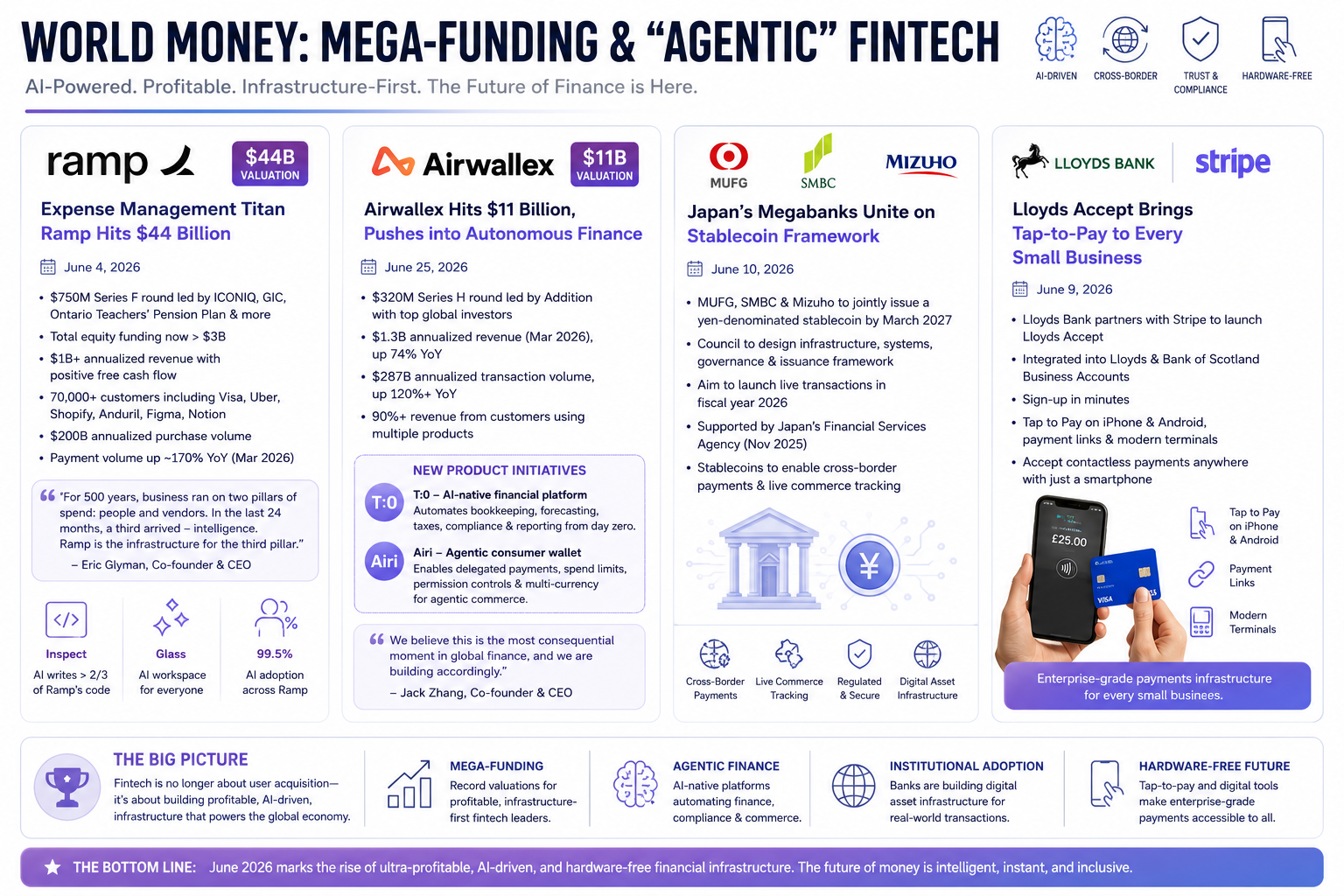
The fintech sector has undergone a fundamental transformation. The era of burning cash for user acquisition is over. Today, the industry is laser-focused on ultra-profitable, AI-driven corporate spend management and cross-border payment infrastructure. June 2026 has delivered a cascade of major developments that confirm this new direction—from blockbuster funding rounds to groundbreaking bank collaborations and the rise of autonomous finance.
Expense Management Titan Ramp Hits $44 Billion
Corporate expense management platform Ramp announced a $750 million Series F primary financing round on June 4, valuing the company at $44 billion. The round was led by ICONIQ, GIC, and Ontario Teachers‘ Pension Plan, with new investors including Goldman Sachs Alternatives, D.E. Shaw & Co., Morgan Stanley Investment Management, Generation Investment Management, Insight Partners, and BroadLight Capital. The raise brings Ramp’s total equity funding to more than $3 billion.
The valuation jump—up from $32 billion in November—reflects mounting optimism that AI can reshape corporate finance by automating tasks such as expense reporting, invoice processing, and bookkeeping. Ramp’s growth metrics underscore the momentum: as of June 1, 2026, the company surpassed $1 billion in annualized revenue while maintaining positive free cash flow. The platform now serves more than 70,000 customers—including Visa, Uber, Shopify, Anduril, Figma, and Notion—and processes $200 billion in annualized purchase volume. Total payment volume grew approximately 170% year-over-year in March 2026, the company’s highest growth rate in three years, despite the business now being roughly 20 times larger.
Ramp co-founder and CEO Eric Glyman framed the company’s mission in sweeping terms: “For 500 years, business ran on two pillars of spend: people and vendors. In the last 24 months, a third arrived – intelligence, paid by the token and invisible to every system we‘ve built to manage cost. Ramp is the infrastructure for the third pillar”. The company is extending its capabilities into managing token spend—the fastest-growing cost in business—and entering the accounting firm market through Stack. Internally, Ramp has built two AI tools: Inspect, a software factory that now writes more than two-thirds of Ramp’s code, and Glass, an AI workspace deployed across every employee function, giving the company a 99.5% AI adoption rate.
Airwallex Hits $11 Billion, Pushes into Autonomous Finance
Global payments platform Airwallex secured $320 million in Series H funding on June 25, bringing its valuation to $11 billion—up from $8 billion in December 2025. The round was led by returning investor Addition, with participation from Baillie Gifford, Hummingbird, QED Investors, T. Rowe Price, Hedosophia, Haun Ventures, Washington University in St. Louis, and Amex Ventures.
The investment will accelerate product development across autonomous finance and agentic commerce, expand infrastructure and regulatory footprint into new markets, and scale teams building next-generation AI-native financial software. Airwallex’s momentum is striking: in March 2026, the company reached $1.3 billion in annualized revenue, up 74% year-over-year, and $287 billion in annualized transaction volume, up more than 120% year-over-year. More than 90% of Airwallex’s revenue now comes from customers using more than one product.
Airwallex is announcing two new product initiatives: T:0, an AI-native financial platform that automates bookkeeping, forecasting, taxes, compliance, and reporting from day zero; and Airi, an agentic consumer wallet that will evolve into broader wallet infrastructure for agentic commerce, including delegated agent payments, spend limits, permission controls, and multi-currency balances. “We believe this is the most consequential moment in the history of global finance, and we are building accordingly,” said Jack Zhang, co-founder and CEO. “The licenses, local network integrations, and settlement rails we spent ten years constructing are precisely the kind of infrastructure [the agentic economy] needs”.
Japan‘s Megabanks Unite on Stablecoin Framework
Regional banking is undergoing its own digital transformation. Japan’s three largest banks—Mitsubishi UFJ Financial Group (MUFG), Sumitomo Mitsui Financial Group (SMBC), and Mizuho Financial Group—announced plans on June 10 to jointly issue a yen-denominated stablecoin by March 2027. The three banks have entered into a memorandum of understanding to establish a council that will “serve as a framework for examining the potential development of an issuance infrastructure related to the subject stablecoin, as well as the design of systems, schemes, and governance structures”. The organizations aim to launch live transactions of the stablecoin during the fiscal year 2026.
The move follows Japan‘s Financial Services Agency declaring support for the joint stablecoin project in November 2025. MUFG has stated that stablecoins could serve a variety of purposes, including facilitating cross-border payments. The development reflects a broader global trend, with the UK’s Financial Conduct Authority identifying domestically issued stablecoin progress as a key priority for 2026, and Hong Kong recently granting its first stablecoin issuer licenses.
Lloyds Accept Brings Tap-to-Pay to Every Small Business
Daily digital payments are becoming hardware-free. On June 9, Lloyds Bank announced a collaboration with Stripe to launch Lloyds Accept, a new suite of flexible payment tools for small businesses. Powered by Stripe Connect, Lloyds Accept is integrated directly into Lloyds and Bank of Scotland Business Accounts, with sign-up times typically within minutes.
The suite includes Tap to Pay on smartphones, payment links, and modern terminal devices for in-person payments. Lloyds Accept supports Tap to Pay on iPhone or Tap to Pay on Android, enabling businesses to accept contactless payments wherever they trade—from on-site customer locations and markets to community and school events—using only a smartphone and the Lloyds Accept app. At checkout, customers simply hold their card or digital wallet near the merchant‘s device to pay securely. The proposition gives small businesses access to the same payments infrastructure as the world’s largest companies.
The Bottom Line
June 2026 marks a definitive shift in financial technology. Ramp‘s $44 billion valuation and $1 billion annualized revenue demonstrate that AI-driven corporate spend management is a massive, profitable market. Airwallex’s $11 billion valuation and push into autonomous finance and agentic commerce signal that cross-border payments infrastructure is becoming the foundation for the next generation of AI-native financial software. Japan‘s three megabanks uniting on a joint stablecoin framework shows that traditional financial institutions are embracing digital assets for live commerce tracking. And Lloyds Accept, powered by Stripe, is making tap-to-pay accessible to every micro-merchant with a smartphone.
The era of fintech burning cash for user acquisition is over. The era of ultra-profitable, AI-driven, and hardware-free financial infrastructure is already here.

Vishal Sable
B.Tech AD @ shri balaji institute of technology and management
Engineering and tech journalist. I love exploring the impact of emerging technologies on global defense, sovereignty, and everyday life. Always looking for the real story behind the headlines.